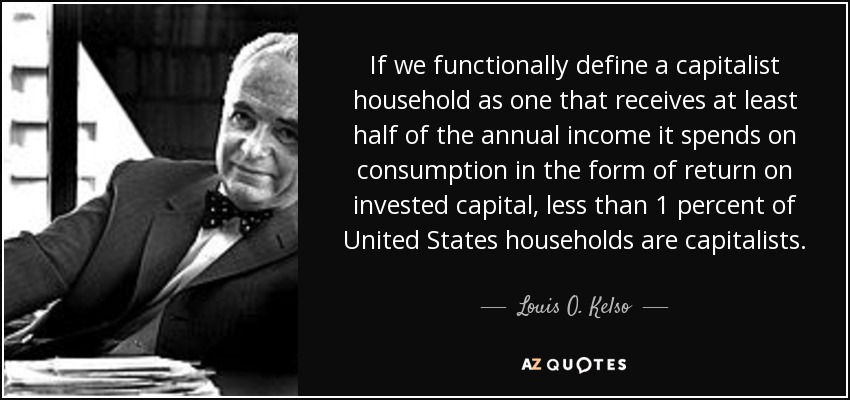
If we functionally define a capitalist household as one that receives at least half of the annual income it spends on consumption in the form of return on invested capital, less than 1 percent of United States households are capitalists.
Labor is the source of subsistence, capital is the source of affluence. My idea is to make everyone a capitalist, and therefore, financially secure.
The path the capitalist revolution will take faces in exactly the opposite direction from that taken by the communist revolution. It seeks to diffuse the private ownership of capital instead of abolishing it entirely. It seeks to make all men capitalists instead of preventing anyone from being a capitalist by making the State the only capitalist.
The banker, therefore, is not so much primarily a middleman in the commodity "purchasing power" as a producer of this commodity. However, since all reserve funds and savings today usually flow to him, and the total demand for free purchasing power, whether existing or to be created, concentrates on him, he has either replaced private capitalists or become their agent; he has himself become the capitalist par excellence.
It is not socialist, as some of our critics contend. It isn't purely capitalist, either. It is a new way. A third way. A more humane, trusting, productive, exhilarating, and, in every sense, rewarding way.
If the helplessness and isolation of labour, who have nothing to sell but their labour, can be totally removed by connecting labour with capital through a universal credit system, we'll then have other kinds of actors on the economic scene different from what the existing capitalist world would allow us to bring out.
Whatever the country, capitalist or socialist, man was everywhere crushed by technology, made a stranger to his own work, imprisoned, forced into stupidity. The evil all arose from the fact that he had increased his needs rather than limited them; . . . As long as fresh needs continued to be created, so new frustrations would come into being. When had the decline begun? The day knowledge was preferred to wisdom and mere usefulness to beauty. . . . Only a moral revolution - not a social or political revolution - only a moral revolution would lead man back to his lost truth.
Work of all kinds is got from poor women, at prices that will not keep soul and body together, and then the articles thus made aresold for prices that give monstrous prices to the capitalist, who thus grows rich on the hard labor of our sex.
No capitalists after any war were ever so well paid for money loaned to the nation that carried it on. No class of money-makers ever gained such prosperity by any other war, as our War for the Union brought to the money-getters of America. All this was due in great measure to the rank and file of the Union army. Now let no rich man haggle with a needy veteran of that war about his right to a pension!
Before the 1970s, banks were banks. They did what banks were supposed to do in a state capitalist economy: they took unused funds from your bank account, for example, and transferred them to some potentially useful purpose like helping a family buy a home or send a kid to college.
In a capitalist society, all human relationships are voluntary.
The goals of development are always and everywhere stated in terms of consumer value packages standardized around the North Atlantic-and therefore always and everywhere imply more privileges for a few... Underdevelopment is the result of a state of mind common to both socialist and capitalist countries. Present development goals are neither desirable nor reasonable. Unfortunately antiimperialism is no antidote.
Labour, because it chose to remain unintelligent, either became subservient, or insolently believed in damaging the capitalists' goods and machinery or even in killing the capitalists.
What the two hands of the labourer can achieve, the capitalist will never get with all his gold and silver.
We have to end the capitalist system. We have to make love our value. You are rich when you love and you are rich when you are giving away your time and what you have to help other people.
We live in a predatory capitalist society in which everything is for sale. Everybody is for sale, so there is ubiquitous commodification - be it of music, food, people, or parking meters.
The barriers that renewables and efficiency face come less from our living in a capitalist market economy and more from not taking market economics seriously.
Obviously there are some organizations that go out on the street and say we want an end to the capitalist system. But obviously that is not going to happen as a result of just assuming that stance.
The capitalist workplace is one of the most profoundly undemocratic institutions on the face of the Earth. Workers have no say over decisions affecting them. If workers sat on the board of directors of democratically operated self-managed enterprises, they wouldn't vote for the wildly unequal distribution of profits to benefit a few and for cutbacks for the many.
The more successful capitalists are in cutting their wage costs, the less money workers will have to buy back what those same capitalists produce. It's a contradiction.
But when reason and the study of history began revealing the irrationality, the limitations, and the merely transitory nature of the capitalist order, bourgeois ideology as a whole and with it bourgeois economics began abandoning both reason and history.
Nothing a housewife does is of value in capitalist terms because it does not take place on the market and therefore does not contribute to the Gross National Product.
Given the fact that we are in a capitalist society, we still do not want to overlook not only what a corporation produces and its profitability but also how it impacts the environment, touches human life and whether it protects or undermines the dignity of the human person.
The ideal of having a real job that you risk your soul in and make good or be damned, belongs to the heroic age of capitalist enterprise, imbued with self-righteous beliefs about hard work, thrift, and public morals. Such an ideal might still have been mentioned in public fifty years ago; in our era of risk-insured semimonopolies and advertised vices it would be met with a ghastly stillness.
There has been a noticeable decline in the labor factor in all wealthy countries in the past 20 years. The rich are getting richer, but those at the lower end aren't moving ahead as quickly as the capitalists.
Follow AzQuotes on Facebook, Twitter and Google+. Every day we present the best quotes! Improve yourself, find your inspiration, share with friends
or simply: