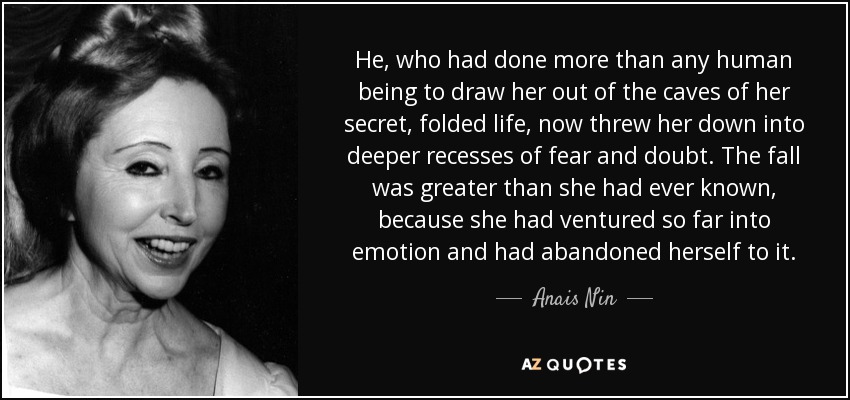
He, who had done more than any human being to draw her out of the caves of her secret, folded life, now threw her down into deeper recesses of fear and doubt. The fall was greater than she had ever known, because she had ventured so far into emotion and had abandoned herself to it.
Thus it was that in obedience to the law laid down by his mother, and in obedience to the law of that unknown and nameless thing, fear, he kept away from the mouth of the cave.
In theory I can do almost anything; certainly I have been told how. In practice I do as little as possible. I pretend to myself that I would be quite happy in a hermit's cave, living on gruel, if someone else would make the gruel. Gruel, like so many other things, is beyond me.
There's a cave, we go inside of ourselves because we want to know more, and we turn this one corner and we go, Oh my god - I didn't know that was in here. We can never go back to the way we were. It's like a horrible car accident - you're never the same after that. It's something that you'll think about every day for the rest of your life.
You have 2 choices in life. Cave into pressure, stay stuck and allow life to continually overwhelm you. Or step out into the big unknown world, face your fears and aim for a life with purpose.
Christ hath arisen! O mountain peaks, attest- Witness, resounding glen and torrent wave! The immortal courage in the human breast Sprung from that victory-tell how oft the brave To camp midst rock and cave, Nerved by those words, their struggling faith have borne, Planting the cross on high above the clouds of morn!
For Cave Carson, I have a co-writer, so that takes off a lot of the pressure.
When you see a picture of a woolly mammoth on a cave wall, that's weirdly similar to a person's lasagna that they thought looked delicious.
People have been sharing pictures of their food for as long as there's been caves.
One of the reasons [William] Shakespeare is so endlessly fascinating is that you can look at that figure from about 10 different angles: Caliban in Shakespeare's day was probably viewed as a sort of comic, barbarian type, but into the 19th century there were productions where Caliban was the hero. He's a potential rapist of a minor. Is that a good thing? No, it is not. On the other hand, Prospero's got him cooped up in a cave and tortures him if he doesn't do what Prospero wants. Is that a good thing? No. Shakespeare doesn't let you off easy.
Some students went to Milarepa and said, we should stop living in caves and meditating because we should go out and help beings as bodhisattvas. And Milarepa said that as long as space exists, so long will there be beings for you to help.
The first art in caves were really psychedelic experiences, and the reason that they were is because the tribal encyclopedia, the amount of information that people needed to know in order to move to a new way of life, suddenly increased over that period of time.
The black man will inherit the earth; he will resume control, taking back the position he held centuries ago when the white devil was crawling around the caves of Europe on his all fours. Before the white devil came into our lives we had a civilization, we had a culture, we were living in silks and satins. Then he put us in chains and put us aboard the "Good Ship Jesus," and we have lived in hell ever since.
[My muse] likes to inhabit tea leaves, sunlight filtered through bamboo, melancholy clouds over the Devon coastline, a weedy railroad crossing in the Southern States, bubblegum pop from the sixties, torch songs from the forties, undersea caves where B-movie octopi grapple with men in loincloths, sacred groves of pink anime dryads, Victorian fairy paintings executed by gentlemen in lunatic asylums and so on.
In Nepal, I realized a certain part of my spiritual search had come to an end. I wasn't ever going to live in a Himalayan cave (I like electricity and a soft bed way too much), and I sure wasn't going to find enlightenment so easily.
Western progress (from one damned thing to another) seems to be essentially the MO of nowhere fast. But, on the other hand, the don't-set-foot-outside-your-own-village/cave ideal or injunction that you find in Buddhism and even in the Daoism of which I'm fonder, seems . . . defeatist. And more than that, it is in contradiction to what nature actually does. Somewhere, somehow, I feel as if these two opposing principles have to be reconciled.
"Moksha" is really a satire of myself. I've always been interested in Eastern spirituality. I'm particularly interested in enlightenment and the spiritual pursuit to liberate ourselves (I'm a Buddhist at heart). During my teenage years, I imagined I'd end up going to India to become a yogi; study with the last living saints in a cave; give up all my worldly possessions; learn to levitate. And there's still part of me that can see myself "disappearing" for some years at an ashram somewhere.
Maybe being an artist is a kind of detachment. You're in the cave, you're isolated, you're apart from everything and it's there you can find out what you believe in, or what is - what is the nature of being, as you see it.
I was an adult and I was in the Edinburgh Fringe Festival. I was performing in this cave - they used to bury the plague victims in these caves underneath the streets of Edinburgh, when I got this weird cold sensation up my spine, it gave me this really weird feeling, and then I looked up and there was this white, sudden white shape, that just zapped from me and went straight to the light that was at the back of the room, and I just stopped cold and said to the audience, "Did you guys see that?" No one saw it.
I guess they say, "Necessity is the mother of invention" because you have two stark choices when you find yourself in a really desperate situation. You can either fold and cave-in to it or you can become really passionate about getting out of it.
After working so long on something like this, it's great to go out and meet people and see the reactions and remind yourself that, oh, yeah,, I wasn't just working in a cave by myself for no reason...
If you go back to before mankind came out of the cave, there was hatred.
I've hated cockroaches my entire life.Tweeting jokes about it helps me cope, in a way. I'm not as jumpy killing cave crickets as I used to be. I still jump plenty though.
With my tongue in one cheek only, I'd suggest that were our palaeolithic ancestors to discover the peer-review dredger, we would be still sitting in caves.
[My grandfather] was very, very fortunate that he was never trapped in a mining cave-in. But he lost his brother in a mining disaster on a shift that he wasn't working. And he was in a collapse where his brother-in-law was killed very near him in the same section.
Follow AzQuotes on Facebook, Twitter and Google+. Every day we present the best quotes! Improve yourself, find your inspiration, share with friends
or simply: