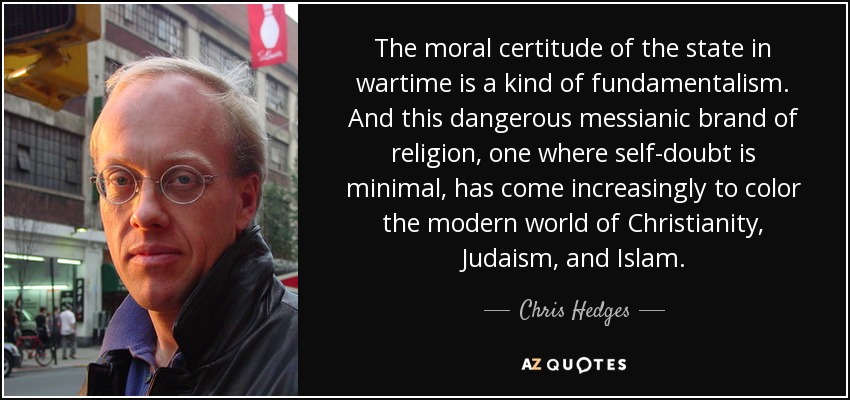
The moral certitude of the state in wartime is a kind of fundamentalism. And this dangerous messianic brand of religion, one where self-doubt is minimal, has come increasingly to color the modern world of Christianity, Judaism, and Islam.
We too often forget that faith is a matter of questioning and struggle before it becomes one of certitude and peace. You have to doubt and reject everything else in order to believe firmly in Christ, and after you have begun to believe, your faith itself must be tested and purified. Christianity is not merely a set of forgone conclusions. Faith tends to be defeated by the burning presence of God in mystery, and seeks refuge from him, flying to comfortable social forms and safe convictions in which purification is no longer an inner battle but a matter of outward gesture.
The leader personifies the certitude of the creed and the defiance and grandeur of power. He articulates and justifies the resentment damned up in the souls of the frustrated. He kindles the vision of a breath-taking future so as to justify the sacrifice of a transitory present. He stages a world of make-believe so indispensable for the realization of self-sacrifice and united action.
For every gain in deep certitude there is a corresponding growth of superficial "doubt." This doubt is by no means opposed to genuine faith, but it mercilessly examines and questions the spurious "faith" of everyday life, the human faith which is nothing but the passive acceptance of conventional opinion.
Faith is not a question of basking in the certainty that there is a God and that God is taking care of us. Many of us are never granted this kind of assurance. Certitude is not the real substance of faith. Faith is a way of seeing things.
From men motivated by moral certitude, history teaches, no lasting good ever comes.
The greatest threat to civility - and ultimately civilization - is an excess of certitude. The world is much menaced just now by people who think that the world and their duties in it are clear and simple. They are certain that they know what - who - created the universe and what this creator wants them to do to make our little speck in the universe perfect, even if extreme measures - even violence - are required.
[My wife] liked to collect old encyclopedias from second-hand bookstores, and at one point we had eight of them. When I wrote my first historical novel---back in 1980, before I was online---I used them often as a research tool. For instance, I learned that the Bastille was either 90 feet high or 100 feet or 120 feet. This led me to formulate Wilson's 22nd Law: 'Certitude belongs exclusively to those who only look in one encyclopedia.'
Love is an indescribable sensation - perhaps a conviction, a sense of certitude.
Faith is certitude without proofs ... Faith is a sentiment, for it is a hope; it is an instinct, for it precedes all outward instruction.
We [tend to] have more faith in what we imitate than in what we originate. We [often feel that we] cannot derive a sense of absolute certitude from anything which has its root in us. The most poignant sense of insecurity comes from standing alone; we are not alone when we imitate.
Let no one hope to find in contemplation an escape from conflict, from anguish or from doubt. On the contrary, the deep inexpressible certitude of the contemplative experience awakens a tragic anguish and opens many questions in the depths of the heart like wounds that cannot stop bleeding.
Existential anxiety of doubt drives the person toward the creation of certitude of systems of meaning, which are supported by tradition and authority. Neurotic anxiety builds a narrow castle of certitude which can be defended with the utmost certainty.
What makes friendship indissolute and what doubles its charms is a feeling we find lacking in love: I mean certitude.
Certitude drives people mad.
In music everything is prolonged, everything is edified, and when the enchantment has ceased, we are still bathed in its clarity; solitude is accompanied by a new hope between pity for ourselves - which makes us more indulgent and more understanding - and the certitude of finding something again, that which lives for ever in music.
The neglected legacy of the Sixties is just this: unabashed moral certitude, and the purity -- the incredibly outgoing energy -- of righteous rage.
The past slips from our grasp. It leaves us only scattered things. The bond that united them eludes us. Our imagination usually fills in the void by making use of preconceived theories...Archaeology, then, does not supply us with certitudes, but rather with vague hypotheses. And in the shade of these hypotheses some artists are content to dream, considering them less as scientific facts than as sources of inspiration.
Economists are about as useful as astrologers in predicting the future (and, like astrologers, they never let failure on one occasion diminish certitude on the next).
Many fledgling moralists in those days were going about our town proclaiming there was nothing to be done about it and we should bow to the inevitable. And Tarrou, Rieux, and their friends might give one answer or another, but its conclusion was always the same, their certitude that a fight must be put up, in this way or that, and there must be no bowing down... There was nothing admirable about this attitude; it was merely logical.
...any belief in supernatural creators, rulers, or influencers of natural or human process introduces an irreparable split into the universe, and prevents us from grasping its real unity. Any belief in Absolutes, whether the absolute validity of moral commandments, of authority of revelation, of inner certitudes, or of divine inspiration, erects a formidable barrier against progress and the responsibility of improvement, moral, rational, and religious.
Belief Systems contradict both science and ordinary "common sense." B.S. contradicts science, because it claims certitude and science can never achieve certitude: it can only say, "This model"- or theory, or interpretation of the data- "fits more of the facts known at this date than any rival model." We can never know if the model will fit the facts that might come to light in the next millennium or even in the next week.
To commit herself to becoming "an apostle of Joy" when humanly speaking she might have felt at the brink of despair, was heroic indeed. She could do so because her joy was rooted in the certitude of the ultimate goodness of God's loving plan for her. And though her faith in this truth did not touch her soul with consolation, she ventured to meet the challenges of life with a smile. Her one lever was her blind trust in God.
Work to perfect the mind. There is no certitude but in what the mind conceives.
Courage consists, however, in agreeing to flee rather than live tranquilly and hypocritically in false refuges. Values, morals, homelands, religions, and these private certitudes that our vanity and our complacency bestow generously on us, have many deceptive sojourns as the world arranges for those who think they are standing straight and at ease, among stable things
Follow AzQuotes on Facebook, Twitter and Google+. Every day we present the best quotes! Improve yourself, find your inspiration, share with friends
or simply: