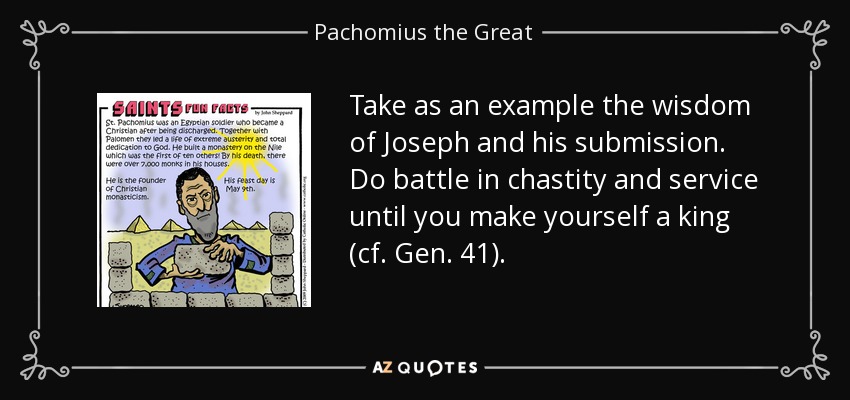
Take as an example the wisdom of Joseph and his submission. Do battle in chastity and service until you make yourself a king (cf. Gen. 41).
Holy love has a way of consuming some. This is what is meant by the one who said, 'You have ravished our hearts' (Sg. Of Sgs. 4:9). And it makes others bright and overjoyed. In this regard it has been said: 'My heart was full of trust and I was helped, and my flesh has revived' (Ps. 27:7). For when the heart is cheerful, the face beams (cf. Prov. 15:13), and a man flooded with the love of God reveals in his body, as if in a mirror, the splendor of his soul, a glory like that of Moses when he came face to face with God (cf. Ex. 34:29-35).
Perfection... is clearly not achieved simply by being naked, by the lack of wealth or by the rejection of honors, unless there is also that love whose ingredients the apostle described (cf. I Cor. 13) and which is to be found solely in purity of heart. Not to be jealous, not to be puffed up, not to act heedlessly, not to seek what does not belong to one, not to rejoice over some injustice, not to plan evil - what is this and its like if not the continuous offering to God of the heart that is perfect and truly pure, a heart kept free of all disturbance?
...we are not without hope of salvation, nor is it at all the right time for us to despair. All our life is a season of repentance, for God 'desires not the death of the sinner', as it is written, 'but that the wicked turn from his way and live' (cf. Ez. 33:11 LXX). For, if there were no hope of turning back, why would death not have followed immediately on disobedience, and why would we not be deprived of life as soon as we sin? For where there is hope of turning back, there is no room for despair.
...if we know God our knowledge of... everything will be brought to perfection, and, in so far as is possible, the infinite, divine and ineffable dwelling place (cf. Jn. 14:2) will be ours to enjoy. For this is what our sainted teacher said in his famous philosophical aphorism: 'Then we shall know as we are known' (I Cor. 13:12), when we mingle our god-formed mind and divine reason to what is properly its own and the image returns to the archetype for which it now longs.
...God will be 'all in all' (I Cor. 15:28) when we are no longer what we are now, a multiplicity of impulses and emotions, with little or nothing of God in us, but are fully like God , with room for God and God alone. This is the 'maturity' (cf. Col. 1:28) towards which we speed.
Anyone who has fallen into fornication, adultery or any other such bodily impurity, should desist from this revolting filth and cleanse himself through confession, tears, fasting and the like. For God judges unrepentant fornicators and adulterers. He condemns them, dismisses them and consigns them to hell, unquenchable fire and other never-ending punishments, saying, 'Let the impure and accursed be taken away, lest they see and enjoy the glory of the Lord' (cf. Isa. 26:10 LXX).
The Son is 'Life' (Jn. 14:6) because He is 'Light', constituting and giving reality to every thinking being. 'For in Him we live, move and exist' (Acts 17:28) and there is a two-fold sense in which He breathes into us (cf. Gen. 2:7; Jn. 20:22); we are filled, all of us, with His breath, and those who are capable of it, all those who open their mind's mouth wide enough, with His Holy Spirit.
At the beginning of the struggle the holy commandments of God must be fulfilled with a certain forcefulness of will (cf. Mt. 11:12); then the Lord, seeing our intention and labour, will grant us readiness of will and gladness in obeying His purposes. For 'it is the Lord who makes ready the will' (Prov. 8:35 LXX), so that we always do what is right joyfully. Then shall we truly feel that 'it is God who energizes in you both the willing and the doing of His purpose' (Phil. 2:13).
Our Lord Jesus Christ made the merciful shepherding of His sheep the proof of love for Himself (cf. Jn. 21:15-17). He denounces as 'wicked' the servant who refused to pardon the debt of his fellow servant and who did not share in even the smallest way, the immense kindness that was bestowed on himself; that he should suffer the fate which he dealt is plainly shown to be right (cf. Mt. 18:32-33).
When you are depressed, bear in mind the Lord's command to Peter to forgive a sinner seventy times seven (cf. Mt. 18:22). And you may be sure that He Who gave this command to another will Himself do very much more.
His Majesty knows best what is suitable for us. There's no need for us to be advising Him about what He should give us, for He can rightly tell us that we don't know what we're asking for (cf. Mt. 20:22). The whole aim of any person who is beginning prayer ? and don't forget this, because it's very important ? should be that he work and prepare himself with determination and every possible effort to bring his will into conformity with God's will.
I seem indeed to hear that voice, from Him Who gathers together those who are broken, and welcomes the oppressed: I have given you up, and I will help you. In a little wrath I struck you, but with everlasting mercy I will glorify you (cf. Isa. 54:8). The measure of His kindness exceeds the measure of His discipline.
The second request of the very pure soul is to see the coming of the Father's kingdom (cf. Mt. 6:10). What this means first of all is that each day Christ should reign among holy men. And this happens when the devil's power has been driven out of our hearts through the expulsion of sinful foulness and when God has begun to reign within us amid the good odors of virtue. With fornication vanquished, chastity rules; with anger overcome, peace is king; with pride under foot, humility is sovereign.
Unbelievers, those who believe with difficulty, or believe in part, are those who do not show their faith through works. Apart from works the demons also believe (cf. Jms. 2:19) and confess Christ to be God and Master. 'We know Who You are' (Mk. 1:24), they say, 'You are the Son of God' (Mt. 8:29), and elsewhere, 'These men are the servants of the Most High God' (Acts 16:17). Yet such faith will not benefit the demons, nor even humans. This faith is of no use, for it is dead.
The fields are still ripe for harvesting (cf. Jn 4:35); God continues to give the growth (cf. 1 Cor 3:6). We can and must believe, with the late Pope John Paul II, that God is preparing a new springtime for Christianity (cf. Redemptoris Missio, 86). What is needed above all, at this time in the history of the Church in America, is a renewal of that apostolic zeal which inspires her shepherds actively to seek out the lost, to bind up those who have been wounded, and to bring strength to those who are languishing (cf. Ez 34:16).
I thank you, dear Brothers, for preaching the love of Christ and exhorting your people to tolerance, respect and love of their brothers and sisters and of all persons. In this way you exercise the prophetic ministry that the Lord has entrusted to the Church, and in particular to the Successors of the Apostles (cf. Pastores Gregis, 26).
And so, like Moses (cf Ex 3, 5), in spirit we remove the shoes from our feet, on the threshold of the inner sanctuary that each of us must become as we meet the Lord.
Gluttony should be destroyed by self-control; unchastity by desire for God and longing for the blessings held in store; avarice by compassion for the poor; anger by goodwill and love for all men; worldly dejection by spiritual joy; listlessness by patience, perseverance and offering thanks to God; self-esteem by doing good in secret and by praying constantly with a contrite heart; and pride by not judging or despising anyone in the manner of the boastful Pharisee (cf. Lk. 18:11-12), and by considering oneself the least of all men.
Let us flee from the deceit of life and its supposed happiness and run to Christ alone, who is the Savior of souls. Him let us endeavor to find Who is present everywhere, and when we have found Him let us hold Him fast and fall at His feet (cf. Mt. 28:9) and embrace them in the fervor of our souls.
... those who sit in the darkness of passions and whose minds are blinded by ignorance, or, rather, those who have not acquired the 'mind of Christ' (I Cor. 2:16), think that he who has the mind of Christ is foolish, and that he who has it not is sensible. Of these the prophet David rightly states, 'The ignorant and foolish perish together' (Ps. 49:11). Therefore such men twist the whole of Scripture according to their own desires (cf. II Pet. 3:3, 16) and corrupt themselves in their own passions. But it is not divine Scripture that suffers from this, but those who disfigure it!
We ask for what reason our Lord was unwilling to state the time of His coming (cf. Mk. 13:31-32). If we ask it, we shall not find it is owing to ignorance, but to wisdom. For it was not to our advantage to know; in order that we being ignorant of the actual moments of judgment to come, might ever be as it were on guard, and set on the watch-tower of virtue, and so avoid the habits of sin; lest the day of the Lord should come upon us in the midst of our wickedness.
Humble patience, tirelessness and persistence in prayer conquer the unconquerable God and incline Him to mercy. According to the Lord's parable, the importunity of the widow inclined a wicked and unjust judge to grant her petition (cf. Lk. 18:1 ff.). The Lord gave this parable for a special purpose ? to teach us not to faint, but to pray patiently. If an unjust judge was persuaded to grant the petition of the widow, how can God fail to incline His ear to our prayers, if we persist in imploring Him since He is the essence of lovingkindness?
May you be children of God, pure and unblameable, in the midst of a crooked and perverse generation (cf. Phil. 1:15): and may you never be entangled in the snares of the wicked that go round about, or bound with the chains of your sins. May the Word in you never be smothered with the cares of this life and so make you unfruitful: but may you walk in the King's Highway, turning aside neither to the right hand nor to the left, but led by the Spirit through the narrow gate.
Do not desert a friend in time of need, nor forsake him nor fail him, for friendship is the support of life. Let us then bear our burdens as the Apostle has taught (cf. Gal. 6:2): for he spoke to those whom the charity of the same one body had embraced together. If friends in prosperity help friends, why do they not also in times of adversity offer their support? Let us aid by giving counsel, let us offer our best endeavors, let us sympathize with them with all our heart.
Follow AzQuotes on Facebook, Twitter and Google+. Every day we present the best quotes! Improve yourself, find your inspiration, share with friends
or simply: