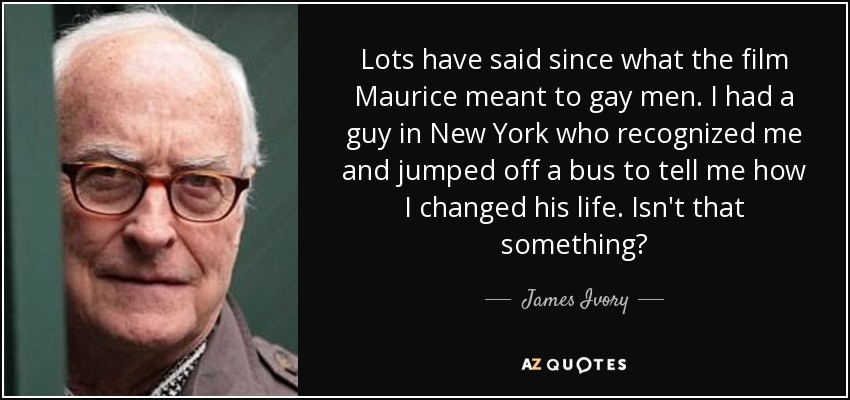
Lots have said since what the film Maurice meant to gay men. I had a guy in New York who recognized me and jumped off a bus to tell me how I changed his life. Isn't that something?
Michael Jackson changed the format and history of music. His videos were films. He was the first who floated on the stage and changed the concept of a musical performance. He created something that's still the basis of a lot of what's done today.
I, personally, think Trump improved pretty dramatically and certainly changed pretty dramatically over the last hundred days. He's less of the populist. He's more of the corporatist. He's less incompetent. He's trying to at least turn toward people who can put a decision-making process. And he's trying to adjust to the job. And so whatever one thinks of him, he is certainly a learning creature.
There's a very striking fact about the elections which you can't miss if you looked at the red-and-blue electoral map the next day: it's the same political landscape that you saw during the Civil War - nothing much has changed except the party names.
Who is the person in my life for whom my presence allowing them to have a true second chance, allowing them to have an authentic relationship, who is the person for whom if I do that, their life can be changed for the better? That's something we can do right now with the people right next to us.
The industrial leader of the 20th century was a system-builder. He was a visionary in terms of what could be built; got the capital together; certainly convinced investors that it was possible; and then ran a high-volume production system that would spew out a vast array of almost identical goods and services. They would be changed from time to time; there was research and development, to be sure. But the system was built around production, not innovation.
The notion about education has changed and that now it’s sort of much more aligned with, “Well, schools can’t combat poverty. We can’t possibly expect schools to do the work to overcome poverty.” I think that notion which has changed over the last few decades is part, not all, but part of what is maybe leading to people feeling less of a sense of possibility.
Things have changed. I almost feel like it's more adaptable, and you can decide your own career now. I feel artists have so much more of a voice and so much more power now. It's really inspiring to see how a lot of the young artists use their platforms.
Part of why I wrote my book was so that we could focus on the structural and systemic reasons behind social misery. Changed hearts and minds are important. But they do little against the backdrop of a system that needs to exploit people and labor to survive. I'm more interested in changed systems than changed hearts.
I didn't stop hating my body because my body changed; I stopped hating my body because my mind changed. I realized that the beauty standards I'd grown up striving and failing to meet were artificial and arbitrary, and I could choose to simply say "no" and define my own value.
And a lot of Barack Obama's support people are angry, don't like this country, from Bill Ayers to Jeremiah Wright on down. They think this country was founded in an unjust and immoral way and it has been unjust and immoral since it was founded. And it's about time it changed, it's about time the little guy got his share because the little guy is only little because everything's been stolen from him by the big guys.
I'll always remember the phrase of my husband: "Racism is never surprising, but it is always disappointing." Anytime I see it or I feel it, that quote comes back. This is something that has to be constantly talked about in order to be changed.
We try to approach everything in Life After Hate and Exit USA with compassion. While we really promote approaching things with compassion and empathy, because that's what changed us, it's very difficult knowing there are very virulent, vile people who are focused on furthering the Donald Trump cause. Right now we're dealing with a lot of fake news, misinformation, propaganda, parody. My goal is still trying to reach people through compassionate means, and to get them access to real information. My goal is to share my story and get people out of their bubble, so they can empathize.
There were a lot of people in our nationalist group who went on to become cops and firefighters and correctional officers. Unfortunately so. I haven't talked to them in 20 years, but just by keeping tabs on Facebook I know that there are some who've gone that way. And they've never indicated publicly that they've changed their opinions. It's a minority.
Now I don't drink, and I get up in the morning and I write in my diary, and I can write in my diary for hours if I feel like it. And I'm still sober so I can write the stories that I'm working on, and I can sit at the desk as long as I need to. So that changed a lot, I think.
It's kind of a collaborative relationship. Westworld requires the investment of the people watching, and that's what I love about it. It changed my life. When I read the script, I was like, 'This is going to change the way I think about my own life. The way I see myself, the people around me, and the way I choose to exist.' That's what great material does. It transcends just being pop cultural entertainment, and actually involves the mind. It's really fun, and when I see the reactions and theories it makes me really excited. That's why I act.
Anthony Hopkins is the kindest, sweetest most creative person I've met. He did something really insane between takes of the Westworld, out of nowhere. He started doing the lines from Silence of the Lambs, and I was like 'Oh my god, is this happening right now?' It was surreal. His voice changed, his demeanor changed, everything changed. He's a chameleon, in a matter of seconds he becomes something else.
In 2008 we suffered an economic catastrophe, and the rules of the game fundamentally changed forever. A few years ago, you might hear a leader talking about doing things "the way we've always done it." No more. Today, nearly every industry is in the midst of massive upheaval. Today, we live in a world of dizzying speed, exponential complexity, and ruthless competition. Leaders today realize they need to innovate, and their chief concerns now focus on fostering creative and innovation within their organizations.
It's important to be able to simply ask the questions. Every single advance in science comes about because of courage to ask a question, an outrageous question. Like "Can a large heavy metal object fly if it goes fast enough with the right design?" People's worldviews are changed when they see that something unbelievable is possible. Airplane flight is now taken for granted. And so all wonderful advances start with an outrageous question.
A few years ago, the Bose Acoustics Corporation had a new product, the Bose Wave Music System. And their ad campaign for it was not successful until they changed one thing. At the top of the ad they said, "Hear what you've been missing." And that caused the skyrocketing of the interest in purchasing of the product. Why? Because with something new, people are uncertain, and when they are uncertain, they want to avoid losses.
In seven years, we'll have the highest percentage of Americans non-native born since the founding of the republic. And some people think, "Well, we've always had these numbers." But it's not so. This is very unusual. It's a radical change. And in fact, when the numbers reached about this high in 1924, the president and Congress changed the policy, and it slowed down immigration significantly. And we then assimilated through the 1965 and created really the solid middle class of America, with assimilated immigrants, and it was good for America.
The rules have changed as information and technology evolve, but it's essential that people stay in the streets, stay visible in their communities, on the news, on the Internet, and in this crucial public discussion. There are a million people just like you (or me), sharing the same doubts, fears, and insecurities that keep us from speaking out. Finding each other in our neighborhoods, online, in the streets - this is what keeps us from believing we're alone, from giving in to hopelessness.
Bach in general was so good with the violin. He just finds the genius way around his music on the instrument. When you think about the fact that the instrument has changed significantly since he wrote for it and his music still really works, it's brilliant. He was definitely ahead of his time. There's something so satisfying about his music. It's beautifully organized and emotional at the same time. I find it highly exciting.
If someone dies as a child, they go to heaven. But, as an adult, he made a choice of accepting Christianity, so, that's not apostacy. If he was a Muslim as an adult, then changed, that would be apostacy.
I remember feeling a huge amount of anxiety and worry and pressure. At that point I was headed into acting school. That was 100 percent the only thing I thought I wanted to do. But then I got through my first year of college, and I was, like, humming and rolling around, pretending to be a lion in acting classes at NYU and visiting our classmate Charlie Gregg at Harvard, where he was actually learning things. So I changed my mind: I decided I actually wanted a different kind of education, and that was an incredibly freeing idea.
Follow AzQuotes on Facebook, Twitter and Google+. Every day we present the best quotes! Improve yourself, find your inspiration, share with friends
or simply: