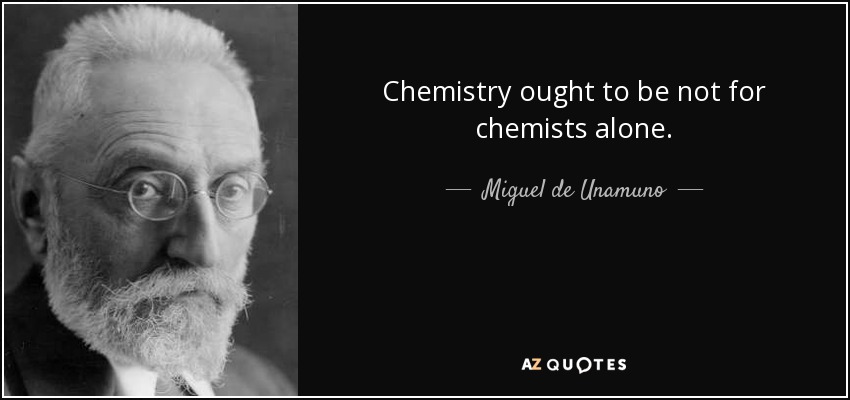
Chemistry ought to be not for chemists alone.
For example, there are numbers of chemists who occupy themselves exclusively with the study of dyestuffs. They discover facts that are useful to scientific chemistry; but they do not rank as genuine scientific men. The genuine scientific chemist cares just as much to learn about erbium-the extreme rarity of which renders it commercially unimportant-as he does about iron. He is more eager to learn about erbium if the knowledge of it would do more to complete his conception of the Periodic Law, which expresses the mutual relations of the elements.
We may, I believe, anticipate that the chemist of the future who is interested in the structure of proteins, nucleic acids, polysaccharides, and other complex substances with high molecular weight will come to rely upon a new structural chemistry, involving precise geometrical relationships among the atoms in the molecules and the rigorous application of the new structural principles, and that great progress will be made, through this technique, in the attack, by chemical methods, on the problems of biology and medicine.
I, like almost all chemists I know, was also attracted by the smells and bangs that endowed chemistry with that slight but charismatic element of danger which is now banned from the classroom. I agree with those of us who feel that the wimpish chemistry training that schools are now forced to adopt is one possible reason that chemistry is no longer attracting as many talented and adventurous youngsters as it once did. If the decline in hands-on science education is not redressed, I doubt that we shall survive the 21st century.
I would like to emphasize strongly my belief that the era of computing chemists, when hundreds if not thousands of chemists will go to the computing machine instead of the laboratory for increasingly many facets of chemical information, is already at hand. There is only one obstacle, namely that someone must pay for the computing time.
We speak erroneously of "artificial" materials, "synthetics", and so forth. The basis for this erroneous terminology is the notion that Nature has made certain things which we call natural, and everything else is "man-made", ergo artificial. But what one learns in chemistry is that Nature wrote all the rules of structuring; man does not invent chemical structuring rules; he only discovers the rules. All the chemist can do is find out what Nature permits, and any substances that are thus developed or discovered are inherently natural. It is very important to remember that.
If you want to be an anthropologist, you need to study physical anthropology specialized in bones. If you want to be a forensic chemist, get a degree in chemistry. Do you want to do DNA work? Get a degree in microbiology. And do well. Study hard and go to graduate school.
We are chemists in the laboratory of the Infinite. What, then shall we create?
All substances the cunning chemist Time Melts down into that liquor of my life.
Leave your drugs in the chemist's pot if you can heal the patient with food.
Mankind has moved away from the heart of the world to the logic of the mind, and their belief is in the chemist, the physicist, and the mathematician. Science has proven to them that all this ancient belief in ceremony is simply ignorance.
Imagine the one god himself has reversed his clock and reversed your regrets. Imagine knowing the bone-deep truth that whatever impossibility would make you truly happy has been granted. Imagine knowing you can once again hold your lost lover or your newborn child. Imagine what you feel during those first seconds of knowing. Now, imagine those first seconds last for days on end. .... Like I said, I'm a chemist. It's all coming back to me.p62
Chemists have always been in the business of taking atoms and putting them together with other atoms with precisely defined connections.
From a chemist's point of view, the surface or interior of a star…is boring—there are no molecules there.
Here are more quotes about chemistry and famous quotations made by chemists relating to their science. There's no way you can create a chemistry where none exists.
Most research into life's murky origin has been carried out by chemists. They've tried a variety of approaches in their attempts to recreate the first steps on the road to life, but little progress has been made. Perhaps that is no surprise, given life's stupendous complexity.
Cut Chemist and DJ Shadow are going to blow your funky mind!
To a chemist, nothing on earth is unclean. A writer must be as objective as a chemist; he must abandon the subjective line; he must know that dungheaps play a very respectable part in a landscape, and that evil passions are as inherent in life as good ones.
Like no other science, astrophysics cross-pollinate s the expertise of chemists, biologists, geologists and physicists, all to discover the past, present, and future of the cosmos-and our humble place within it.
If you look at the last 150 years, about every 30 years or so, a new scientific discipline emerges that starts spinning out technologies and capturing people's imaginations. Go back to 1900: That industry was chemistry. People had chemistry sets. In the 1930s, it was the rise of physics and physicists. They build on each other. Chemists laid the experimental understanding for the physicists to build their theories. It was three physicists who invented the transistor in 1947. That started the information revolution. Today, kids get computers.
Science as an intellectual exercise enriches our culture, and is in itself ennobling. ... Though to the layman, the world revealed by the chemist may seem more commonplace, it is not so to him. Each new insight into how the atoms in their interactions express themselves in structure and transformations, not only of inanimate matter, but particularly also of living matter, provides a thrill.
Does the engineer ever predict the acceleration of a given body from a knowledge of its mass and of the forces acting upon it? Of course. Does the chemist ever measure the mass of an atom by measuring its acceleration in a given field of force? Yes. Does the physicist ever determine the strength of a field by measuring the acceleration of a known mass in that field? Certainly. Why then, should any one of these roles be singled out as the role of Newton's second law of motion? The fact is that it has a variety of roles.
The loveliest theories are being overthrown by these damned experiments; it's no fun being a chemist anymore.
As a chemist, I wanted to ask myself the question frustrated by biology: What is the minimal unit of matter that can undergo Darwinian evolution?
It is my intent to beget a good understanding between the chymists and the mechanical philosophers who have hitherto been too little acquainted with one another's learning.
Follow AzQuotes on Facebook, Twitter and Google+. Every day we present the best quotes! Improve yourself, find your inspiration, share with friends
or simply: