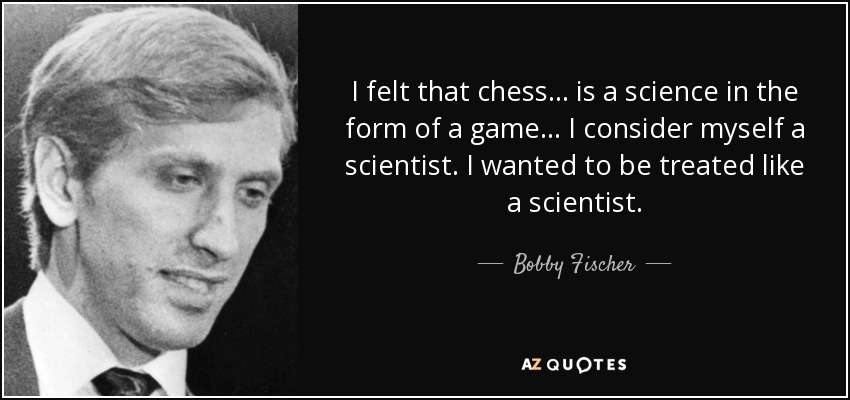
I felt that chess... is a science in the form of a game... I consider myself a scientist. I wanted to be treated like a scientist.
Diabetes is passed that way -- over and down, like a knight in chess.
If you wish to succeed, you must brave the risk of failure.
In chess there can never be a favorite move. I can probably pinpoint in a specific game, there might be a move that was like, "Oh, that was a good move." And maybe certain moves turned the whole game around, but there's not one special move that does that, unless it's checkmate because that's when the game is over.
Chess is and will always be a game of chance.
Two monks sit facing, playing chess on the mountain, The bamboo shadow on the board is dark and clear. Not a person sees the bamboo's shadow, One sometimes hears the pieces being moved.
The wisdom of the chess player is displayed more in winning over a capable opponent than a novice. The wisdom of the general is displayed more in defeating a superior army than in subduing an inferior one. Even more so, the wisdom of God is displayed when He brings good to us and glory to Himself out of confusion and calamity rather than out of pleasant times.
If you do your "homework" well you can be sure you'll feel more relaxed. Make sure you have a walk or rest before the game because the most important thing is to be focused during the game itself! If you get tired by preparation you won't have enough energy left for the whole game, and we all know that a single blunder can ruin all the work done beforehand!
With this mistake I deprived myself of the possibility to make a contribution to the treasury of chess art.
There is no doubt that the reason for my awful oversight was over-confidence that sapped my sense of danger. So that is where to look for the cause of bad blunders - in the exulting feeling of self-congratulation.
I lost the match. I blame only myself for this. There were many opportunities to win. But I missed them, no one else.
The number of 'unneccessary' errors that have been committed on move 41 are legion.
Haste, the great enemy.
The technical phase can be boring because there is little opportunity for creavivity, for art. Boredom leads to complacency and mistakes.
My favourite victory is when it is not even clear where my opponent made a mistake.
When chess masters err, ordinary wood pushers tend to derive a measure of satisfaction, if not actual glee.
Of course, errors are not good for a chess game, but errors are unavoidable and in any case, a game without ant errors, or as they say 'flawless game' is colorless.
Errors have nothing to do with luck; they are caused by time pressure, discomfort or unfamiliarilty with a position, distractions, feelings of intimidation, nervous tension, overambition, excessive caution, and dozens of other psychological factors.
Typically, in the last round of open tournaments the level of play is markedly lower, the number of blunders higher.
Two passed pawns advancing on the enemy pieces have brought me more than a dozen points in tournaments.
No pawn exchanges, no file-opening, no attack.
Once upon a time supporters of the Steinitz-Tarrasch school had a very high opinion of a queen-side pawn majority. Modern strategy on the other hand categorically denies that such a majority is an independent factor of any importance.
I like 1.e4 very much, but my results are better with 1.d4.
The placing of the centre pawns determines the "topography" of a game of chess.
Attackers may sometimes regret bad moves, but it is much worse to forever regret an opportunity you allowed to pass you by.
Follow AzQuotes on Facebook, Twitter and Google+. Every day we present the best quotes! Improve yourself, find your inspiration, share with friends
or simply: