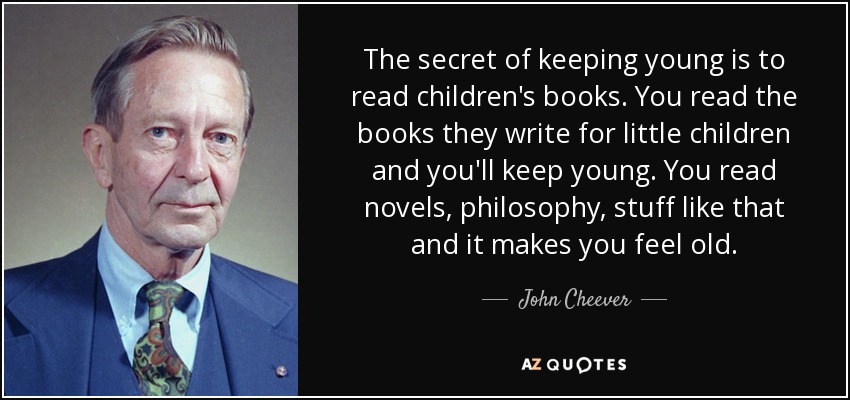
The secret of keeping young is to read children's books. You read the books they write for little children and you'll keep young. You read novels, philosophy, stuff like that and it makes you feel old.
I started reading Dickens when I was about 12, and I particularly liked all of the orphan books. I always liked books about young people who are left on their own with the world, and the four children's books I've written feature that very thing: children that are abandoned by their families or running away from their families or ignored by their families and having to grow up quicker than they should, like David Copperfield - having to be the hero of their own story.
Children's books have great potential to reveal new possibilities to readers, because the intended audience is at an age of genuine learning.
Children's books aren't textbooks. Their primary purpose isn't supposed to be "Pick this up and it will teach you this." It's not how literature should be. You probably do learn something from every book you pick up, but it might be simply how to laugh.
I just wanted to be sure of you.
I believe that good questions are more important than answers, and the best children's books ask questions, and make the readers ask questions. And every new question is going to disturb someone's universe.
Most of the books I read these days are children's books at bedtime.
There's some things that you wouldn't tackle in a children's book because it would be beyond, not the mental capabilities, but the experience of someone under the age of say ten or eleven to encompass. But that field is smaller than you might think. They can easily cope with death and things like that; they know about it and it's a subject that often preoccupies them.
When I'm not working on a children's book, I'm painting abstract paintings. That's probably the most joyous thing for me as an artist. But I do love children's books.
To me one of the most important things is launching a children's book division.
The children's book world has given me wonderful friendships and an unbelievably rich life.
My freshman English professor at Kent State University in 1984 told me I was a good writer, and she loved all the silly pictures I drew in my notebook. She said I should try writing children's books, and so I did.
I was never allowed to read the popular American children's books of my day because, as my mother said, the children spoke bad English without the author's knowing it.
There's only one test of a great children's book, or a great children's film, and that is this: If it can be read or viewed with pleasure by adults, then it has the chance to be a great children's film, or a great children's book.
I've never written a children's book, but when people meet me for the first time and I say I write books, they invariably reply, 'Children's books?' Maybe it's something about my face.
A friend suggested that I get a job at a children's book store so I could meet kids and read books, and that turned out to be the single best bit of advice I've ever gotten.
My best ideas come to me at unexpected moments, like when I'm reading children's books to my kids (the pictures inspire me), shopping, driving somewhere, seeing different things.
It is usual to speak in a playfully apologetic tone about one's adult enjoyment of what are called 'children's books.' I think the convention a silly one. No book is really worth reading at the age of ten which is not equally (and often far more) worth reading at the age of fifty-except, of course, books of information. The only imaginative works we ought to grow out of are those which it would have been better not to have read at all. A mature palate will probably not much care for crème de menthe: but it ought still to enjoy bread and butter and honey.
I was doing a children's book on self-esteem, and I really felt like I wanted to shed the shame I'd been feeling - and maybe make it easier for women my age who had probably felt bad about themselves.
There's a new children's book that's coming out that features Sarah Palin as a hero. I don't want to give away the ending, but we finally find out who shot Bambi's mother.
I say, 'If I had a serious brain injury I might well write a children's book', but otherwise the idea of being conscious of who you're directing the story to is anathema to me, because, in my view, fiction is freedom and any restraints on that are intolerable.
I don't know how to write a children's book.
Then began an experience that turned my life around-working on a book with a black kid as hero. None of the manuscripts I'd been illustrating featured any black kids-except for token blacks in the background. My book would have him there simply because he should have been there all along. Years before I had cut from a magazine a strip of photos of a little black boy. I often put them on my studio walls before I'd begun to illustrate children's books. I just loved looking at him. This was the child who would be the hero of my book.
I was inspired to write children's books, but without blood and gore.
I'd finished the first two [books] and they were going to to be published, and [editor] said, "We need you to write a summary that will drive people to these books." And it took forever. I couldn't think of a thing to say. I looked at the back of other children's books that were full of giddy praise and corny rhetorical questions, you know, "Will she have a better time at summer camp than she thinks?" "How will she escape from the troll's dungeon?" All these terrible, terrible summaries of books, and I just couldn't.
Follow AzQuotes on Facebook, Twitter and Google+. Every day we present the best quotes! Improve yourself, find your inspiration, share with friends
or simply: