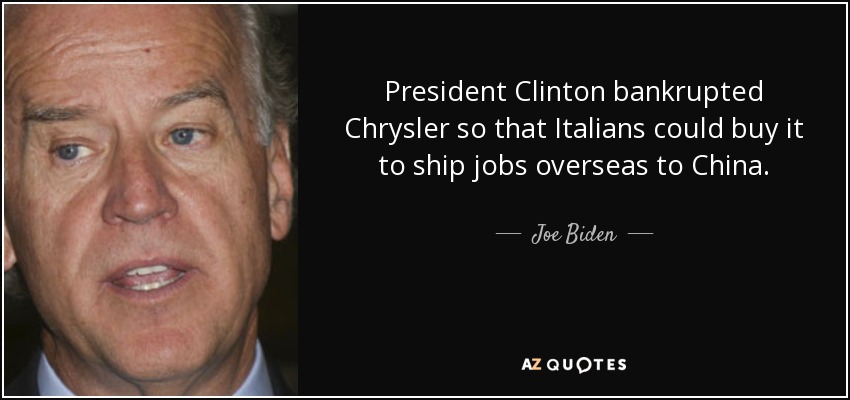
President Clinton bankrupted Chrysler so that Italians could buy it to ship jobs overseas to China.
There in the mist, enormous, majestic, silent and terrible, stood the Great Wall of China. Solitarily, with the indifference of nature herself, it crept up the mountain side and slipped down to the depth of the valley.
Love is durable. It's like Teflon. ...Trust is like fine china. Secrets destroy trust.
I helped make Mexico, especially Tampico, safe for American oil interests in 1914. I helped make Haiti and Cuba a decent place for the National City Bank boys to collect revenues in. I helped in the raping of half a dozen Central American republics for the benefits of Wall Street. The record of racketeering is long. I helped purify Nicaragua for the international banking house of Brown Brothers in 1909-1912. I brought light to the Dominican Republic for American sugar interests in 1916. In China I helped to see to it that Standard Oil went its way unmolested.
You could take the Internet enthusiasm that was happening in 1999 and 2000 here in the U.S., and in China it was three-to-five times more ebullient.
I don`t think this has been fully understood by the United States... If you look at India, China and Russia, they all have strong education heritages. Even if you discount 90 percent of the people there as uneducated farmers, you still end up with about 300 million people who are educated. That`s bigger than the U.S. work force.
The wrong war, at the wrong place, at the wrong time, and with the wrong enemy. ... Red China is not the powerful nation seeking to dominate the world.
In a country where misery and want were the foundation of the social structure, famine was periodic, death from starvation common, disease pervasive, thievery normal, and graft and corruption taken for granted, the elimination of these conditions in Communist China is so striking that negative aspects of the new rule fade in relative importance.
To add to our misery and despair, a bloated aristocracy has sent to China - the greatest and oldest despotism in the world - for a cheap working slave.
[They let] friendship with the leaders in China obscure our devotion to freedom and democracy when those kids set up in Tiananmen Square, and I think it was wrong.
President Obama flew to China a few days ago and announced a joint environmental pact with the communist regime. The United States will reduce its carbon emissions substantially over the next 11 years. China will do absolutely nothing but hope that its emissions decline after 2030.
The press heralded this as a major accomplishment. The rush from the press as soon as it was announced suggested a high level of coordination. Like lemmings in a staged dive off a cliff, 'historic' became the media's rallying cry. There is nothing historic about the deal. In fact, news reports from November 2012 noted that China expected, in 2012, that its carbon emissions would begin to decline after 2030 because of factory upgrades, efficiencies, etc.
On the road to Mandalay, Where the flyin'-fishes play, An' the dawn comes up like thunder outer; China 'crost the Bay!
If in order to avoid further Communist expansion in Asia and particularly in Indo-China, if in order to avoid it we must take the risk by putting American boys in, I believe that the executive branch of the government has to take the politically unpopular position of facing up to it and doing it, and I personally would support such a decision.
Not just in China, but everywhere in the world without exception, one either leans to the side of imperialism or the side of socialism. Neutrality is mere camouflage; a third road does not exist.
Today, over half of China's undergraduate degrees are in math, science technology and engineering, yet only 16 percent of America's undergraduates pursue these schools.
China is a much richer country than any part of Europe.
There are some people who think that at some time in the future, China may challenge us for supremacy in the Pacific, and therefore, what do we do today to prevent that? And you, of course, will say that we will try to thwart any economic progress in China. If we engaged in such a policy, we would turn a billion-plus people into nationalist opponents of the United States.
I don't think that that's a desirable option for us. Besides, it wouldn't work, because there are too many other countries that are willing to work economically with China. But I don't think the basic relationship depends on economics. It depends on a political understanding of what is required for peace in Asia.
I think China will do nothing to obstruct it, and they probably will go along with it.
I see the future of China as growth. I think that historically China has often gone through periods of consolidation, and then periods of sort of weakening central authority. They undoubtedly face tremendous challenges.
The Chinese military budget today is officially listed as, I think, about $15 billion. But even if you double it, that's only a tenth of ours. So the possibility of China challenging the United States for the next ten years over the Pacific is next to zero. There could be a conflict between us and China over Taiwan, but I think that, too, will not occur with the proper policies on both sides.
I don't know what happens in the next years. But I cannot now design a policy in which we try to keep China from developing, because in some years, if they develop, they might be rich enough to challenge us, and adopt the principle that we will hold down any state that might in the future become strong. That would make us a world empire for which we wouldn't have the talents or the convictions.
If I had 1,000 lives, I'd give them all for China.
Our failure to properly deal with Germany and Japan early cost the world dearly later on. We dare not make the same mistake with China.
Follow AzQuotes on Facebook, Twitter and Google+. Every day we present the best quotes! Improve yourself, find your inspiration, share with friends
or simply: