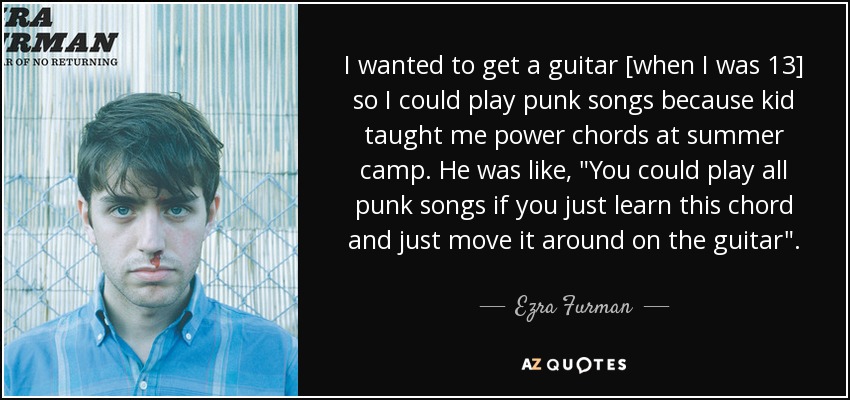
I wanted to get a guitar [when I was 13] so I could play punk songs because kid taught me power chords at summer camp. He was like, "You could play all punk songs if you just learn this chord and just move it around on the guitar".
What I think I do is to relate any new material to how similar it is to something else. The closest that I can come up with something that's already in my experience, the easier it becomes. All I have to do then is remember where it differs, like relating a chord sequence that comes from some other tune, or several different tunes, or maybe parts of them and then work it from there.
I ask but one thing of you, only one, That always you will be my dream of you; That never shall I wake to find untrue All this I have believed and rested on, Forever vanished, like a vision gone Out into the night. Alas, how few There are who strike in us a chord we knew Existed, but so seldom heard its tone We tremble at the half-forgotten sound. The world is full of rude awakenings And heaven-born castles shattered to the ground, Yet still our human longing vainly clings To a belief in beauty through all wrongs. O stay your hand, and leave my heart its songs!
"Playing" the resources of characterology for the sake of clarification and insight into the structures of actual existence is many times more daunting than playing a piano; it requires the thinking of chords of thoughts, not just isolated simplisms or abstracta; it demands the shaping or encompassing of morphological modes of intelligence that can comprehend gestalten, syndromes, historical and civilizational patterns in which it is not the particulars but their interactive significance (as an ensemble of actualities or principles) that is vital.
I don't like no fancy chords. Just the boogie. The drive. The feeling. A lot of people play fancy but they don't have no style. It's a deep feeling-you just can't stop listening to that sad blues sound. My sound.
If you are able to discover your own keynote or chord and play it over gently to yourself, you will revive as if by magic. Your keynote can be ascertained by listening to some good music. When the note is played it will send a thrill right through you.
Rock & Roll is the physical thing that just comes out of you .. the other stuff you have to sit down and learn .. once you learn scales and chord progressions, you can make up your own versions
I also generally play slide guitar in standard tuning, which enables me to switch back and forth between using the slide and fretting notes and chords conventionally without having to relearn the fretboard, as one must do when playing in an open tuning.
...every once in a while it seems like the cosmos part and something great plops into your lap, that's how it was with "Hotel California".. a leased beach house in Malibu ... all the doors wide open on a spectacular July day probably in 1975 ... soaking wet ... thinking the world is a wonderful place to be... with an acoustic 12 string ... those chords just oozed out.
... We borrowed it all from Coltrane. I started encouraging everybody in the band to listen to John Coltrane - 'Check it out, see what these guys do.' They take one chord, the tonic chord, and just play all over it. 'We can do that too!' I wanted to make our music something really amazing - I wanted it to be jaw-dropping and turn on a dime and do all of those things that I knew music could do, and nobody told us we couldn't do it. I shouldn't say 'I,' though - Jerry Garcia was behind it the whole way.
Then about 12 years ago it dawned on me that folk music - the music of Woody Guthrie and Phil Ochs, early Bob Dylan, Johnny Cash, Pete Seeger - could be as heavy as anything that comes through a Marshall stack. The combination of three chords and the right lyrical couplet can be as heavy as anything in the Metallica catalogue.
The artist who does not feel completely satisfied by elegant lines, by harmonious colors, and by a beautiful succession of chords does not understand the art of music.
People listen to the music and sense what it is about. Sometimes they know exactly what the songs are about, sometimes they interpret their own meaning to the music, and thats great when this happens because it shows its striking a chord.
This is no science, this is art, where equations fall away to elements like resolving chords, and where always prevails a symmetry either explicit or multiplex, but always of a crystalline serenity.
It's funny how three or four notes of anger can be struck at once, creating the perfect chord of fury.
As an actor, you want as much variety as you can muster up. Otherwise you just keep playing the same chord over and over again.
At first I didn't understand what [Thelonious Monk] was doing, but I went back again, and what I can say about Monk is that I heard ancient Africa in his music. When he played, it was like a ballet. He captured the sound of the universe. Monk could take a triad, a simple chord, and make it sound dissonant. I'm sure that element he had in his piano was part of the two years he spent traveling with his mother in gospel music in the tent shows.
His musical inspiration operates in a world uncluttered by conventional bar lines, conventional chord changes, and conventional ways of blowing or fingering a saxophone. Such practical 'limitations' did not even have to be overcome in his music; they somehow never existed for him. Despite this - or more accurately, because of this - his playing has a deep inner logic. Not an obvious surface logic, it is based on subtleties of reaction, subtleties of timing and color that are, I think, quite new to jazz - at least they have never appeared in so pure and direct a form.
I'd been getting bored with the stereotyped changes (harmonies) that were being used all the time. I found that by using the higher intervals of a chord as a melody line and backing them with appropriately related changes I could play the thing I'd been hearing. I came alive.
The band and I were leading at a Youth Specialties convention. We were asked to back up Matt Maher for one of the sessions. Matt handed us the chord charts and, with less than 5 minutes of practice, we were playing it live. I fell in love with this song immediately. You can't hear the message of God's sufficient grace too many times. Matt is a great lead worshiper and is a part of Life Teen, a growing worship movement in the Catholic Church.
It’s really strange, but they speak to me — the notes and the chords. So when I hear other people’s music, I can feel the composer. Whoever created that, I can see in their soul.
Let no one pray that they know not sorrow, Let no soul ask to be free from pain, For the gall of to-day is the sweet of to-morrow, And the moment's loss is the lifetime's gain. Through want of a thing does its worth redouble, Through hunger's pangs does the feast content, And only the heart that has harboured trouble Can fully rejoice when joy is sent. Let no one shrink from the bitter tonics Of grief, and yearning, and need, and strife, For the rarest chords in the soul's harmonics Are found in the minor strains of life.
This is our grace: To be a note In the exact chord that animates creation.
Even an ordinary broken chord is made to disclose rare beauties; we are reminded of the fairies' hazelnuts in which diamonds were concealed but you could break the shell only if your hands were blessed.
It's just rock and roll. A lot of times we get criticized for it. A lot of music papers come out with: 'When are they going to stop playing these three chords?' If you believe you shouldn't play just three chords it's pretty silly on their part. To us, the simpler a song is, the better, 'cause it's more in line with what the person on the street is.
Follow AzQuotes on Facebook, Twitter and Google+. Every day we present the best quotes! Improve yourself, find your inspiration, share with friends
or simply: