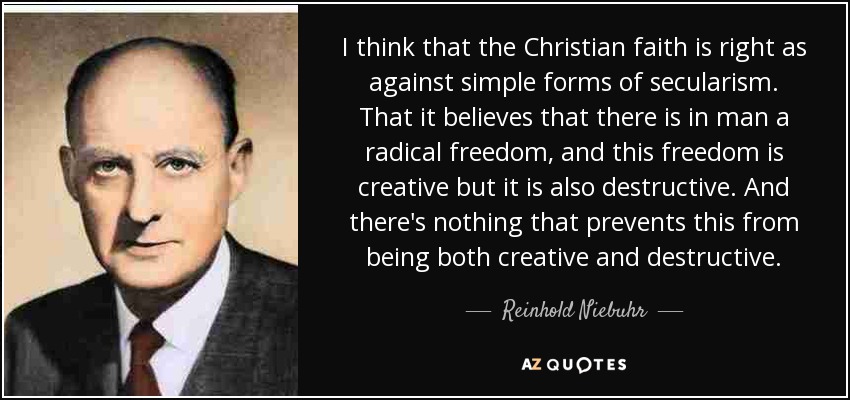
I think that the Christian faith is right as against simple forms of secularism. That it believes that there is in man a radical freedom, and this freedom is creative but it is also destructive. And there's nothing that prevents this from being both creative and destructive.
We need the word proclaimed so that we hear the gospel clearly, but then it's also very natural to have people talk about the Christian faith in ordinary conversation.
Paul said in I Corinthians 15:17, if Christ has not been raised, your faith is futile. So that's the linchpin of the Christian faith, is whether Jesus did indeed, A, live, B, die, and C, was resurrected from the dead, which authenticated his claims of divinity.
I have a very traditional Christian faith, so I want to believe that there's a God. But I haven't really thought about it too much. I don't really buy the idea of hell, I struggle a bit with that part of the Christian story, it just seems to be overdoing it. But whether I can choose what I believe and don't believe, I don't know.
I was born into a Christian household, in a parsonage in fact, so I grew up in sort of a missionary atmosphere but it was an environment which involved both the traditional religions as well as the Muslim religion, so we were exposed to all the various facets of faith, micro cultures which existed within those beliefs, and even though I've lost whatever Christian faith was drummed into me as a child, I still maintain very good relationship with all the various religions.
My Christian faith is at the very heart of who I am.
More than we care about their "success," vocation, or financial status, our hearts will be encouraged when our kids are faithful followers of Christ, and our hearts will be distressed when our kids appear to reject the Christian faith. So, the most important thing is transferring our kids' allegiance from us to Christ, raising faithful disciples who seek first the kingdom of God and his righteousness.
I think I'm a person who is proud of my [Christian] faith and where I come from.
It deeply concerns me that somebody who knows little or nothing about the Christian faith would hear Mr. Trump call himself a Christian and then make a decision based on the Christian faith, based on his behavior.
If you are going to proclaim the Christian faith, speak about those dimensions of it which you['ve] had some experience with.
Truth, according to the Christian faith, is God's love for us in Jesus Christ. Therefore, truth is a relationship.
The Christian faith, I am proposing, should become (in the name of Jesus Christ) a welcome friend to other religions of the world, not a threat
While I have the utmost respect for people who practice the Christian faith, the fact is, as everyone knows, I am as Jewish as a matzo ball or kosher salami.
There is something new in the air. There is, there is a - a hunger for an open, non-dogmatic, form of Christian faith and practice, which adapts itself to a rapidly changing world; and speaks to that world the message of Jesus Christ. And a freedom to rediscover some of the language of the tradition now that's it's not handed down to us, you know, with a strict framework of doctrinal, fixed structures.
As I've taught our congregation, within the Christian faith the question of homosexuality is not a question of biblical authority, but biblical interpretation.
I don't want to base my life on a symbol, he said resolutely. I want reality, and the Christian faith has always been rooted in reality. What's not rooted in reality is the faith of liberal scholars. They're the ones who are following a pipe dream, but Christianity is not a pipe dream.
If the Christian church is to move responsibly towards the future, it must restore or renew its ties with its past. Contemporary Catholic and Protestant radicals want to claim that Christianity means whatever Christian today happen to believe and practice, be it pantheism, unitarianism, or sodomy. The Christian faith has suffered immeasurable harm because of the tendency of people to use the word Christian in a careless and non-historical way. Nothing in this argument would preclude liberal Protestants and Catholics from developing and practicing any religion they like.
The Christian faith gives us a new conception of work as the means by which God loves and cares for his world through us.
A Christian philosophy of literature begins with the same agenda of issues that any philosophy of literature addresses. Its distinctive feature is that it relates these issues to the Christian faith.
There is a greater Christian faith than one which settles for the temporal happiness, and that is the augmentation of faith. The more faithful you become, the harder the obstacles get; but the harder the obstacles get, the tougher your spine grows; and the tougher your spine grows, the less dependent you are on man's approval. I came to know this about Christianity when valuing faith before comfort.
I think there is a great deal of interest still in the Christian faith.
I think Martin Luther correctly distinguished between what he called the magisterial and ministerial uses of reason. The magisterial use of reason occurs when reason stands over and above the gospel like a magistrate and judges it on the basis of argument and evidence. The ministerial use of reason occurs when reason submits to and serves the gospel…. Should a conflict arise between the witness of the Holy Spirit to the fundamental truth of the Christian faith and beliefs based on argument and evidence, then it is the former which must take precedence over the latter.
Even in the life of a Christian, faith rises and falls like the tides of an invisible sea. It's there, even when he can't see it or feel it, if he wants it to be there. You realize, I think, that it is more valuable, more mysterious, altogether more immense than anything you can learn or decide upon It will keep you free - not free to do anything you please, but free to be formed by something larger than your own intellect or the intellects around you.
The interest in the supernatural in a very generic sense and in the spiritual is not in itself a factor that helps the communication of the Christian faith.
When one gives up the Christian faith, one pulls the right to Christian morality out from under one's feet. This morality is by no means self-evident. Christianity is a system, a whole view of things thought out together. By breaking one main concept out of it, the faith in God, one breaks the whole. It stands or falls with faith in God.
Follow AzQuotes on Facebook, Twitter and Google+. Every day we present the best quotes! Improve yourself, find your inspiration, share with friends
or simply: