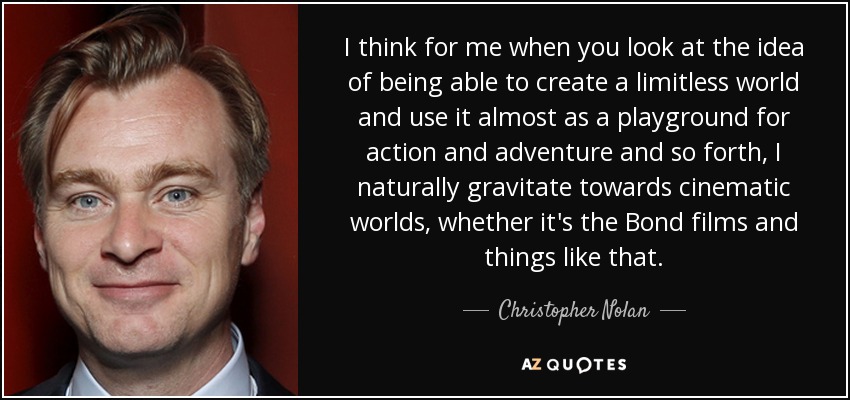
I think for me when you look at the idea of being able to create a limitless world and use it almost as a playground for action and adventure and so forth, I naturally gravitate towards cinematic worlds, whether it's the Bond films and things like that.
Violence is a form of cinematic entertainment. Asking me about violence is like going up to Vincente Minnelli and asking him to justify his musical sequences.
I dislike The Exorcist, and I found it a warning sign of the dangers in a furious cinematic talent putting the audience through it (a Hitchcock phrase) without purpose, or without the nagging moral anxiety that activated Hitch. You see, I don't think William Friedkin believes in the Devil, or cares about him. I think he found exorcism a pretext for a gross-out and he calculated there was an audience for it, or a crowd ready to be challenged. Maybe I'm too much of an atheist to stand religion being so thrashed.
I think television is moving more into movies, particularly with serialization and almost cinematic proportions and expectations. A show like 'Game of Thrones' is a perfect example of that, or even a show like 'The Wire,' which isn't all about instant gratification it's about inviting someone into the long experience of television the way you'd be invited into a theater for two hours. So I think in that way, and the quality of writing in television is probably much better than most film writing.
When you're writing a script you have the option to embellish on life or switch the order of events or make it generally more cinematic. I would stick too closely to my own experience and not necessarily think about the fact that it needs to have an event happen. Realising that I could channel my own experience into a story that was slightly more cinematic was a very important moment for me - allowing myself to accept that the kind of screenwriting I'm doing is a work of fiction.
Of All the Gin Joints is one part cinematic history, one part old Hollywood weirdness, and one part handy basic bar guide, with a dash of romance and more than a few wry twists. Bailey and Hemingway prove themselves very entertaining cultural mixologists.
If we [black people] do not show up and support the march towards cinematic equality, the march towards being on a level at - we don't even have to be higher than whites, but to be viewed in the same common thread of this is a professional, these are stories that people are interested in, instead of being fed the same old BS dogma that's been fed and the studios have used.
I don't like making didactic, pedagogical documentaries based on standard formulas of narration: I'm only interested in the ambitious French tradition of the documentaire de création where the film, if successful, is not about something but that something itself. The goal is to incorporate areas of risk and paradox that we associate with cinematic art.
I still don't feel I know Hitchcock at all. I find that the more one looks, the more elusive he becomes. But my admiration for Hitchcock the filmmaker remains undiminished. He is a giant of the cinema and the darkness in him informs his cinematic language. You can't separate one from the other.
Purely cinematic film ... actually the purest expression of a cinematic idea.
I really think that the Jersey Boys musical - and this is just my opinion - lends itself to being cinematic in some way, because its a jukebox musical; the characters break into song only for the scene transitions.
Charles Dickens was an incredibly cinematic writer. He wrote this one hundred years before there were movies. He writes very thematically. It is amazing.
With portable cameras and affordable data and non-linear digital editing, I think this is a golden age of documentary filmmaking. These new technologies mean we can make complicated, beautifully crafted and cinematic films about real-life stories.
I can't write a scene unless I've visualized it. Unless I can actually see it, and that's why a lot of reviewers have said my books are very cinematic, because I actually do see them before I write them.
I think sometimes the way to preserve the magic of a book is to throw it away - meaning, not to cling to the way a book does its magic but to find a cinematic equivalent.
TV has a longer narrative, and TV's more like short stories. So there's less rules with TV; you can make it a little bit different. [With] movies, the medium has more constraints, so it was just about what stories are the most cinematic and the best resolution.
It is really amazing to be able to do cinematic, big feature style film music on a weekly basis and do it in LA, on a big scoring stage, on a studio lot, and do it with the right players and make it sound great.
There's a cinematic quality that happens in my mind when I hear something that really lands. An album is just a journal of a life moving through time.
Being a digital photographer I'm in awe of the older generation of photographers who created all those iconic cinematic style images on film, such as Man Ray's portrait of the photographer Lee Miller.
[My work] looks very cinematic because it's not abstract video art. It's sometimes very narrative and since I play with film grammar in my video work, making a feature film was almost the same challenge.
There is a part of me that likes things that are epic, that's why I think a lot of my songs go to these soundscapes that are cinematic, because I really like the epic storytelling.
I came to this project and 'Far from Heaven' from completely different vantage points. 'Heaven' was of course about the Douglas Sirk films of that period, with the very specific cinematic language and style of melodrama. With 'Carol,' it was presented to me already packaged, with Cate Blanchett attached and Phyllis Nagy's script complete - when it came to me it had a long history and pre-history.
Reality's its own thing. And I'm not really into reality that much. I'm into this cinematic stylized reality that can comment on reality. It's like the most beautiful parts of reality and the saddest parts, but it's none of this middle ground.
I suppose the short chapters and differing narrative points of view are quite "cinematic" devices, which came very naturally to me.
Sometimes people come in as a director, and they just want the result, and they barely want that to tell you the truth. Sometimes directors barely talk to the actors; they are so focused on the cinematic elements of the movie, getting the shot and getting the lighting right or getting the CGI effects right and all of that, and they just trust that you are just going to do what you do.
Follow AzQuotes on Facebook, Twitter and Google+. Every day we present the best quotes! Improve yourself, find your inspiration, share with friends
or simply: