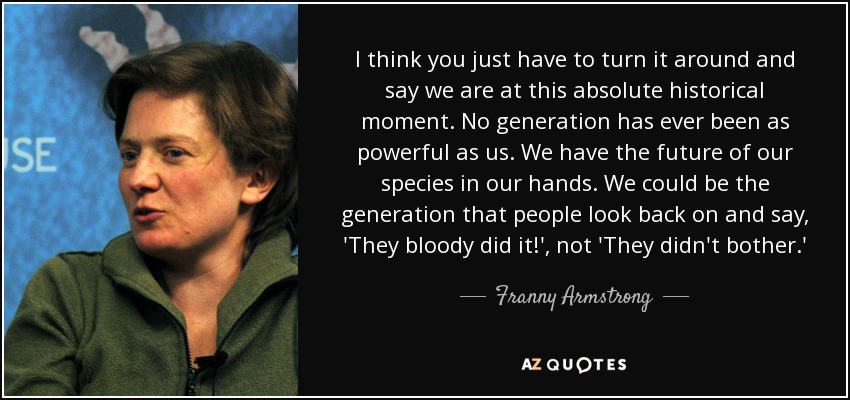
I think you just have to turn it around and say we are at this absolute historical moment. No generation has ever been as powerful as us. We have the future of our species in our hands. We could be the generation that people look back on and say, 'They bloody did it!', not 'They didn't bother.'
There's something really happening and really moving, and it's exciting and it makes me very optimistic because it is going to be the engine for how we really combat climate change. Which is strong communities.
I confess to considerable doubts about the eventual stability of democracy, unless buttressed by constitutional safeguards and a general climate of opinion which thoroughly understands the case for liberty in general
The climate of England has been the world's most powerful colonizing impulse.
For all its enormous range of space, climate, and physical appearance, and for all the internal squabbles, contentions, and strivings, what you northerners never appreciate...is that Texas is so big that you can live your life within its limits and never give a damn about what anyone in Boston or San Francisco thinks.
I have come to the frightening conclusion that I am the decisive element. It is my personal approach that creates the climate.
For me, DJ culture - with its obsession with collecting records and archiving everything - predated the "cloud" concept with primitive material like the mixtape. Now we would call it "collaborative filtering" or something technical, but the impulse is the same - gather fragments, make something new. That is how you will bypass the climate-change skeptics: render them totally obsolete.
Overall, The Population Bomb was probably too optimistic. I was writing about climate change - Anne and I actually wrote the book. We discussed whether or not you'd have to take a gondola to the Empire State Building, and that sort of thing, but we didn't know at the time whether the climate change would be in the direction of heating or cooling. We just didn't know enough about it.
Organisms are starting to move in response to climate change all over the place. Bees are disappearing and we don't have many of the native pollinators left to replace them. We're in deep trouble; there's no question about it. But ecologists tend to think of something that's going to be bad in ten years as very fast, and of course, politicians only think of things in a two-, four-, six-year cycle.
Stanford may be the best university in the world, but you can get all the way through here without knowing where your food came from, without being able to say where we came from, without being able to give a coherent description of why the climate is changing and why we should be concerned about it. So I started teaching a course in human evolution and the environment that's open to all Stanford students, no prerequisites.
Enormous forces are affecting the world, and we can't possibly overestimate their importance. These include demographic developments, climate change, digitalization and the rise of Asia. And then there's the most important one: the end of a life lived on credit. We must finally free ourselves from debt.
It is in fact necessary to reduce CO2 emissions. There is no reason why we shouldn't spend our vacations on (the North Sea island of) Sylt instead of in the Seychelles, or drive more economical cars - for the sake of preserving increasingly scarce resources if nothing else. But that won't enable us to stop climate change. As long as China, India and the United States continue the way they have been, what we Germans do is more or less irrelevant.
We can no longer completely avoid anthropogenic climate change. At best, limiting the temperature rise to two degrees is just about possible, according to optimistic estimates. That's why we should spend more time talking about adjusting to the inevitable and not about reducing CO2 emissions. We have to take away people's fear of climate change.
The fear of climatic catastrophes is an ancient one and not unlike our fear of strangers. In the past, people believed that the climate almost always changes for the worse, and only rarely for the better - God's punishment for sinful behavior.
Unfortunately many scientists see themselves too much as priests whose job it is to preach moralistic sermons to people. This is another legacy of the 1968 generation, which I happen to belong to myself. In fact, it would be better if we just presented the facts and scenarios dispassionately - and then society can decide for itself what it wants to do to influence climate change.
Protecting biodiversity is just as important and critical to the survival of mankind as stabilizing the climate. Species protection and climate are interdependent.
We need a much better understanding of the climate before making policy choices that would impose substantial economic costs on our Nation.
Any so-called leader who does not take this issue (climate change) seriously or treats it like a joke is not fit to lead
Obviously murder and graffiti are two vastly different crimes. But they are part of the same continuum, and a climate that tolerates one is more likely to tolerate the other.
Now is the time to divest and invest to let our world leaders know that we, as individuals and institutions, are taking action to address climate change, and we expect them to do their part this December in Paris at the U.N. climate talks.
It's too late to stop climate change, that's for sure, but we can still influence the degree of changes and the degree of impacts. We can prepare for a softer landing.
Once the impact of climate change becomes visible, politics will react quickly and forcefully. We saw that in Germany in 2002 during the floods on the Elbe River. They, in fact, determined the result of the (general) elections (later that same year).
The response to my op-ed by global warming alarmists has been interesting. Former Vice President Al Gore has called me a "denier" and informs us that climate change is "a principle in physics. It's like gravity. It exists." Perhaps he's right. Climate change is like gravity - a naturally occurring phenomenon that existed long before, and will exist long after, any governmental attempts to affect it.
There's real economic costs to climate change - So, Superstorm Sandy led to billions of dollars in damages. The fires out in the west, 70 million dollars a day are being spent in fighting fires that have clearly been exacerbated by drought and climate change. So, people have pointed out the true dollars and cents cost of inaction on climate change.
No country can solve climate change alone, we have to take global measures.
Follow AzQuotes on Facebook, Twitter and Google+. Every day we present the best quotes! Improve yourself, find your inspiration, share with friends
or simply: