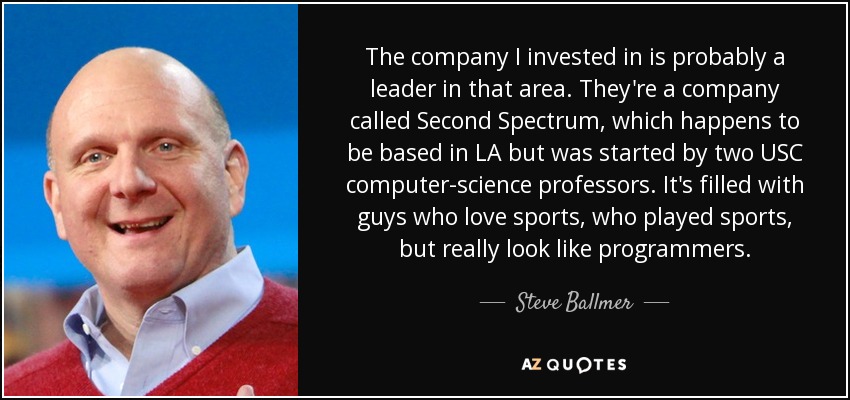
The company I invested in is probably a leader in that area. They're a company called Second Spectrum, which happens to be based in LA but was started by two USC computer-science professors. It's filled with guys who love sports, who played sports, but really look like programmers.
I actually remember very specifically the night that I launched Facebook at Harvard. I used to go out to get pizza with a friend who I did all my computer science homework with. And I remember talking to him and saying I am so happy we have this at Harvard because now our community can be connected but one day someone is going to build this for the world.
Why is computer science a good field for women? For one thing, thats where the jobs are, and for another, the pay is better than for many jobs, and finally, its easier to combine career and family.
It's now up to the states to figure out how they implement that definition of a well-rounded education, in other words, where they spend federal funds. The new law, the Every Student Succeeds Act, has suggestions like computer science, health, foreign language and geography. So there's no guarantee the arts will now flourish. Arts advocates are ready to help states and school districts with their plans.
I'm basically a computer science nerd.
My undergraduate work was in computer science and economics. It just happened to be at that time when 34 percent of computer-science majors were women. We didn't realize it was at the peak at the time.
I had the opportunity, as a child, to grow up in a community center where I was exposed to theater, music, art, and computer science; things that I would have never had the opportunity to even meet had it not been for those people taking time out of their schedules, helping us as children to travel all over the world while sitting in a gymnasium. That's what I did before I was a musician, before I was a recording artist, I was a teacher and a community leader.
You know that Estonia, based largely on how successful Skype was, built by Estonian developers, that was a tenth of the entire country's GDP when eBay bought it. That was like a decade ago, it was f****** Estonia, they were behind the Iron Curtain two decades earlier. They're now pushing for K-12 education in computer science in public schools. They've gotten the message. They know how much value that can bring.
If somebody is working on a new medicine, computer science helps us model those things. We have a whole group here in Seattle called the Institute for Disease Modelling that is a mix of computer science and math-type people, and the progress we're making in polio or plans for malaria or really driven by their deep insights.
My background, I really am a computer hacker. I've studied computer science, I work in computer security. I'm not an actively a hacker, I'm an executive but I understand the mindset of changing a system to get the outcome that you want. It turns out to make the coffee, the problem is actually how the beans get turn into green coffee. That's where most of the problems happen.
When I studied computer science at Duke University in the first half of the 1980s, I had professors who treated women differently than men. I kind of got used to it. At Microsoft, I had to use my elbows and make sure I spoke up at the table, but it was an incredibly meritocratic place. Outside, in the industry, I would feel the sexism. I'd walk into a room and until I proved my worth, everyone would assume that the guy presenting with me had credibility and I didn't.
We are lucky in the United States to have our liberal arts system. In most countries, if you go to university, you have to decide for all English literature or no literature, all philosophy or no philosophy. But we have a system that is one part general education and one part specialization. If your parents say you've got to major in computer science, you can do that. But you can also take general education courses in the humanities, and usually you have to.
I try to learn certain areas of computer science exhaustively; then I try to digest that knowledge into a form that is accessible to people who don't have time for such study.
Drs. Margolis and Fisher have done a great service to education, computer science, and the culture at large. Unlocking the Clubhouse should be required reading for anyone and everyone who is concerned about the decreasing rate of women studying computer science.
The term "informatics" was first defined by Saul Gorn of University of Pennsylvania in 1983 (Gorn, 1983) as computer science plus information science used in conjunction with the name of a discipline such as business administration or biology. It denotes an application of computer science and information science to the management and processing of data, information and knowledge in the named discipline.
I recommend computer science to people who practice meditation. The mental structures that are used in computer science are very similar exercises done in Buddhist monasteries.
The issues involved are sufficiently important that courses are now moving out of the philosophy departments and into mainstream computer science. And they affect everyone. Many of the students attracted to these courses are not technology majors, and many of the topics we discuss relate to ethical challenges that transcend the computer world.
For years, computer scientists were treating operating systems design as sort of an open-reserch issue, when the field's direction had been decided by commercial operations. Computer science has become completely cut off from reality.
Progress in computer science is made with the distribution of revolutionary software systems and the publication of revolutionary books. We don't need a fancy information system to alert us to these grand events; they will hit us in the face. Another good excuse for ignoring the literature is that, since everyone has strong beliefs about fundamentals but can't support those beliefs rationally or consistently convince non-believers, computer science is actually a religion.
A fashionable idea in technical circles is that quantity not only turns into quality at some extreme of scale, but also does so according to principles we already understand. Some of my colleagues think a million, or perhaps a billion, fragmentary insults will eventually yield wisdom that surpasses that of any well-thought-out essay, so long as sophisticated secret statistical algorithms recombine the fragments. I disagree. A trope from the early days of computer science comes to mind: garbage in, garbage out.
Daniel Dennett is our best current philosopher. He is the next Bertrand Russell. Unlike traditional philosophers, Dan is a student of neuroscience, linguistics, artificial intelligence, computer science, and psychology. He's redefining and reforming the role of the philosopher.
Perhaps writers should never be allowed to get together in a workplace context. It's not like studying computer science, after all. The emotions are at large, and are shared and are questioned. There is a vulnerability.
When I'm working on a problem, I never think about beauty. I think only how to solve the problem.
My hope is that in the future, women stop referring to themselves as 'the only woman' in their physics lab or 'only one of two' in their computer science jobs.
[Though computer science is a fairly new discipline, it is predominantly based on the Cartesian world view. As Edsgar W. Dijkstra has pointed out] A scientific discipline emerges with the - usually rather slow! - discovery of which aspects can be meaningfully 'studied' in isolation for the sake of their own consistency.
Follow AzQuotes on Facebook, Twitter and Google+. Every day we present the best quotes! Improve yourself, find your inspiration, share with friends
or simply: