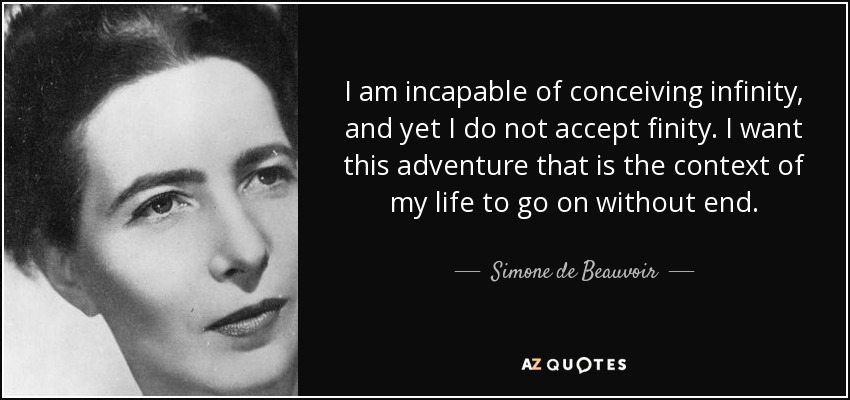
I am incapable of conceiving infinity, and yet I do not accept finity. I want this adventure that is the context of my life to go on without end.
The human species was given dominion over the earth and took the opportunity to exterminate other species and warm the atmosphere and generally ruin things in its own image, but it paid this price for its privileges: that the finite and specific animal body of this species contained a brain capable of conceiving the infinite and wishing to be infinite itself.
He possessed the logic of all good intentions and a knowledge of all the tricks of his trade, and yet he never succeeded at anything, because he believed too much in the impossible. Surprising? Why so? He was forever in the act of conceiving it!
The only reality we can ever truly know is that of our perceptions, our own consciousness, while that consciousness, and thus our entire reality, is made of nothing but signs and symbols. Nothing but language. Even God requires language before conceiving the Universe. See Genesis: “In the beginning was the Word.
I am incapable of conceiving infinity, and yet I do not accept finity.
Is the god the source, or is the god a human manner of conceiving of the force and energy that supports the world? In our tradition God is a male. This male and female differentiation is made, however, within the field of time and space, the field of duality. If God is beyond duality, you cannot say that God is a "He." You cannot say God is a "She." You cannot say God is an "It." (18)
No human being escapes the necessity of conceiving some good outside himself towards which his thought turns in a movement of desire, supplication, and hope.
From the war of nature, from famine and death, the most exalted object which we are capable of conceiving, namely, the production of higher animals, directly follows.
The impossibility of conceiving that this grand and wondrous universe, with our conscious selves, arose through chance, seems to me the chief argument for the existence of God.
When we pray, we must begin by conceiving God in full and vigorous images, but we must go on to acknowledge the inadequacy of them and to adhere nakedly to the imageless truth of God.
Art lies in conceiving and designing, not in the actual execution' - this was left for lesser minds.
The object of all religious activity is to mingle the human and the non-human, and the lower gods represent that which is cast back to the human from the non-human - human gods merely, practice-gods who embody the errors which man makes in first conceiving the non-human.
This merely formal conceiving of the facts of one's own wretchedness is at the same time a departure from them--placing them in the object. It is not idle, therefore, to observe reflexively that in that very Thought, one has separated himself from them, and is no longer that which empirically he still sees himself to be.
No longer can we consider what the artist does to be a self-contained activity, mysteriously inspired from above, unrelated and unrelatable to other human activities. Instead, we recognize the exalted kind of seeing that leads to the creation of great art as an outgrowth of the humbler and more common activity of the eyes in everyday life. Just as the prosaic search for information is "artistic" because it involves giving and finding shape and meaning, so the artist's conceiving is an instrument of life, a refined way of understanding who and where we are.
Yet the most pervasive error one encounters in contemporary arguments about belief in God-especially, but not exclusively, on the atheist side-is the habit of conceiving of God simply as some very large object or agency within the universe, or perhaps alongside the universe, a being among other beings, who differs from all other beings in magnitude, power, and duration, but not ontologically, and who is related to the world more or less as a craftsman is related to an artifact.
The difficulties of economics are mainly the difficulties of conceiving clearly and fully the conditions of utility.
Theism, as a way of conceiving God, has become demonstrably inadequate, and the God of theism not only is dying but is probably not revivable. If the religion of the future depends on keeping alive the definitions of theism, then the human phenomenon that we call religion will have come to an end. If Christianity depends on a theistic definition of God, then we must face the fact that we are watching this noble religious system enter the rigor mortis of its own death throes.
The proper method of philosophy consists in clearly conceiving the insoluble problems in all their insolubility and then in simply contemplating them, fixedly and tirelessly, year after year, without any hope, patiently waiting.
If an organised body is not in the situation and circumstances best adapted to its sustenance and propagation, then, in conceiving an indefinite variety among the individuals of that species, we must be assured, that, on the one hand, those which depart most from the best adapted constitution, will be most liable to perish, while, on the other hand, those organised bodies, which most approach to the best constitution for the present circumstances, will be best adapted to continue, in preserving themselves and multiplying the individuals of their race.
Classical philosophical theism maintained the ontological distinction between God and creative world that is necessary for any genuine theism by conceiving them to be of different substances, with particular attributes predicated of each.
I hold that the mark of a genuine idea is that its possibility can be proved, either a priori by conceiving its cause or reason, or a posteriori when experience teaches us that it is in fact in nature.
It was not the visible sun, but its invisible Creator who consecrated this day for us, when the Virgin Mother, fertile of womb and integral in her virginity, brought him forth, made visible for us, by whom, when he was invisible, she too was created. A Virgin conceiving, a Virgin bearing, a Virgin pregnant, a Virgin bringing forth, a Virgin perpetual. Why do you wonder at this, O man?
I do think that copyrights and intellectual property are important - it's important to be able to keep people from making verbatim copies of a particular creation that could somehow hurt the creator. If I spend time conceiving and making a piece of art and somebody else sees that it has market value and replicates it in order to steal part of my market, then that's not cool.
Once we have taken the backward step to an abstract view of our whole system of beliefs, evidence, and justification, and seen that it works only, despite its pretensions, by taking the world largely for granted, we are not in a position to contrast all these appearances with an alternative reality. We cannot shed our ordinary responses, and if we could it would leave us with no means of conceiving a reality of any kind.
I wish my life and decisions to depend upon myself, not on external forces of whatever kind. I wish to be the instrument of my own, not other men's, acts of will. I wish to be the subject, not an object...I wish to be somebody, not nobody; a doer - deciding, not being decided for, slef-directed and not acted upon by external nature or by other men as if I were a thing, or an animal, or a slave incapable of playing a human role, that is, of conceiving goals and policies of my own and realizing them.
Follow AzQuotes on Facebook, Twitter and Google+. Every day we present the best quotes! Improve yourself, find your inspiration, share with friends
or simply: