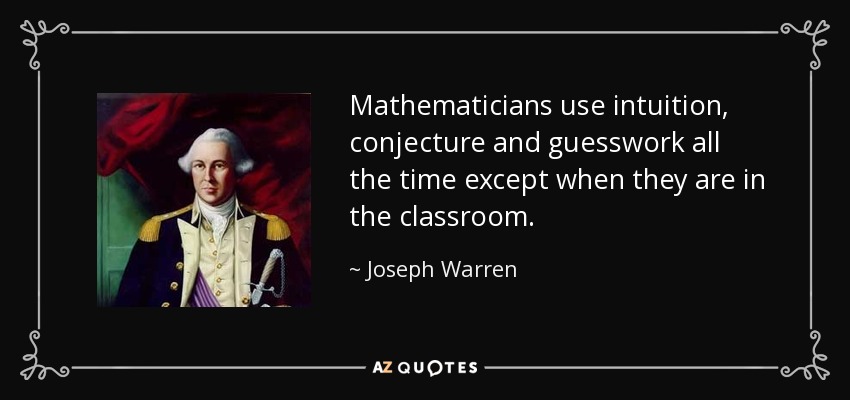
Mathematicians use intuition, conjecture and guesswork all the time except when they are in the classroom.
From the almost total absence of fossil evidence relative to the origin of the phyla, it follows that any explanation of the mechanism in the creative evolution of the fundamental structural plans is heavily burdened with hypothesis. This should appear as an epigraph to every book on evolution. The lack of direct evidence leads to the formulation of pure conjecture as to the genesis of the phyla; we do not even have a basis to determine the extent to which these opinions are correct.
Every conjecture we can form with regard to the works of God has as little probability as the conjectures of a child with regard to the works of an adult.
Such self-transformation is the most difficult and dangerous challenge to the imagination, and it is the most rewarding. Meeting it is only possible for the person whose mind is open to contradictions and well-practiced in free conjecture.
To believe straight away is foolishness, to believe after having seen clearly is good sense. That is the Buddhist policy in belief; not to believe stupidly, or to rely only on people, textbooks, conjecture, reasoning, or whatever the majority believes, but rather to believe what we see clearly for ourselves to be the case. This is how it is in Buddhism.
Ah! my dear Watson, there we come into those realms of conjecture, where the most logical mind may be at fault. Sherlock Holmes speaking with Dr. Watson.
Mathematics is about problems, and problems must be made the focus of a student's mathematical life. Painful and creatively frustrating as it may be, students and their teachers should at all times be engaged in the process - having ideas, not having ideas, discovering patterns, making conjectures, constructing examples and counterexamples, devising arguments, and critiquing each other's work.
In the space of one hundred and seventy-six years the Mississippi has shortened itself two hundred and forty-two miles. Therefore, in the Old Silurian Period the Mississippi River was upward of one million three hundred thousand miles long, seven hundred and forty-two years from now the Mississippi will be only a mile and three-quarters long. There is something fascinating about science. One gets such wholesome returns of conjecture out of such a trifling investment of fact.
It is well to fetter the wings of our fancy and restrain its flights. It is quite possible we may have formed entirely erroneous ideas of what we actually see. The greenish gray patches may not be seas at all, nor the ruddy continents, solid land. Neither may the obscuring patches be clouds of vapor. Man is too quick at forming conclusions. Let him but indistinctly see a thing, or even be undecided as to whether he does actually see it and he will then and there set himself to theorizing, and build immense castles of conjecture on a foundation, of whose existence he is by no means certain.
Everybody liked better to conjecture how the thing was, than simply to know it; for conjecture soon became more confident than knowledge, and had a more liberal allowance for the incompatible.
Scientists have no agreed theory of the origin of life - plenty of scenarios, conjectures and just-so stories, but nothing with solid experimental support.
I desire that your conjectures should not reach beyond your creative will. Could you create a god? Then do not speak to me of any gods.
Ourselves are cosmic and capacious beyond conjecture, and to experience some notion of the planetary perspective is the richest income from travelling. It takes all to inform and educate all. Sallies forth from our cramped firesides into other homes, other hearts, are wonderfully wholesome and enlarging. Travel opens prospects on all sides, widens our horizon, liberates the mind from geographical and conventional limitations, from local prejudices and national, showing the globe in its differing climates, zones, and latitudes of intelligence.
When we seek a textbook case for the proper operation of science, the correction of certain error offers far more promise than the establishment of probable truth. Confirmed hunches, of course, are more upbeat than discredited hypotheses. Since the worst traditions of "popular" writing falsely equate instruction with sweetness and light, our promotional literature abounds with insipid tales in the heroic mode, although tough stories of disappointment and loss give deeper insight into a methodology that the celebrated philosopher Karl Popper once labeled as "conjecture and refutation.
The world, and whatever that be which we call the heavens, by the vault of which all things are enclosed, we must conceive to be a deity, to be eternal, without bounds, neither created nor subject at any time to destruction. To inquire what is beyond it is no concern of man; nor can the human mind form any conjecture concerning it.
Whether a law be void for its repugnancy to the Constitution, is, at all times, a question of much delicacy, which out seldom, if ever, to be decided in the affirmative, in doubtful case. ... But it is not on slight implication and vague conjecture that the legislature is to be pronounced to have transcended its powers, and its acts to be considered as void. The opposition between the Constitution and the law should be such that the judge feels a clear and strong conviction of their incompatibility with each other.
All doctrines relating to the creation of the world, the government of man by superior beings, and his destiny after death, are conjectures which have been given out as facts, handed down with many adornments by tradition, and accepted by posterity as "revealed religion". They are theories more or less rational which uncivilised men have devised in order to explain the facts of life, and which civilised men believe that they believe.
A private man has always the liberty (because thought is free) to believe or not believe in his heart those acts that have been given out for miracles, according as he shall see what benefits can accrue by men's belief, to those that pretend, or countenance them, and thereby conjecture whether they be miracles or lies.
All these delusions of Divination have their root and foundation from Astrology. For whether the lineaments of the body, countenance, or hand be inspected, whether dream or vision be seen, whether marking of entrails or mad inspiration be consulted, there must be a Celestial Figure first erected, by the means of whole indications, together with the conjectures of Signs and Similitudes, they endeavour to find out the truth of what is desired.
There may be a soul of the world, there may be ... a psychical side, of which we are not aware, to every atom in the universe, and the psychical side, like the moon, may show us ever but the one face, the other forever in the shadow; but, at best, this is only a conjecture, it presents no solid foundation upon which to rest a theory.
Their origin is commonly unknown; for the practice often continues when the cause has ceased, and concerning superstitious ceremonies it is in vain to conjecture; for what reason did not dictate, reason cannot explain.
A mathematician experiments, amasses information, makes a conjecture, finds out that it does not work, gets confused and then tries to recover. A good mathematician eventually does so - and proves a theorem.
While the scientist, on the one hand, is concerned with giving a faithful description of facts, on the other, he has the equally important task of construing them in relation to some explanatory conjecture. Similarly the historian has a double duty: both of reporting the past as nearly as possible as it passed or was lived through by men at the time (without doctoring up events to fit later developments or some more "enlightened reading" of them); and second, of interpreting their import in the light of a present hypothesis.
No state sorrier than that of the man who keeps up a continual round, and pries into "the secrets of the nether world," as saith the poet, and is curious in conjecture of what is in his neighbour's heart.
Without the knowledge of the true number of the people, as a principle, the whole scope and use of keeping bills of birth and burials is impaired; wherefore by laborious conjectures and calculations to deduce the number of people from the births and burials, may be ingenious, but very preposterous.
Follow AzQuotes on Facebook, Twitter and Google+. Every day we present the best quotes! Improve yourself, find your inspiration, share with friends
or simply: