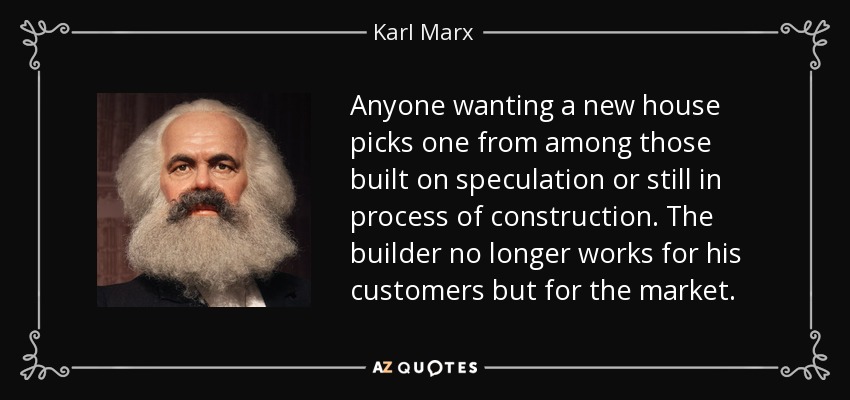
Anyone wanting a new house picks one from among those built on speculation or still in process of construction. The builder no longer works for his customers but for the market.
To mystify, in the active sense, is to befuddle, cloud, obscure, mask whatever is going on, whether this be experience, action, or process, or whatever is "the issue." It induces confusion in the sense that there is failure to see what is "really" being experienced, or being done, or going on, and failure to distinguish or discriminate the actual issues. This entails the substitution of false for true constructions of what is being experienced, being done (praxis), or going on (process), and the substitution of false issues for the actual issues.
In the construction of a country, it is not the practical workers but the idealists and planners that are difficult to find.
When you advance a frontier, you're doing something that no one has done before. Every time that happens, you have to innovate. You have to think in new ways that hadn't been thought before. You have to invent a new piece of hardware, a new concept, a new law of physics, a new material, a new construction material to enable you to accomplish what it is that you chose to reach for by dreaming about tomorrow.
The religion of art, like the religion of politics, was born from the ruins of Christianity. Art inherited from the old religion the power of consecrating things and endowing them with a sort of eternity; museums are our temples, and the objects displayed in them are beyond history. Politics--or more precisely, Revolution--co-opted the other function of religion: changing human beings and society. Art was an asceticism, a spiritual heroism; Revolution was the construction of a universal church.
I get just as excited about building a birdhouse as when providing strategic counsel to a client.
Cities need old buildings so badly it is probably impossible for vigorous streets and districts to grow without them.... for really new ideas of any kind--no matter how ultimately profitable or otherwise successful some of them might prove to be--there is no leeway for such chancy trial, error and experimentation in the high-overhead economy of new construction. Old ideas can sometimes use new buildings. New ideas must use old buildings.
Through algebra you easily arrive at equations, but always to pass therefrom to the elegant constructions and demonstrations which usually result by means of the method of porisms is not so easy, nor is one's ingenuity and power of invention so greatly exercised and refined in this analysis.
Macroscopic objects, as we see them all around us, are governed by a variety of forces, derived from a variety of approximations to a variety of physical theories. In contrast, the only elements in the construction of black holes are our basic concepts of space and time. They are, thus, almost by definition, the most perfect macroscopic objects there are in the universe.
To write music is to raise a ladder without a wall to lean it against. There is no scaffolding: the building under construction is held in balance only by the miracle of a kind of internal logic, an innate sense of proportion.
No way construction of this tricky plan was built by other than a greater hand.
I read not so long ago about the construction of a large telescope in Chile's Atacama Desert, where rainfall can average a millimetre a year and the air is fifty times as dry as the air in Death Valley. Needless to say, skies over the Atacama are pristine. The pilgrim astronomer ventures to the earth's ravaged reaches in order to peer more keenly at other worlds, and I suppose the novelist is up to something similar.
Space and force pervade language. Many cognitive scientists (including me) have concluded from their research on language that a handful of concepts about places, paths, motions, agency, and causation underlie the literal or figurative meanings of tens of thousands of words and constructions, not only in English but in every other language that has been studied.
If you saw me working with construction crews or graphic designers, you'd see how much I'm really hoping for them to bring something to the table and let God in the room and let things happen naturally.
I think that metaphor really is a key to explaining thought and language. The human mind comes equipped with an ability to penetrate the cladding of sensory appearance and discern the abstract construction underneath - not always on demand, and not infallibly, but often enough and insightfully enough to shape the human condition. Our powers of analogy allow us to apply ancient neural structures to newfound subject matter, to discover hidden laws and systems in nature, and not least, to amplify the expressive power of language itself.
The Love Undercover series features two cops, a street rat, and a construction worker as the lead heroes.
While a man is stringing a harp, he tries the strings, not for music, but for construction. When it is finished it shall be played for melodies. God is fashioning the human heart for future joy. He only sounds a string here and there to see how far His work has progressed.
Let not your peace rest in the utterances of men, for whether they put a good or bad construction on your conduct does not make you other than you are.
That fine part of our construction, the eye, seems as much the receptacle and seat of our passions as the mind itself; and at least it is the outward portal to introduce them to the house within, or rather the common thoroughfare to let our affections pass in and out.
Centres, or centre-pieces of wood, are put by builders under an arch of stone while it is in the process of construction till the keystone is put in. Just such is the use Satan makes of pleasures to construct evil habits upon; the pleasure lasts till the habit is fully formed; but that done the habit may stand eternal. The pleasures are sent for firewood, and the hell begins in this life.
There is no word or action but may be taken with two hands,--either with the right hand of charitable construction, or the sinister interpretation of malice and suspicion; and all things do succeed as they are taken. To construe an evil, action well is but a pleasing and profitable deceit to myself; but to misconstrue a good thing is a treble wrong,--to myself, the action, and the author.
A vast deal of ingenuity is wasted every year in evoking the undesirable, in the careful construction of objects which burden life. Frankenstein was a large rather than an isolated example.
For the first time in six or seven thousand years, many people of goodwill find themselves confused about art. They want to enjoy it because enjoying art is something they expect of themselves as civilized persons, but they're unsure how to do so. They aren't even sure which of the visible objects are art and which are furniture, clothes, hors d'oeuvres, or construction rubble, and whether a pile of dead and decomposing rats is deliberate art or just another pile of decomposing rats.
Sometimes I think the resurrection of the body, unless much improved in construction, a mistake!
Quotes are like prompts. A way of searching, connecting the dots. Other people's thinking has always - both positively and negatively - jumpstarted my thinking. Quotes are also a way of acting out not just a text, and not just thinking, but the making of a text. The construction of thinking. The quotes are part of those constructions and reflections. Thinking through quotes, which to say scouring a range of texts for insight, is one way to outline the process of thinking/feeling through a subject.
Follow AzQuotes on Facebook, Twitter and Google+. Every day we present the best quotes! Improve yourself, find your inspiration, share with friends
or simply: