



I would argue that nothing gives life more purpose than the realization that every moment of consciousness is a precious and fragile gift.
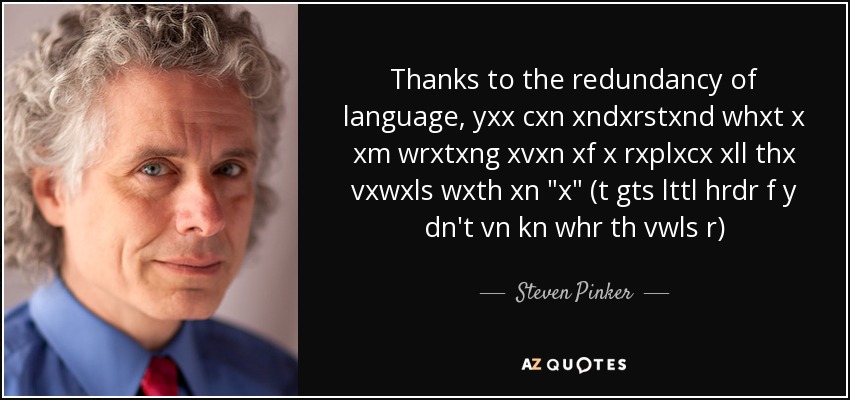
Thanks to the redundancy of language, yxx cxn xndxrstxnd whxt x xm wrxtxng xvxn xf x rxplxcx xll thx vxwxls wxth xn "x" (t gts lttl hrdr f y dn't vn kn whr th vwls r)
We will never have a perfect world, but it's not romantic or naive to work toward a better one.
We instinctively fear snakes, but we appear not to be afraid of fast cars, which are a real danger now. This suggests our emotions were shaped by our evolutionary environment not the one we grew up in.
All our behaviours are a result of neurophysiological activity in the brain. There is no reason to believe there is any magic going on.
Without goals the very concept of intelligence is meaningless
Societies that empower women are less violent in every way.
Reading is a technology for perspective-taking. When someone else's thoughts are in your head, you are observing the world from that person's vantage point.
Cognitive psychology has shown that the mind best understands facts when they are woven into a conceptual fabric, such as a narrative, mental map, or intuitive theory. Disconnected facts in the mind are like unlinked pages on the Web: They might as well not exist.
Babies are born with the instinct to speak, the way spiders are born with the instinct to spin webs. You don't need to train babies to speak; they just do. But reading is different.
Morality comes from a commitment to treat other as we wish to be treated, which follows from the realization that none of us is the sole occupant of the universe.
In our society, the best predictor of a man's wealth is his wife's looks, and the best predictor of a woman's looks is her husband's wealth.
We're living in primate heaven. We're warm, dry, we're not hungry, we don't have fleas and ticks and infections. So why are we so miserable?
We are visual creatures. Visual things stay put, whereas sounds fade.
Cognitive psychology tells us that the unaided human mind is vulnerable to many fallacies and illusions because of its reliance on its memory for vivid anecdotes rather than systematic statistics.
Most wars are not fought over shortages of resources such as food and water, but rather over conquest, revenge, and ideology.
Reason is non-negotiable. Try to argue against it, or to exclude it from some realm of knowledge, and you've already lost the argument, because you're using reason to make your case. ... We don't "believe" in reason.
Violent movements attract thugs and firebrands who enjoy the mayhem. Violent tactics provide a pretext for retaliation by the enemy and alienate third parties who might otherwise support the movement.
What a dull universe it would be if everything in it conformed to our expectations, if it held nothing to surprise or baffle us or confound our common sense. A century ago no one foresaw the existence of black holes, an expanding universe, oceans on Jupiter's moons, or DNA. What could be more enriching than to know that we share a common origin with all living things, that we are kin to chimpanzees, redwoods and mollusks? And isn't it a source of wonder to realize that the iron in our blood and the calcium in our bones were created in the bellies of supernovas?
It's natural to think that living things must be the handiwork of a designer. But it was also natural to think that the sun went around the earth. Overcoming naive impressions to figure out how things really work is one of humanity's highest callings.
Knowing there is a world that will outlive you, there are people whose well-being depends on how you live your life, affects the way you live your life, whether or not you directly experience those effects. You want to be the kind of person who has the larger view, who takes other people's interests into account, who's dedicated to the principles that you can justify, like justice, knowledge, truth, beauty and morality.
Being smarter gives you a tailwind throughout life. People who are more intelligent earn more, live longer, get divorced less, are less likely to get addicted to alcohol and tobacco, and their children live longer.
All of the violence that doesn't occur doesn't get reported on the news.
After their return from Babylon, the practice of human sacrifice died out among the Jews, but survived as an ideal in one of its break-away sects, which believed that God accepted the torture-sacrifice of an innocent man in exchange for not visiting a worse fate on the rest of humanity. The sect is called Christianity.
The theory that religion is a force for peace, often heard among the religious right and its allies today, does not fit the facts of history.
Follow AzQuotes on Facebook, Twitter and Google+. Every day we present the best quotes! Improve yourself, find your inspiration, share with friends
or simply: