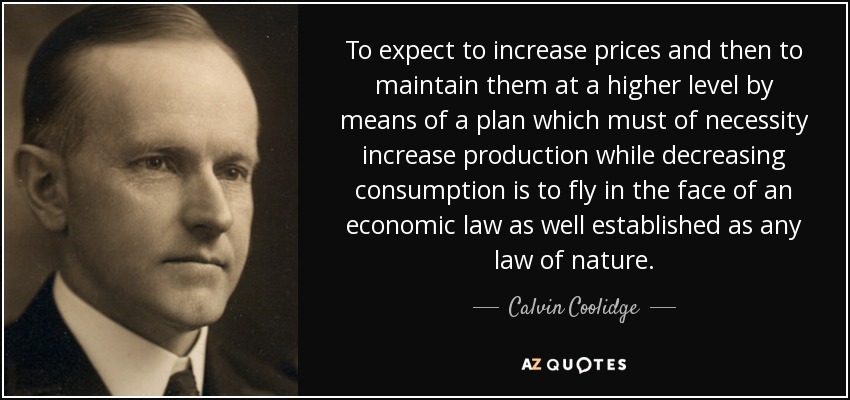
To expect to increase prices and then to maintain them at a higher level by means of a plan which must of necessity increase production while decreasing consumption is to fly in the face of an economic law as well established as any law of nature.
The hippie is the scion of surplus value. The dropout can only claim sanctity in a society which offers something to be dropped out of--career, ambition, conspicuous consumption. The effects of hippie sanctimony can only be felt in the context of others who plunder his lifestyle for what they find good or profitable, a process known as rip-off by the hippie, who will not see how savagely he has pillaged intricate and demanding civilizations for his own parodic lifestyle.
The Cairo conferenceis about a complicated web of education and employment, consumption and poverty, development and health care. It is also about whether governments will follow where women have so clearly led them, toward safe, simple and reliable choices in family planning. While Cairo crackles with conflict, in the homes of the world the orthodoxies have been duly heard, and roundly ignored.
It's all very Italian (and decidedly un-American): to insist that doing the right thing is the most pleasurable thing, and that the act of consumption might be an act of addition rather than subtraction.
My job is for the people. It's for the public. It's for their consumption. So I've done a lot in that way, and I see that the hard work has finally paid off.
Consumption is a social relationship, the dominant relationship in our society-one that makes it harder and harder for people to hold together, to create community.
What I think about is what people spend their time on this planet doing. So No.1 is sleep, No.2 is work, and No.3 is sight, sound, and motion video consumption. Basically, four to five hours a day is what Americans spend consuming video.
I should like to suggest that at least on the face of it a stroke by stroke story of a copulation is exactly as absurd as a chew by chew account of the consumption of a chicken's wing.
Television thus illustrates the mixed blessings of technological change in American society. It is a new medium, promising extraordinary benefits: great educational potential, a broadening of experience, enrichment of daily life, entertainment for all. But it teaches children the uses of violence, offers material consumption as the answer to life's problems, sells harmful products, habituates viewers to constant stimulation, and undermines family interaction and other forms of learning such as play and reading.
As much as possible, and this as quickly as possible: that is what the great mental and emotional illness craves that is variously called "present" or "culture," but that is actually a symptom of consumption.
The pace of consumption, waste and environmental change has so stretched the planet's capacity that our contemporary lifestyle, unsustainable as it is, can only precipitate catastrophes, such as those which even now periodically occur in different areas of the world ... we need to reflect on our accountability before those who will have to endure the dire consequences.
I really believe we in the music industry can work together to find a way to bond technology with integrity and just really hope we can teach the younger generation the value of investment in music rather than the ephemeral consumption of it.
Humans build their societies around consumption of fossil water long buried in the earth, and these societies, being based on temporary resources, face the problem of being temporary themselves.
Although population and consumption are societal issues, technology is the business of business. If economic activity must increase tenfold over what it is today to support a population nearly double its current size, then technology will have to reduce its impact twenty-fold merely to keep the planet at its current levels of environmental impact. For example, to stabilize the climate we may have to reduce real carbon emissions by as much as 80 percent, while simultaneously growing the world economy by an order of magnitude.
The essence of the problem is about consumption, recognizing that a society that consumes one-third of the world's resources is unsustainable. This level of consumption requires constant intervention into other people's lands. That's what's going on.
Unrestrained automobility, hedonism, individualism, and conspicuous consumption cannot be sustained because they take more than they give back. A spiritually impoverished world cannot be sustained because meaninglessness, anomie, and despair will corrode the desire to be sustained and the belief that humanity is worth sustaining. But these are the very things that distinguish the modern age from its predecessors, Genuine sustainability, in other words, will come not from superficial changes but from a deeper process akin to humankind growing up to a fuller stature.
Man today is fascinated by the possibility of buying, more, better, and especially, new things. He is consumption hungry... To buy the latest gadget, the latest model of anything that is on the market, is the dream of everybody, in comparison to which the real pleasure in use is quite secondary. Modern man, if the dared to be articulate about his concept of heaven, would describe a vision which would look like the biggest department store in the world.
The effect of the post-Enlightenment project for human society is that all human activity is absorbed into labor. It becomes an unending cycle of production for the sake of consumption. The modern concept of "built-in obsolescence" makes this clear. The cycle of production and consumption has to be kept going, and the work of the artist or craftsman who aims to create something enduring becomes marginal to the economic order.
Likewise, the world of action, of politics, is reduced to a conflict of views about how to keep the cycle of production and consumption going. Questions of ultimate purpose are excluded from the public world.
The illusion that mechanical progress means human improvement ... alienates us from our own being and our own reality. It is precisely because we are convinced that our life, as such, is better if we have a better car, a better TV set, better toothpaste, etc., that we condemn and destroy our own reality and the reality of our natural resources. Technology was made for man, not man for technology. In losing touch with being and thus with God, we have fallen into a senseless idolatry of production and consumption for their own sakes.
Excess consumption doesn't make people happy. We can continue to provide for our needs, but we can't continue the endless pursuit of ever more consumer goods. There is no energy source that can provide enough consumer goods to meet our human and emotional needs; there never has been, and that's why it's been such a fruitless pursuit.
Statistics compiled by the German Federal Motor Transport Authority highlight how successfully we have reduced fuel consumption. A few years ago, the CO2 emissions for the BMW brand were at well over 200 grams per kilometer. In 2009, that number was at 159 grams. This puts us below our direct competitors.
BMW models are more powerful on average than competitors. This is precisely what we are aiming for: less fuel consumption and more driving pleasure.
In the European Union, a fleet average of 95 grams of CO2 per kilometer will be permitted in 2020. This corresponds to fuel consumption of about four liters (per 100 kilometers; about 59 mpg). We have to continue reducing the fuel consumption of our vehicles and offer hybrid and electric vehicles, or else we will be unable to achieve these values.
Every day we hear about a new invention here and there and they are reducing considerably their consumption of oil. But the day they use hydrogen for transportation, this is the day that oil disappears.
Follow AzQuotes on Facebook, Twitter and Google+. Every day we present the best quotes! Improve yourself, find your inspiration, share with friends
or simply: