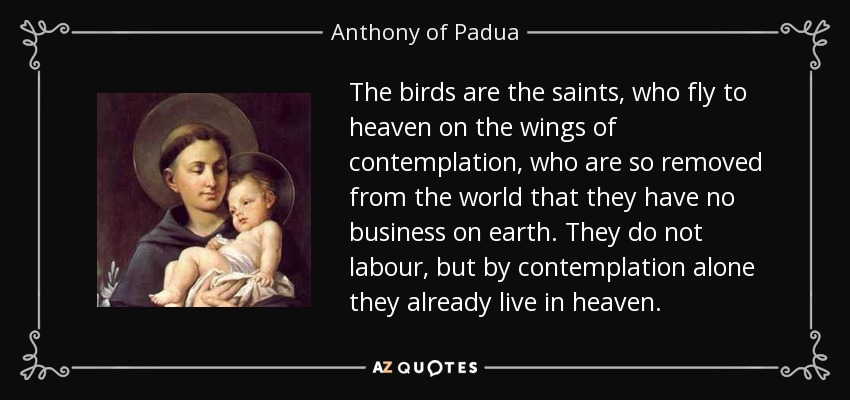
The birds are the saints, who fly to heaven on the wings of contemplation, who are so removed from the world that they have no business on earth. They do not labour, but by contemplation alone they already live in heaven.
The animal has its happiness in the senses, the human beings in their intellect, and the gods in spiritual contemplation. It is only to the soul that has attained to this contemplative state that the world really becomes beautiful.
Contemplation for an hour is better than formal worship for sixty years.
When you can discover where the fresh colors of the faded flower abide, or the music of the broken lyre, seek life among the dead. Such are the anxious and fearful contemplations of the common observer, though the popular religion often prevents him from confessing them even to himself.
To arrive at the simplest truth, as Newton knew and practiced, requires years of contemplation. Not activity Not reasoning. Not calculating. Not busy behaviour of any kind. Not reading. Not talking. Not making an effort. Not thinking. Simply bearing in mind what it is one needs to know.
In the contemplation of beauty we are raised above ourselves, the passions are silenced and we are happy in the recognition of a good that we do not seek to possess.
So in life, some enter the services of fame and others money, but the best choice is that of those few who spend their time in the contemplation of nature, and as lovers of wisdom.
Through humility, soul-searching, and prayerful contemplation we have gained a new understanding of certain dogmas. The church no longer believes in a literal hell where people suffer. This doctrine is incompatible with the infinite love of God. God is not a judge but a friend and a lover of humanity. God seeks not to condemn but only to embrace. Like the fable of Adam and Eve, we see hell as a literary device. Hell is merely a metaphor for the isolated soul, which like all souls ultimately will be united in love with God.
Leaving behind the false, return to the true: make no discriminations between self and others. In contemplation, one's mind should be stable and unmoving, like a wall.
The highest form of praise you can offer to yourself, to God and to the world is to spend time each day expressing gratitude. It says to God that you are aware and appreciative of grace. It says to life that you are acknowledging its awesome presence in you. It says to yourself that you are worth the time it takes to be healed. Time spent in silence, contemplation and gratitude is time spent in devotion to a higher calling and a more loving state of being.
Childhood is only the beautiful and happy time in contemplation and retrospect: to the child it is full of deep sorrows, the meaning of which is unknown.
Self-contemplation is apt to end in self-conceit.
Instead of yielding to idle conversation it might profit one to cultivate silence and contemplation.
A contemplation of God's works, a generous concern for the good of mankind, and the unfeigned exercise of humility only, denominate men great and glorious.
The mind is sicker than the sick body; in contemplation of its sufferings it becomes hopeless. [Lat., Corpore sed mens est aegro magis aegra; malique In circumspectu stat sine fine sui.]
I want to yell about it most days and stop strangers in the street to share my outrage. But my mind is too serpentine to offer instant poem reactions. I can however stand back and examine the deeper ground, or at least that's what I hope my poems are doing. I believe contemplation can be an ethical act and literature can be a profound agent of cultural change, so I hope in some way my poems expand the conversations about environmental decline and social responsibility.
Self knowledge is best learned not by contemplation, but by action.
When love has carried us above all things ... we receive in peace the Incomprehensible Light, enfolding us and penetrating us. What is this Light, if it be not a contemplation of the Infinite, and an intuition of Eternity? We behold that which we are, and we are that which we behold; because our being, without losing anything of its own personality, is united with the Divine Truth.
Probably the undertaker thinks less of death than almost any other man. He is so accustomed to it that his mind must involuntarily turn from its horror to a contemplation of how much he makes out of the burial.
Good-nature is that benevolent and amiable temper of mind which disposes us to feel the misfortunes and enjoy the happiness of others, and, consequently, pushes us on to promote the latter and prevent the former; and that without any abstract contemplation on the beauty of virtue, and without the allurements or terrors of religion.
That virtue therefore which is but a youngling in the contemplation of evil, and knows not the utmost that vice promises to her followers, and rejects it, is but a blank virtue, not a pure; her whiteness is but an excremental whiteness.
Art itself is essentially ethical; because every true work of art must have a beauty or grandeur of some kind, and beauty and grandeur cannot be comprehended by the beholder except through the moral sentiment. The eye is only a witness; it is not a judge. The mind judges what the eye reports to it; therefore, whatever elevates the moral sentiment to the contemplation of beauty and grandeur is in itself ethical.
It is better to spend one day contemplating the birth and death of all things than a hundred years never contemplating beginnings and endings.
O admirable necessity! O powerful action! What mind can penetrate your nature? What language can express this marvel? None, to be sure. This is where human discourse turns toward the contemplation of the divine.
From the first shock of the contemplation of a face depends the principal sensation which guides me throughout the entire execution of a portrait.
Follow AzQuotes on Facebook, Twitter and Google+. Every day we present the best quotes! Improve yourself, find your inspiration, share with friends
or simply: