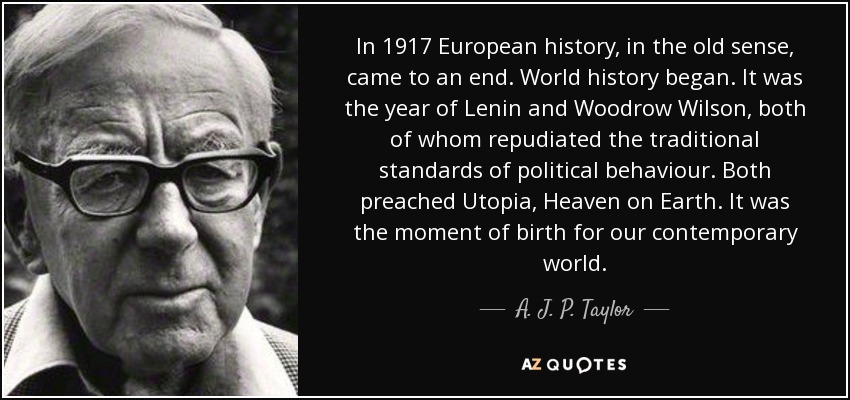
In 1917 European history, in the old sense, came to an end. World history began. It was the year of Lenin and Woodrow Wilson, both of whom repudiated the traditional standards of political behaviour. Both preached Utopia, Heaven on Earth. It was the moment of birth for our contemporary world.
Consider the cost when Christians ignore Jesus commands to sell their possessions and give to the poor and instead choose to spend their resources on better comforts, larger homes, nicer cars, and more stuff. Consider the cost when these Christians gather in churches and choose to spend millions of dollars on nice buildings to drive up to, cushioned chairs to sit in, and endless programs to enjoy for themselves. Consider the cost for the starving multitudes who sit outside the gate of contemporary Christian affluence.
It is a paradox in the contemporary world that in our desire for peace we must willingly give ourselves to struggle.
I simply love classic design when it's reinterpreted. These collections reflect the spirit of this design philosophy; clean pared down lines and forms rooted in tradition yet made to feel new and modern with unexpected or stylized scale, finishes and detailing. This contemporary take on tradition creates a look that's at once current yet timeless, fresh yet familiar…the essence of both beautiful design and a beautifully designed home.
The cacophony of contemporary popular culture makes it hard to discern the call of truth and wisdom. There is no area in which practicing asceticism is more important.
The most striking feature of contemporary culture is the unslaked craving for transcendence.
Through luminous and erudite readings of the texts, Hasana Sharp shows us how profound and radical is Spinoza's conception of nature and his claim that humans always remain part of nature, acting solely according to the same rules. She demonstrates the political consequences of adopting this perspective through a provocative intervention in contemporary feminist theory, while along the way opening promising avenues for future work in a variety of other fields, such as animal studies and ecology. This is a challenging and important book.
In a world where concepts are so often deployed in an ad hoc fashion, half explored before being displaced by others, it is immensely refreshing to encounter such serious and sustained attention to the building blocks of inquiry—and to the responsibilities thereby incurred. Designs on the Contemporary is a work of profound importance to the philosophy of anthropology. In conjunction with Rabinow’s other works, it creates a nonpareil, a configuration of thought with no equal.
My aim is to communicate with the last man in the audience. Art minus communication is meaningless. The term 'abhinaya' is not just facial expressions. It means drawing the spectator to an idea. Look at the modern advertisements. It's contemporary abhinaya. But one who creates should know what has to be completely and what has to be suggestively portrayed. That is ethical aesthetics. The Natyasastra says a production must be such that a family should be able to watch it together.
It is easy enough to write and talk about God while remaining comfortable within the contemporary intellectual climate. Even people who would call themselves unbelievers often use the word gesturally, as a ready-made synonym for mystery. But if nature abhors a vacuum, Christ abhors a vagueness. If God is love, Christ is love for this one person, this one place, this one time-bound and time-ravaged self.
The style, often found difficult in the earlier books, is just as individual but more perfectly modulated to experience, and the dialogue is much closer to contemporary idiom, especially when those cadences have been masterfully twisted to satirical ends.
Imprisonment in the contemporary is the worst of all intellectual tyrannies.
Morley is one of the outstanding voices of her generation, as a singer, songwriter and bandleader she's in a class of her own, transcends all categories and is making a major contribution to contemporary music.
The mathematic, then, is an art. As such it has its styles and style periods. It is not, as the layman and the philosopher (who is in this matter a layman too) imagine, substantially unalterable, but subject like every art to unnoticed changes form epoch to epoch. The development of the great arts ought never to be treated without an (assuredly not unprofitable) side-glance at contemporary mathematics.
Homo sapiens Yuck You contemporary fools laugh at religious and political lies spewed by sociopaths, lies that tether you forever to poverty and mediocrity. Yet, when your ears come upon the truth, the facts of life, you hide your faces and cry, not able
One of those blocks (that prevent the 'Middle East from entering the mainstream of modernity') is the orthodox tenet that the Koran and the scriptures contain all the knowledge required to deal with the problems of contemporary society.
Somewhere a portion of contemporary art has to exist as an example of what the art and its context were meant to be.
Like contemporary poetry, philosophy is one of those things, especially at the beginning stages, most people would rather do than study - which is why most of what gets done is so impoverished.
The denial of contemporary genius is the rule rather than the exception. No one counts the eagles in the nest, till there is a rush of wings; and lo! they are flown.
The idea of an isolated American painting , so popular in this country during the thirties, seems absurd to me, just as the idea of a purely American mathematics or physics would seem absurd... And in another sense, the problem doesn't exist at all; or, if it did, would solve itself: An American is an American and his painting would naturally be qualified by the fact, whether he wills or not. But the basic problems of contemporary painting are independent of any one country.
The problem of meaning today is the problem of how the diverse and superficially self-contradictory experiences of men can be put into a consistent picture that will provide contemporary man with a convincing basis from which to live and to act.
Contemporary philosophers have exercised themselves with the problem of our knowledge of other minds. Enmeshed in the dogma of the ghost in the machine, they have found it impossible to discover any logically satisfactory evidence warranting one person in believing that there exist minds other than his own. I can witness what your body does, but I cannot witness what your mind does, and my pretensions to infer from what your body does to what your mind does all collapse, since the premises for such inferences are either inadequate or unknowable.
Contemporary culture is not very good on responsibility.
I grew up listening to Patsy Klein, Reba Mcentire and would study their voices. But once I became bored with that, I moved on to more contemporary stuff like Sheryl Crow and I combined everything that I had learned from country and rock and made this CD.
Much modern art is, at first sight, unnerving... in the contemporary world, we have come to expect instant response and immediate understanding.
Follow AzQuotes on Facebook, Twitter and Google+. Every day we present the best quotes! Improve yourself, find your inspiration, share with friends
or simply: