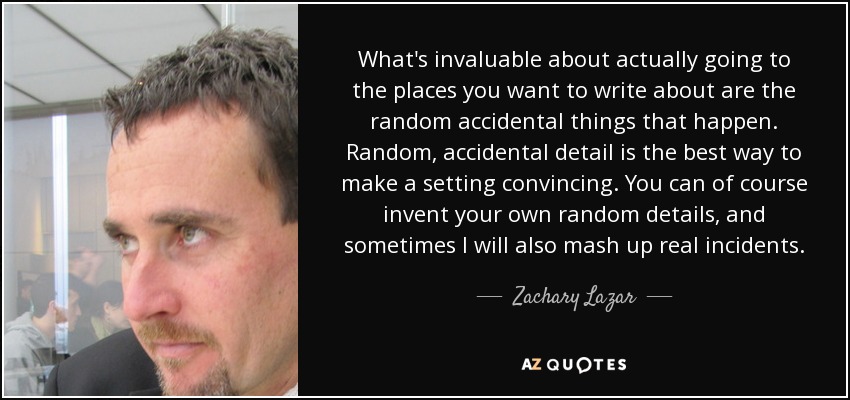
What's invaluable about actually going to the places you want to write about are the random accidental things that happen. Random, accidental detail is the best way to make a setting convincing. You can of course invent your own random details, and sometimes I will also mash up real incidents.
My interest, perhaps, came out of the trauma of being a young immigrant in this country and constantly feeling my "resident alien" status. I remember trying to learn English on kindergarten playgrounds. I tried hard to be a convincing American but it was a losing battle. I was labeled weird and that tag never left me - all through high school, I was always the oddball. It was not always an easy path - I just had to tell myself that one day, being on the periphery would become an asset (and I think it finally has, as a creative adult).
I was aware that I had to pay off things in a convincing emotional fashion, that I had to address the lingering plot points in some real tangible sense, and that I had to make this a self-contained novel, in case I'm run over by a bus tomorrow or in case there's no demand for anyone to ever see a sequel. (Two things that I hope don't happen, incidentally.)
I sometimes have to write for a while before I figure it out, pretend that I know what I'm doing, sort of like ad-libbing on stage until you remember your line - you hope you sound convincing to the audience. The key is to have enough material, enough threads, so that there's something that can be satisfyingly drawn to a conclusion.
So many of the stories are about perspective and viewpoint. It's not just about seeing and revelation. The idea of having many different stories from many different perspectives has something to do with me trying to deal with the impossibility of having a wide enough view to say anything really convincing on that scale.
The only way I was allowed to play was by convincing bands to let me do a few songs while they set up. That went on for years.
What the apartheid system was really good at doing was convincing groups to hate one another.
What you were singing about was believable and convincing, that's the key to a great singer.
On Facebook, a lie can seem as convincing to some as an article from SPIEGEL or the Washington Post. That's a problem. I can then like it and like it again and start creating my own media universe, both for me and for my friends, and so we become more and more fenced off from one another.
I don't speak cockney and I don't pretend to come from that part of the world. For the longest time the English, like the Beatles and so on sounded American. "She loves you yeah yeah yeah!" All of the sudden you sound American. It doesn't work that way with Americans who try to sing English. It's not convincing. If I say "Footy" and "tele" and "Brissy" and "Sydney" and "Simmo" it's not convincing.
Once people know that you can spend the money and that you're willing to spend the money and that you're set up to spend the money in politics, then your threat to spend the money is as convincing as actually spending it.
I think that today's books, in which every quote, every conversation, is taken from a memoir, an autobiography, an interview, or what-have-you, are much more convincing.
D.H. Lawrence, I think, defined the difference between writing an article and writing a novel very well. He said, in writing a novel, the writer must be able to identify emotionally and intellectually with two or three or four contradicting perspectives and give each of them very a convincing voice. It's like playing tennis with yourself and you have to be on both sides of the yard. You have to be on both sides, or all sides if there are more than two sides.
Usually, with a novel, you start with no idea what to do because your job is to create convincing characters and then they just run around getting crazy. The problem with writing a memoir, obviously, is you can't do that because you sort of know what's going to happen. Because you're the character.
I think that as poets, we can get away with stuff because we can ride on the melt of metaphor. We cover a lot of terrain psychically and temporally and linguistically via metaphor, and that can be a stand-in for an argument, whereas in prose, you have to make the argument, and you have to be convincing because the sequence must make sense in time and purpose.
That's not a convincing argument. Public sector jobs are cyclical. Teachers get fired when money is tight, then rehired when things get better. Manufacturing jobs, on the other hand, aren't coming back. They're relics of a past age.
Follow AzQuotes on Facebook, Twitter and Google+. Every day we present the best quotes! Improve yourself, find your inspiration, share with friends
or simply: