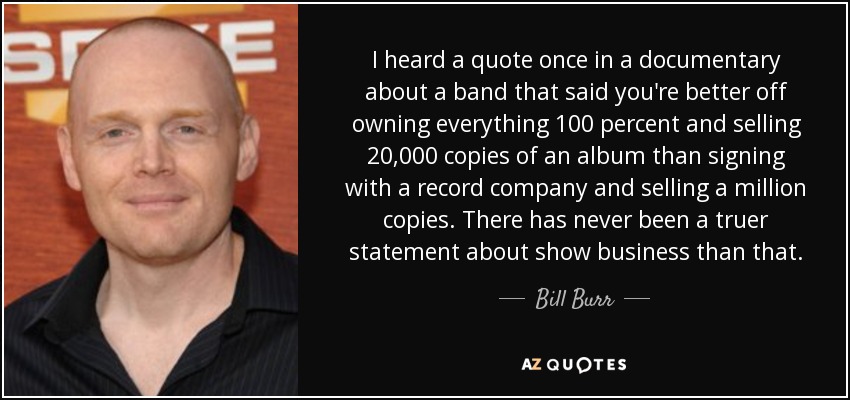
I heard a quote once in a documentary about a band that said you're better off owning everything 100 percent and selling 20,000 copies of an album than signing with a record company and selling a million copies. There has never been a truer statement about show business than that.
By exposing the multiplicity, the facticity, the repetition and stereotype at the heart of every aesthetic gesture, photography deconstructs the possibility of differentiating between the original and the copy. [Photography calls] into question the whole concept of the uniqueness of the art object, the originality of the author, the coherence of the oeuvre within which it was made, and the individuality of so-called self-expression.
I am all emptiness and futility. I am an empty stranger, a carbon copy of my form. I can no longer find what I'm looking for outside of myself. It doesn't exist out there. Maybe it's only in here, inside my head. But my head is glass and my eyes have stopped being cameras, the tape has run out and nobody's words can touch me.
When I was having my hair and make-up done backstage at a fashion show, I would sneak in a copy of Dostoevsky and read it inside a copy of Elle or Vogue. But it would be pretentious of me to say I was more intelligent than the other supermodels.
I think if you steal well, you're a genius. If you copy badly, you're a hack.
The idea is not to copy nature, but to give a feeling of nature.
We all are influenced by things and copy things, but often where there is a certain level of copying, only the surface value ends up being reproduced and that becomes thinner and thinner. I feel like a lot of appropriation suffers from that.
Before I even took pictures I knew that I wanted to have them as hard copy memories.
A photographer doesn't just copy reality, but communicates to others what he or she experiences.
I was really crying the morning after the indication. However I am over that now. Nevertheless, I am proud for it to be in the Rock and Roll hall of fame. But I've got two copies of the guitar now, to remind of the original Teardrop.
I started playing guitar at the age of 8 or 9 years. Very early, and I was like already into pop music and was just trying to copy what I heard on the radio. And at a very early age I started experimenting with old tape recorders from my parents. I was 11 or 12 at that time and then when I was like 14 or 15 I had a punk band. I made all the classic rock musician's evolutions and then in the early nineties I bought my first sampler and that is how I got into electronic music, because I was able to produce it on my own. That was quite a relief.
I've been making Bass Communion music longer than any kind of other music. I don't know if you picked up a copy of a vinyl release I put out a couple of years ago of something called Altamont.
I started writing when I was 5 years old. I would dictate stories to my mother, and she would copy them in a scrapbook. If she changed anything to make it, in her opinion, better, I would throw a tantrum.
We still haven't gotten the message; we still don't see that it's bad. And then we copy everything about their [Roman Empire] structure. I mean Paul Bremer was the proconsul of Iraq. We're still using ancient terminology, we still have Senators and we have an Emperor, almost.
I would say that everyone that you see who is successful in the mainstream, at the top of Billboard, who has a Top 40 hit... at some point, unless they're a complete fabrication of the industry with no identity of their own and a carbon copy clone of someone else, they in themselves started out being underground.
Plastic metaphors and carbon copy similes that aren't going to do anything for anybody and it doesn't showcase creativity; it showcases the fact that the soul of the music has been compromised to control the industry.
My daughter is a practicing physician so believe me I get a lot of the frustration from her. You get it from patients. For me personally, when I ask my doctor to send me my record, what I get is a scanned PDF of his hard copy! This is not good. It would be hopeless to work with a million people if you had to do this on paper, and one of the reasons this is the right time for this is because of the existence of EHRs.
Every single element in an advertisement - headline, subhead, photo, and copy - must be put there not because it looks good, not because it sounds good, but because testing has shown that it works best!
If you use a poor headline, it does not matter how hard you labor over your copy because your copy will not be read.
If the headline is a good one, it is a relatively simple matter to write the copy.
Readers know what the copy is going to say.
Every copywriter knows what it is to struggle with a copy for hours, for days - fixing it, polishing it, rearranging it. We have all been quilty of leaving the headline until the last and the spending half and hour on it - or perhaps only ten minutes.
When liberal celebs stammer out a litany of shopworn bleats about the administration's attempt to turn America into a theocratic prison state, people can't help but notice that these buskers and mummers seem unmoved by the horrors of actual prison states. (Saddam commissioned a copy of the Quran written in his own blood - but John Ashcroft is the real religious nut, don't you know.)
As for developing a writing style'I would say that I tried to copy the pacing of the old movies I loved as a kid.
There's not a lot of precedent for weird, bald musicians in the Lower East Side making records in their bedrooms and going on to sell a lot of copies of the record. Especially if you look at the pop climate.
Follow AzQuotes on Facebook, Twitter and Google+. Every day we present the best quotes! Improve yourself, find your inspiration, share with friends
or simply: