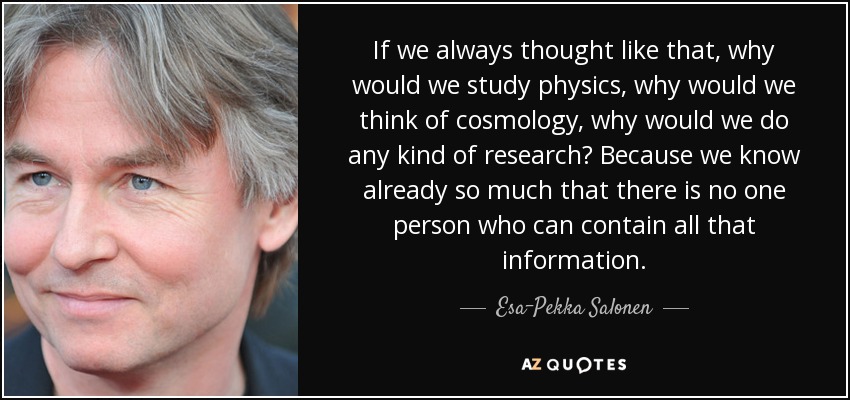
If we always thought like that, why would we study physics, why would we think of cosmology, why would we do any kind of research? Because we know already so much that there is no one person who can contain all that information.
Often, when I want to read something that is satisfying to me as theology, what I actually read is string theory, or something like that - popularizations, inevitably, of scientific cosmologies - because their description of the scale of things and the intrinsic, astonishing character of reality coincides very beautifully with the most ambitious theology. It is thinking at that scale, and it is thinking that is invested with meaning in a humanly evocative form. That's theology.
I think there's a shamanic temperament, which is a person who craves knowledge, knowledge in the Greek sense of gnosis. In other words, knowledge not of the sort where you subscribe to Scientific American, and it validates what you believe, but cosmologies constructed out of immediate experiences that are found to be always applicable.
Certainly neo-Platonism, Plotinus and Porphyry and that school are psychedelic philosophers. Their idea of an ascending hierarchy of more and more rarefied states is a sophisticated presentation of the shamanic cosmology, which is the cosmology that one experientially discovers when they involve themselves with psychedelics.
Ironically, members on both sides of the debate do agree about one thing: big bang cosmology puts their position in jeopardy. The big bang poses a problem for young-earth creationists because it makes the universe billions of years old rather than thousands. Such an assertion undercuts their system at its foundation. Big bang cosmology also presents a problem for atheistic scientists because it points directly to the existence of a transcendent Creator - a fact they dare not concede.
Cosmologies are made up of small snippets of physical reality that have been remodeled by society into vast cosmic deceptions.
What we're starting to see is a quantum biology, it being applied in biology and cosmology and a host of other sciences, because it does really pertain to how we know. It really helps bring epistemology, which is how do we know what we know, out of the realm of philosophy and brings it into the realm of science.
At times, Zen does get into some Buddhist Cosmology. Nishijima Roshi, my main teacher would talk about that and almost every time immediately say that it was only one way of looking at it. Whenever addressing realms of Heaven or Hell, he'd also address that it was just a psychological state.
In the cosmology that's behind psychology, there is no reason for anyone to be here or do anything.
Follow AzQuotes on Facebook, Twitter and Google+. Every day we present the best quotes! Improve yourself, find your inspiration, share with friends
or simply: