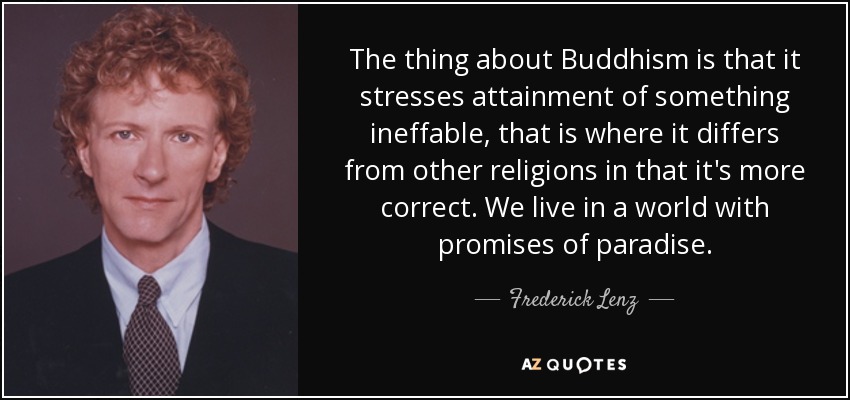
The thing about Buddhism is that it stresses attainment of something ineffable, that is where it differs from other religions in that it's more correct. We live in a world with promises of paradise.
As long as we remain self-reflective and keep looking at who and what we are, as long as we keep our analysis that way, then there's no freedom. We're just trying clothes on in front of a mirror and admiring them.
Buddhism is the study of the way the mind works. One has to be able to hold a large number of relational concepts simultaneously in the mind. It is necessary to grid, to literally unlock realities and dimensions with the power of your mind.
I'm not an historian but I'll venture an opinion: Modern cosmology really began with Darwin and Wallace. Unlike anyone before them, they provided explanations of our existence that completely rejected supernatural agents... Darwin and Wallace set a standard not only for the life sciences but for cosmology as well.
I have an excuse to show off my love of history, and my interest in cosmology.
Like mathematics and music and cosmology and philosophy, poetry, too, can "infinitize" us, granting us what immortality there is to be had in this mortal life. And all those who vibrate in harmony to language that itself vibrates to the harmonies of the infinite are entitled to inclusion among the "small group of people.
Natural history is not taught in seminary. This is curious, as most people in pastoral ministry are about 567 times more likely to be asked about cosmology or sub-nuclear physics or human biology or evolution than they are to be asked about irregular Greek verbs or the danger of the patripassionist heresy. If we monotheists are going to go around claiming that our "God made the heaven and the earth," it is not unreasonable to expect us to know something about what that heaven and earth actually are.
For ten years, I wrote regular columns about science for women's magazines, and to my knowledge I'm the only person in the world who can say that. This has no kudos in either the science-writing world or the academic world, but it's one of the most challenging things I've ever done. It's much harder to write about cosmology for a magazine like Vogue than for the New York Times, which I've also written for, because you have to imagine that on the page opposite there'll be an advertisement for eyeliner, or an article about the latest trends in skirt length.
Every one of the world's "great" religions utterly trivializes the immensity and beauty of the cosmos. Books like the Bible and the Koran get almost every significant fact about us and our world wrong. Every scientific domain -- from cosmology to psychology to economics -- has superseded and surpassed the wisdom of Scripture. Everything of value that people get from religion can be had more honestly, without presuming anything on insufficient evidence. The rest is self-deception, set to music.
The Buddhist message is a message not of the negation of life, but one of affirmation.
From my own personal encounters and studies with both Tantric and Zen Buddhist monks, I have found them to be humorous, warm, charming, and compassionate.
Humor enables us to deal with and overcome many of the most painful and difficult situations in our lives.
The essence of all practice is to be cool. Life is not worth getting excited about because whatever you perceive is an illusion.
The essential premise of Buddhism is that there is enlightenment, there is nirvana. Beyond this world, beyond all worlds, there's something radiant, perfect and eternal.
Even though it's not perceivable to the mind or senses, it's there and enlightenment is absolute freedom.
Buddhism isn't about temples, and incense, and shaved heads, and robes. It's not about church. There are aspects of Buddhism that involve that. People enjoy that, it helps them, it strengthens their practice.
The Buddha gave his first talks, and three or four ascetics became his first disciples. They recognized his enlightenment.
Over a period of years he collected thousands of discples. Many became his students. Many didn't become his students but whenever he was in town they would go and see him.
A time comes when it isn't enough to read about Buddha, we wish to have that happen to ourselves. That's when we move from the exoteric to the esoteric, from religion to mysticism.
Real Buddhism is about meditation.
Buddhism is yoga. Yoga started, who knows when? A long time ago, when the first person found that they could still their thoughts and experience eternity and access the higher planes of mind.
Buddhism has existed forever, just like we have, and occasionally it's codified; it's put together into a system by someone who likes to codify.
Buddhism doesn't come from anybody. It exists by itself.
What we're starting to see is a quantum biology, it being applied in biology and cosmology and a host of other sciences, because it does really pertain to how we know. It really helps bring epistemology, which is how do we know what we know, out of the realm of philosophy and brings it into the realm of science.
At times, Zen does get into some Buddhist Cosmology. Nishijima Roshi, my main teacher would talk about that and almost every time immediately say that it was only one way of looking at it. Whenever addressing realms of Heaven or Hell, he'd also address that it was just a psychological state.
Follow AzQuotes on Facebook, Twitter and Google+. Every day we present the best quotes! Improve yourself, find your inspiration, share with friends
or simply: