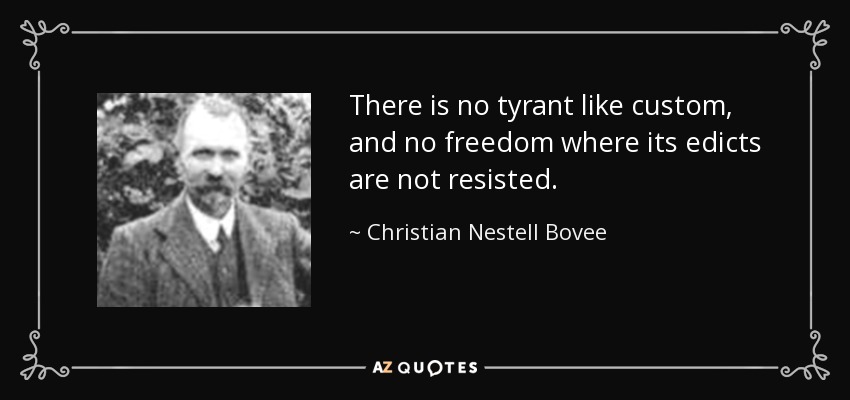
There is no tyrant like custom, and no freedom where its edicts are not resisted.
In reality no food is valued solely for its nutritive power and no garment or house solely for the protection it affords against cold weather and rain.... the demand for goods is widely influenced by metaphysical, religious, and ethical considerations, by aesthetic value judgments, by customs, habits, prejudice, tradition, changing fashions, and many other things.
There are in fact four very significant stumbling blocks in the way of grasping the truth, which hinder every man however learned, and scarcely allow anyone to win a clear title to wisdom, namely, the example of weak and unworthy authority, longstanding custom, the feeling of the ignorant crowd, and the hiding of our own ignorance while making a display of our apparent knowledge.
Most men are followers, and implicitly rely upon the judgment of others. They mistake solemnity for wisdom, and regard a grave countenance as the title page and Preface to a most learned volume. So they are easily imposed upon by forms, strange garments, and solemn ceremonies. And when the teaching of parents, the customs of neighbors, and the general tongue approve and justify a belief or creed, no matter how absurd, it is hard even for the strongest to hold the citadel of his soul. In each country, in defence of each religion, the same arguments would be urged.
The decision we must make now is whether we will give our allegiance to outmoded and unjust customs or to the ethical demands of the universe. As Christians we owe our allegiance to God and His will, rather than to man and his folkways
. . . [Y]ou must understand that we have always considered the writing of books a hindrance to our work, and that for this reason the custom was not to be introduced into the Company. However, since no rule, however general, does not have some exception, we shall see whether it is advisable to have yours printed.
When in Rome, you must do as the Romans do and accept the local customs, if they are not immoral.
I have heard that M. Guesdon is dictating lessons to his seminarians. This is contrary to the custom of the Company and a somewhat ineffective way of teaching, since the students rely on their notes and do not exercise either their judgment or their memory, In this way, their minds remain empty while they pile up papers which they will perhaps never look at again.
The Navy has a custom-if a ship runs aground, the captain is relieved regardless of who is responsible. That's how Abu Ghraib should be handled.
It is the gods' custom to bring low all things of surpassing greatness.
Theatres, actors, critics and public are interlocked in a machine that creaks but never stops. There is always a new season in hand and we are to busy to ask the only vital question which measures the whole structure. Why theatre at all? What for? Is it an anachronism, a superannuated oddity? Surviving like an old monument or a quaint custom? Why do we applaud and what? Has the stage a real place in our lives? What function can it have? What could it serve? What could it explore? What are its special properties?
Each man calls barbarism whatever is not his own practice; for indeed it seems we have no other test of truth and reason than the example and pattern of the opinions and customs of the country we live in
Ancient Chinese custom if you were a guest in one of their homes and you admired some particular thing, they would wrap it up and present it to you as a gift. But isn't that what life does.
I never had a job. I bought my first house within a year of getting out of school, and I built a custom one four and a half years later. The Art Center didn't teach much about business, but I learned a lot from the Fortune 500 companies that were my clients.
[On Sophie Germain] When a person of the sex which, according to our customs and prejudices, must encounter infinitely more difficulties than men... succeeds nevertheless in surmounting these obstacles and penetrating the most obscure parts of [number theory], then without doubt she must have the noblest courage, quite extraordinary talents and superior genius.
Customs, morals — is there a difference? Woman, do you realize what you are doing? Here, by the grace of God and an inside straight, we have a personality untouched by the psychotic taboos of our tribe — and you want to turn him into a carbon copy of every fourth-rate conformist in this frightened land! Why don't you go whole hog? Get him a brief case and make him carry it wherever he goes — make him feel shame if he doesn't have it.
Is all literature eavesdropping, and all art Chinese imitation? our life a custom, and our body borrowed, like a beggar’s dinner, from a hundred charities?
All minds quote. Old and new make the warp and woof of every moment. There is no thread that is not a twist of these two strands. By necessity, by proclivity, and by delight, we all quote. We quote not only books and proverbs, but arts, sciences, religion, customs, and laws; nay, we quote temples and houses, tables and chairs, by imitation.
The one and only substitute for experience which we have not ourselves had is art, literature. We have been given a miraculous faculty: Despite the differences of language, customs and social structure we are able to communicate life experience from one whole nation to another, to communicate a difficult national experience many decades long which the second of the two has never experienced.
Our common law is the stock instance of a combination of custom and its successive adaptations.
There is nothing so extreme that is not allowed by the custom of some nation or other.
The laws of conscience, though we ascribe them to nature, actually come from custom.
Laws gain their authority from actual possession and custom: it is perilous to go back to their origins; laws, like our rivers, get greater and nobler as they roll along: follow them back upstream to their sources and all you find is a tiny spring, hardly recognizable; as time goes by it swells with pride and grows in strength.
At the gates of the forest, the surprised man of the world is forced to leave his city estimates of great and small, wise and foolish. The knapsack of custom falls off his back with the first step he makes into these precincts. Here is sanctity which shames our religions, and reality which discredits our heroes. Here we find Nature to be the circumstance which dwarfs every other circumstance, and judges like a god all men that come to her.
What is morality but immemorial custom? Conscience is the chief of conservatives.
Follow AzQuotes on Facebook, Twitter and Google+. Every day we present the best quotes! Improve yourself, find your inspiration, share with friends
or simply: