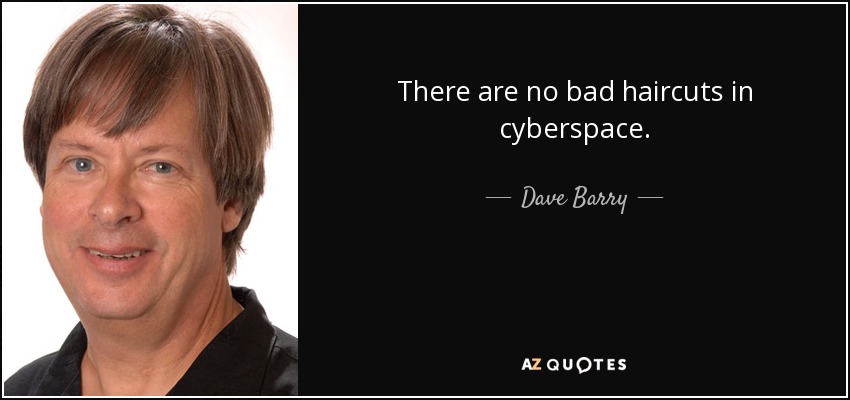
There are no bad haircuts in cyberspace.
A domain name is your address, your address on the Internet. We all have a physical address; we're all going to need an address in cyberspace. They're becoming increasingly important. I believe we'll get to the point where when you're born, you'll be issued a domain name.
We have raised significant concerns about the way that China and individuals acting on behalf of the state of China have acted in cyberspace.
I support freedom of expression, no matter whose, so I oppose DDoS attacks regardless of their target... they're the poison gas of cyberspace.
If cyberspace can screw with you, it will.
That's how it is online—there's no time in cyberspace. It's almost like everything physical evaporates, and it's just your mind and the different sites floating in a void.
Exploring and understanding the Net is an ongoing process. Cyberspace never sits still; it evolves as fast as society itself. Only if we fight to preserve our freedom of speech on the Net will we ensure our ability to keep up with both the Net and society.
The future belongs to neither the conduit or content players, but those who control the filtering, searching and sense-making tools we will rely on to navigate through the expanses of cyberspace.
Nursing has made great progress from being an occupation to becoming a profession in the 20th. Century. As the 21st. Century approaches, further progress will be reported and recorded in Cyberspace - The Internet being one conduit for that. Linking nurses and their information and knowledge across borders - around the world - will surely advance the profession of nursing much more rapidly in the next century
Cyberspace is where you are when you're on the telephone.
There is a regulation of behavior on the Internet and in cyberspace, but that regulation is imposed primarily through code. The differences in the regulations effected through code distinguish different parts of the Internet and cyberspace. In some places, life is fairly free; in other places, it is more controlled. And the difference between these spaces is simply a difference in the architectures of control--that is, a difference in code.
Take cyberspace as an example. We had this wonderful utopian vision of a new home for the mind. What we've reaped isn't cyberspace. It's cyberbia. It's this vast, bland wasteland of vulgar people and trivial ideas and pictures of half-naked starlets. But despite all the uncertainty, has there ever been a more fascinating moment to be alive?
The research on cyberspace is a quest for God. To be God. To be here and there.
The problems we have with our current technology often reveal our own human foibles, and it's these new emotions of cyberspace which reveal our struggles.
In cyberspace, we get many fewer cues about the emotional states and attitudes of the people we're talking to. That makes it less interesting, easier to mis-communicate, and more likely to destroy trust. So you need to treat cyberspace with care, especially being aware of the fragile nature of trust in the virtual world.
The future is unwritten. Cyberspace is the funhouse mirror of our own society, reflects our values and our faults, sometimes in terrifying exaggerations. It doesn't matter who you are today, if you don't show up in that mirror you are just not going to matter very much. Our kids have to show up in the mirror.
The difference between our collective generation and your generation (differentiating the reporters from the students) is that we poured our souls out on paper that got easily yellowed and lost. The danger is that many of your friends (nodding at the students) are putting intimate ideas in cyberspace journals. So when today's 15-year-old is 40, some friend is going to drag out all of that idiotic stuff at their class reunion.
Instead of mindlessly tossing billions at or taking billions from the Net as such, investors should be spending their time making sure that it's the future Fords and General Motors of cyberspace that are getting the capital they need.
The simulator is an object in itself, which is different from televison and leads to cyberspace.
The simulator is the stage in-between television and virtual reality, a moment, a phase. The simulator is a moment that leads to cyberspace, that is to say, to the process because of which we now have two bottles instead of one. I might not see this virtual bottle, but I can feel it. It is settled within reality. This explains why the word virtual reality is more important than the word cyberspace, which is more poetic.
[Bill Clinton] was the man, as a matter of fact, who, in terms of the Communications Decency Act, which would have made the Internet, the whole concept of cyberspace, vulnerable to rampant censorship - he pushed that bill, and I know the man in the Justice Department whom he persuaded - the guy didn't want to lose his job - to write the bill.
Cyberspace is the human transition into a mathematical super space where we as a collectivity become optionally a single point of view.
New landscape of personal media has given us a vaster wasteland of cyberspace. But, luckily for us, there's some really wonderful stuff in it. And if history is any guide, as the media matures, the quality will continue to go up.
The search for truth in cyberspace will take you through the wormhole, and there's nothing on the other side but pedants and nitpickers and bottomless ambiguity. If you're not careful, you'll spend all your time proving everything and understanding nothing.
Cyberspace is - or can be - a good, friendly and egalitarian place to meet.
Follow AzQuotes on Facebook, Twitter and Google+. Every day we present the best quotes! Improve yourself, find your inspiration, share with friends
or simply: