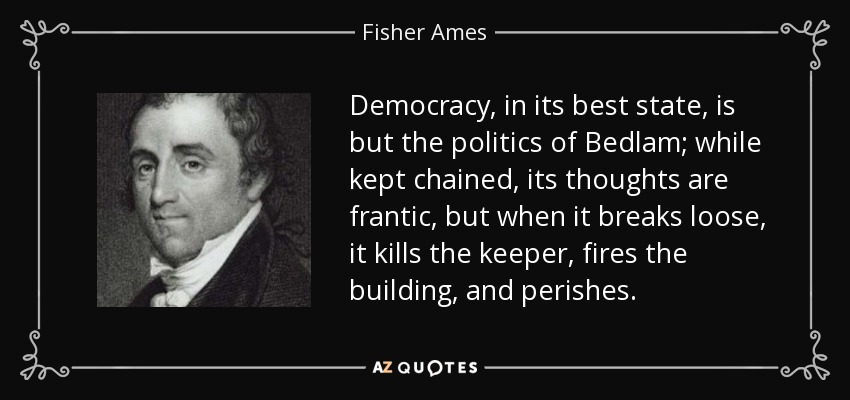
Democracy, in its best state, is but the politics of Bedlam; while kept chained, its thoughts are frantic, but when it breaks loose, it kills the keeper, fires the building, and perishes.
The framers of our Constitution understood the dangers of unbridled government surveillance. They knew that democracy could flourish only in spaces free from government snooping and interference, and they put restraints on government overreaching in the Fourth Amendment of the Bill of Rights. . . . These protections require, at a minimum, a neutral arbiter - a magistrate - standing between the government's endless desire for information and the citizens' desires for privacy.
To define twentieth-century humanism briefly, I would say that it is a philosophy of joyous service for the greater good of all humanity in this natural world and advocating the methods of reason, science, and democracy.
Since Humanism as a functioning credo is so closely bound up with the methods of reason and science, plainly free speech and democracy are its very lifeblood. For reason and scientific method can flourish only in an atmosphere of civil liberties.
The values of science and the values of democracy are concordant, in many cases indistinguishable. Science and democracy began - in their civilized incarnations - in the same time and place, Greece in the seventh and sixth centuries B.C. . . . Science thrives on, indeed requires, the free exchange of ideas; its values are antithetical to secrecy. Science holds to no special vantage points or privileged positions. Both science and democracy encourage unconventional opinions and vigorous debate. Both demand adequate reason, coherent argument, rigorous standards of evidence and honesty.
The reality is that we are hated not because of our democracy, freedoms, and generous social security system; rather, we are hated because of our involvement in foreign conflicts and quarrels that were never our concern.
One day the South will know that when these disinherited children of God sat down at lunch counters, they were in reality standing up for what is best in the American dream and for the most sacred values in our Judaeo-Christian heritage, thereby bringing our nation back to those great wells of democracy which were dug deep by the founding fathers in their formulation of the Constitution and the Declaration of Independence.
We also call upon the king to hand over power to the political parties and for the political parties to shoulder their responsibility and turn the people's demands for democracy and good governance into reality.
The happiest thing that can be said about democracy... is that it is one of the few systems that has been willing to risk a long period of confusion and mixed purposes for the sake of giving man a chance to grow up in mind and responsibility.
Democracy is an experiment, and the right of the majority to rule is no more inherent than the right of the minority to rule; and unless the majority represents sane, righteous, unselfish public sentiment, it has no inherent right.
Patriotic societies seem to think that the way to educate school children in a democracy is to stage bigger and better flag-saluting.
The devotion of democracy to education is a familiar fact. . . . [A] government resting upon popular suffrage cannot be successful unless those who elect . . . their governors are educated.
Jeffersonian Democracy simply meant the possession of the federal government by the agrarian masses led by an aristocracy of slave-owning masses.
The trouble in modern democracy is that men do not approach to leadership until they have lost the desire to lead anyone.
... when the struggle seems to be drifting definitely towards a world social democracy, there may still be very great delays and disappointments before it becomes an efficient and beneficent world system. Countless people ... will hate the New World Order and will die protesting against it. When we attempt to evaluate its promise, we have to bear in mind the distress of a generation or so of malcontents, many of them quite gallant and graceful-looking people.
[the framers of the Constitution] intended our government should be a republic, which differs more widely from a democracy than a democracy from a despotism.
Liberty has never lasted long in a democracy, nor has it ever ended in anything better than despotism.
Democracy is morose, and runs to anarchy.
...to make the world safe for democracy.
And I'd like to say to the Senate, I hope you will say yes to a stronger American democracy in the year 2000.
As the 20th century ended, there were around 120 democracies in the world - and I can assure you more are on the way.
It is no accident that the rise of so many democracies took place in a time when the world's most influential nation was itself a democracy.
I think the important thing is to realize that the establishment of a democracy is sometimes a messy thing and it takes time. Yeah, we've been at it 240 years.
Now the question is, now that we are there, what should we do in the best interest of the U.S., not only from a standpoint of the necessity of some stable democracy in the Middle East.
That does not mean we won't experience the tragedy of the loss of some American lives. We will have an opportunity to instill a democracy in Iraq which will be an example and perhaps force other nations in that region to move in the same direction.
Follow AzQuotes on Facebook, Twitter and Google+. Every day we present the best quotes! Improve yourself, find your inspiration, share with friends
or simply: