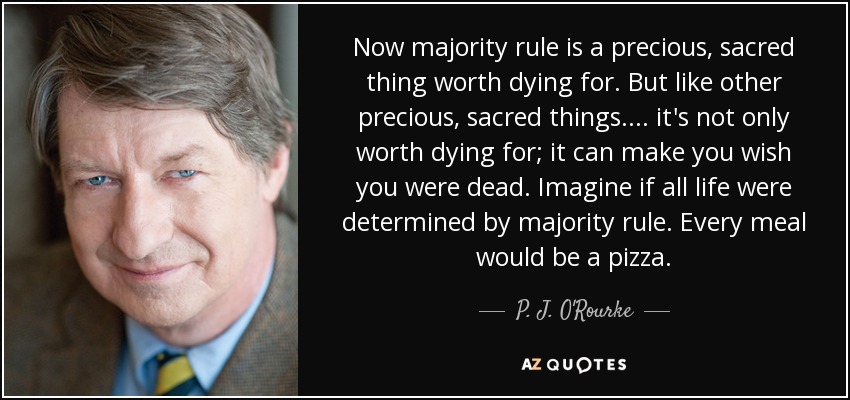
Now majority rule is a precious, sacred thing worth dying for. But like other precious, sacred things .... it's not only worth dying for; it can make you wish you were dead. Imagine if all life were determined by majority rule. Every meal would be a pizza.
An Honest politician will not be tolerated by a democracy unless he is very stupid ... because only a very stupid man can honestly share the prejudices of more than half the nation.
It is intolerable that around 1 in 5 of the world's adults are illiterate. How can we build equitable information societies or thriving democracies if so many remain without the basic tools of literacy?
It has been hard to muster the resources to support fledgling democracies and to intervene on behalf of the most desperate. The AIDS orphans in Uganda, the refugee fleeing Zimbabwe, the young woman who has been trafficked into the sex trade in Southeast Asia. It has been hard, yet this assistance together with the compassionate work of private charities, people of conscience and people of faith, has shown the soul of our country.
The threats against democracy today are in general completely normal. They walk around in costume and tie.
Democracy is better than tyranny.
In a democracy only will the freeman of nature design to dwell.
We have come a long way in America because of Martin Luther King, Jr. He led a disciplined, nonviolent revolution under the rule of law, a revolution of values, a revolution of ideas. We've come a long way, but we still have a distance to go before all of our citizens embrace the idea of a truly interracial democracy, what I like to call the Beloved Community, a nation at peace with itself.
We have a natural constant craving for leadership. Democracy is always a fragile and imperfect achievement. Yet a distinct feeling of malaise in our political culture lingers. There is something missing from our public debates.
I'm not so sure liberal democracy as we know it has reached its terminus. It's clear though, that many have genuinely lost confidence in the Australian political class. One reason is that we like to place enormous burdens of expectations on modern political leaders. To be sure such expectations aren't always honest. Just as we want better public services but object to paying the higher taxes that would make them possible, we often want leadership but only if there aren't hard choices with real consequences.
The politics of that year [2004] are old now, but the problem remains the same, the real culture clash of American life. It's between the essence of fundamentalism - paternalism, authority, and charity - and the messy imperatives of democracy, "the din of the vox populi" once derided by Abram Vereide. It's the difference between false unity, preached from above, and real solidarity, pledged between brothers and sisters - the kinds who are always bickering.
Since an informed citizenry is the basis for a healthy democracy, independent, non-corporate media are more crucial today than ever before
New possibilities for a more active democracy are beginning to emerge in the information age. Effective citizen action is possible if citizens develop the abilities to gain access to information of all kinds and the skills to put such information to effective use.
In effective, sustained citizen action, people learn the skills of public life with which to act effectively. "Commons," or the common wealth-the public goods that are objects of sustainable public action-become not only occasions for collaboration by invaluable sources of citizen education in their own right because they are the occasions for learning such skills.
Globilization in its current form cannot deliver the benefits expected of it. Civil society, particularly in developing countries, must ensure that it does.
The proper response toward what we occasionally imagine to be democracy, methinks, is to retain one's self-respect by not participating in it.
Voting in particular is an embarrassment, being a public display of weak character and low intelligence. Let us face the truth: Democracy, like spitting in public or the Roman games, is the proper activity of the lower intellectual and moral classes. It amounts to collusion in one's own suckering.
Those who wash regularly should not stoop to democracy.
Good, law-abiding, value-oriented citizens are the ultimate in hypocrisy; "majority rules" and the law are exactly the same as being the biggest bully on the block with the biggest stick-it is only might that allows one group to force another to live by its code of conduct.
It is subversive to set up inquisitions like this, state or national, into the thoughts and consciences of Americans. . . . It is subversive for commissions like this to spread hysteria and intimidation throughout the land that Americans are afraid to sign petitions, afraid to read progressive magazines, afraid to make out checks for liberal causes, afraid to join organizations, afraid to speak their mind on public issues. Americans dare not be free citizens! This is the destruction of democracy.
Is it not the excess and greed of this and the neglect of all other things that revolutionizes this constitution too and prepares the way for the necessity of a dictatorship?
And is it not true that in like manner a leader of the people who, getting control of a docile mob, does not withhold his hand from the shedding of tribal blood, but by the customary unjust accusations brings a citizen into court and assassinates him, blotting out a human life, and with unhallowed tongue and lips that have tasted kindred blood, banishes and slays and hints at the abolition of debts and the partition of lands.
And a democracy, I suppose, comes into being when the poor, winning the victory, put to death some of the other party, drive out others, and grant the rest of the citizens an equal share in both citizenship and offices.
In a small Swiss city sits an international organization so obscure and secretive... Control of the institution, the Bank for International Settlements, lies with some of the world's most powerful and least visible men: the heads of 32 central banks, officials able to shift billions of dollars and alter the course of economies at the stroke of a pen.
Politics /n/: from 'poly ticks', short for 'many small bloodsucking insects'.
Follow AzQuotes on Facebook, Twitter and Google+. Every day we present the best quotes! Improve yourself, find your inspiration, share with friends
or simply: