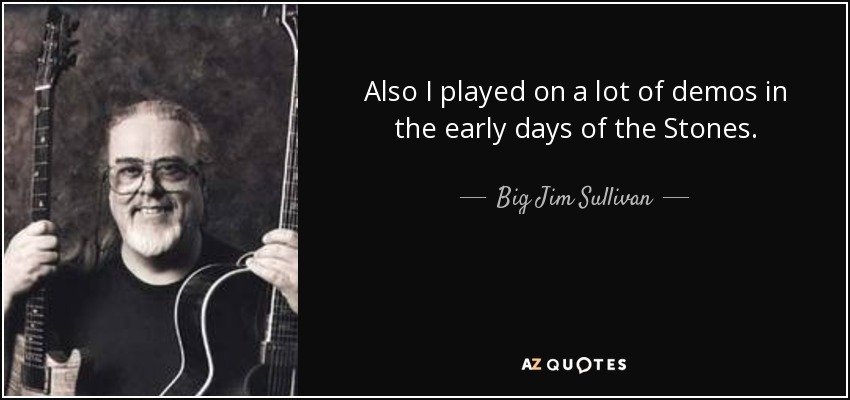
Also I played on a lot of demos in the early days of the Stones.
I think I first realized I wanted to be in country music and be an artist when I was 10. And I started dragging my parents to festivals, and fairs, and karaoke contests, and I did that for about a year before I came to Nashville for the first time. I was 11 and I had this demo CD of me singing Dixie Chicks and Leanne Rimes songs.
DUST includes rarities, demos, unreleased songs and instrumentals, live recordings, and more.
Mutineer is the first album of mine without a demo stage.
We always started these albums as making demos, that went right on until Scary Monsters.
Recording at home enables one to eliminate the demo stage, and the presentation stage in the studio, too.
I got a publishing deal with BMG, they were supportive, and some money to record demos
At the time, I was making good money doing background work and demos.
I never record anything like a demo, I just go for it.
If people are really excited about their music, and that's their primary motivation, then that comes through in demo tapes. That's the most important ingredient.
But I like to listen to demos. I like to hear the finished product. It's like listening to a song - I mean, a story. If you're going to sit here and tell me a story, I just like to listen. I don't want to make them up.
In 1980, I moved to Chicago, and I recorded demo tapes for my friends' bands, and in 1981, the first Big Black record - the first thing I did that was an actual record.
It's taken a long time but eventually when I had the songs in place and demos right and I found myself a manager, that's when everything started happening quickly but I think that's always the way it is.
I was producing demos for a band that was called Physical Ed. Out of production of demos I went and did a few jam sessions with then in Northern California clubs, but I never actually toured with them.
I listen to everything that comes in. I'm not real worried about demo sound quality. I can hear through that sort of thing. If a band can play, then they can play.
Opinions are like demo tapes. I don't want to hear yours
Every band I knew or played with had flyers and properly-recorded demos and contacts; I couldn't even get a gig.
I have started to record some demos so hopefully in the near future I can play live.
I always loved writing songs - writing for myself and demo-ing songs, really with no intention of ever letting anyone else hear them. Finally the Foo Fighters stuff happened when I just went to the studio down the street from my house and recorded some stuff in about five or six days, and all these people wanted to release it as an album. I wanted to release it on my own, with no photos and no names on it.
Sharing the code just seems like The Right Thing to Do. It costs us rather little, but it benefits a lot of people in sometimes very significant ways. There are many university research projects, proof of concept publisher demos, and new platform test beds that have leveraged the code. Free software that people value adds wealth to the world.
In our time, the great task for libertarians is to find an escape from politics in all its forms—from the totalitarian and fundamentalist catastrophes to the unthinking demos that guides so-called ‘social democracy.’ . . . We are in a deadly race between politics and technology. . . . The fate of our world may depend on the effort of a single person who builds or propagates the machinery of freedom that makes the world safe for capitalism.
...Had dreams of fancy cars and limos, And all I wanted was somebody to listen to my demo.
No matter how slick the demo is in rehearsal, when you do it in front of a live audience the probability of a flawless presentation is inversely proportional to the number of people watching, raised to the power of the amount of money involved.
Basically, every band that makes it has some dude with some sense of business. I don't know if our band would've been so successful were it not for Daniel's [Kessler] insight into how things really work. Daniel was the one who was diligently saying, "We should make a demo, send it out, play shows but not too many shows, get on shows with touring bands that are coming to New York."
Go find very early versions of things: the first TV pilot of a later-successful TV show; early audition tapes by famous actors; early demos by famous musicians. Focus on these early examples, not what they became over the next 20 years. Remember that what you're doing will constantly improve.
Follow AzQuotes on Facebook, Twitter and Google+. Every day we present the best quotes! Improve yourself, find your inspiration, share with friends
or simply: