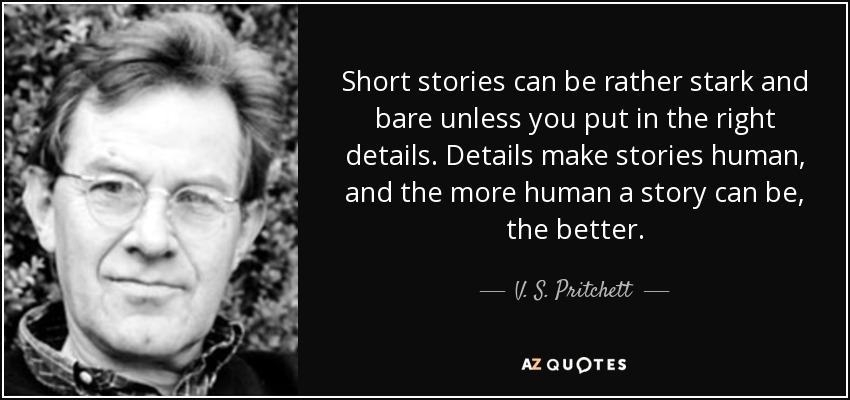
Short stories can be rather stark and bare unless you put in the right details. Details make stories human, and the more human a story can be, the better.
Writers the most learned, the most accurate in details, and the soundest in tendency, frequently fall into a habit which can neither be cured nor pardoned,-the habit of making history into the proof of their theories.
In descriptions of Nature one must seize on small details, grouping them so that when the reader closes his eyes he gets a picture. For instance, you'll have a moonlit night if you write that on the mill dam a piece of glass from a broken bottle glittered like a bright little star, and that the black shadow of a dog or a wolf rolled past like a ball.
I often need physical gesture to balance dialogue. If I write in public, every time I need to know what a character is doing with his hand or foot, I can look up and study people and find compelling gestures that I can harvest. Writing in public gives you that access to a junkyard of details all around you.
I start with no preconceived idea - discovery excites me to focus - then rediscovery through the lens - final form of presentation seen on ground glass, the finished print previsioned completely in every detail of texture, movement, proportion, before exposure - the shutter's release automatically and finally fixes my conception, allowing no after manipulation - the ultimate end, the print, is but a duplication of all that I saw and felt through my camera.
I always choose an area that is of personal interest, but I don't plan my travels in detail. There are so many variables one cannot predict: the changing light, weather, personal mood, and often just plain luck. Of course, you must have a starting point, so I establish some fixed points then improvise as I go. In many cases the locations seem to choose me.
At the root of creativity is an impulse to understand, to make sense of random and often unrelated details. For me, photography provides an intersection of time, space, light, and emotional stance. One needs to be still enough, observant enough, and aware enough to recognize the life of the materials, to be able to 'hear through the eyes'.
The simultaneous recognition, in a fraction of a second, of the significance of an event as well as the precise organization of forms which gives that event its proper expression... In photography, the smallest thing can be a great subject. The little human detail can become a leitmotif.
Every landscape is, as it were, a state of the soul, and whoever penetrates into both is astonished to find how much likeness there is in each detail.
With the eventual acceptance of Darwin's theory we reach a modern understanding of nature, one which has since then changed in detail rather than in fundamentals. Only those who prefer religious faith to beliefs based on reasoning and evidence can still maintain that the human species is the special darling of the entire universe, or that other animals were created to provide us with food, or that we have divine authority over them, and divine permission to kill them.
All fiction relies on the real world in the sense that we all take in the world through our five senses and we accumulate details, consciously or subconsciously. This accumulation of detail can be drawn on when you write fiction.
We are all afraid. That's the thing that unites all truly successful people: fear, fear of failing, fear of criticism, fear of letting down the team in some way. That why they try so hard, that's why they pay attention to detail and try to get every possible duck in a row. It's fear
A German wine label is one of the things life's too short for, a daunting testimony to that peculiar nation's love of detail and organization.
Woman in the companion of man, gifted with equal mental capacities. She has the right to participate in the minutest details in the activities of man, and she has equal right to liberty of freedom and liberty with him.
It's the little things that make the big things possible. Only close attention to the fine details of any operation makes the operation first class.
Most of the luxuries and many of the so-called comforts of life are not only not indispensable but positive hindrances to our progress. Our life is frittered away by detail. I say let your affairs be as two or three, not a hundred or a thousand. And keep your accounts on your thumb nail.
How few people will realize how much detail had to be gone into before Bakelite was a commercial success.
The insistence on complete certainty about the full details of global warming-the most serious threat we have ever faced-is actually an effort to avoid facing the awful, uncomfortable truth: that we must act boldly, decisively, comprehensively, and quickly, even before we know every last detail about the crisis. Those who continue to argue that the appropriate response is merely additional research are simply seeking to camouflage timidity or protect their vested interest in the status quo.
All nationalisms are at heart deeply concerned with names: with the most immaterial and original human invention. Those who dismiss names as a detail have never been displaced; but the peoples on the peripheries are always being displaced. That is why they insist upon their continuity - their links with their dead and the unborn.
95 percent of economics is common sense made complicated, and even for the remaining 5 percent, the essential reasoning, if not all the technical details, can be explained in plain terms.
It is this third consequence that has been elaborated in greatest detail and has formed one of the most significant pillars of historical capitalism, institutional racism.
Haemoglobin is a very large molecule by ordinary standards, containing about ten thousand atoms, but the chances are that your haemoglobin and mine are identical, and significantly different from that of a pig or horse. You may be impressed by how much human beings differ from one another, but if you were to look into the fine details of the molecules of which they are constructed, you would be astonished by their similarity.
No matter what. Wherever your mind wanders, it seems to turn up at the same Field of Dreams. It's the vision you wake up with in the morning, and it's the last thing you picture before you fall asleep. Everytime you think of it, the idea in your head seems to get more vivid, filled in with more detail: You not only want to win a gold medal at the Olympics, you not only can see yourself standing there on the podium, but you can also feel the goose bumps as your national anthem is played; the tears are in your eyes. (That's how real a dream can be and should be)
The more clear and definite you make your picture then,and the more you dwell upon it, bringing out all its delightful details, the stronger your desire will be, and the stronger your desire, the easier it will be to hold your mind fixed upon the picture of what you want.
In a morbid condition of the brain, dreams often have a singular actuality, vividness, and extraordinary semblance of reality. At times monstrous images are created, but the setting and the whole picture are so truth-like and filled with details so delicate, so unexpectedly, but so artistically consistent, that the dreamer, were he an artist like Pushkin or Turgenev even, could never have invented them in the waking state. Such sick dreams always remain long in the memory and make a powerful impression on the overwrought and deranged nervous system.
Follow AzQuotes on Facebook, Twitter and Google+. Every day we present the best quotes! Improve yourself, find your inspiration, share with friends
or simply: