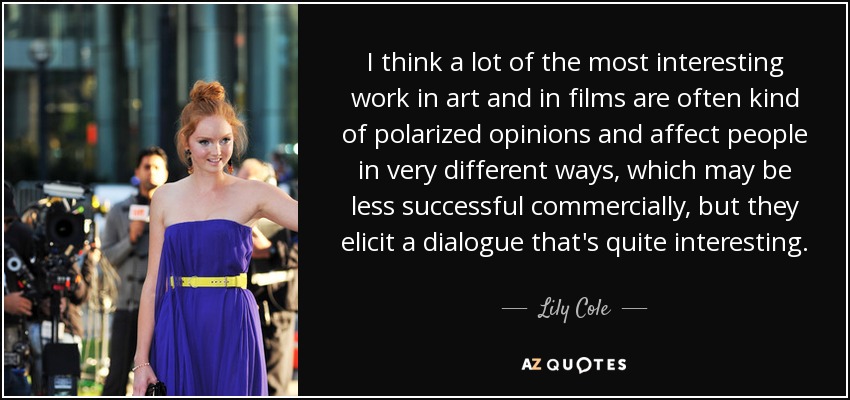
I think a lot of the most interesting work in art and in films are often kind of polarized opinions and affect people in very different ways, which may be less successful commercially, but they elicit a dialogue that's quite interesting.
Dialogue is not just quotation. It is grimaces, pauses, adjustments of blouse buttons, doodles on a napkin, and crossings of legs
In times of change and uncertainty, we need the spirit of jazz more than ever before, to bring people - especially young women and men - together, to nurture freedom and dialogue, to create new bridges of respect and understanding, for greater tolerance and cooperation.
Dialogue in fiction should be reserved for the culminating moments and regarded as the spray into which the great wave of narrative breaks in curving towards the watcher on the shore.
Never have I enjoyed youth so thoroughly as I have in my old age. In writing Dialogues in Limbo, The Last Puritan, and now all these descriptions of the friends of my youth and the young friends of my middle age, I have drunk the pleasure of life more pure, more joyful than it ever was when mingled with all the hidden anxieties and little annoyances of actual living. Nothing is inherently and invincibly young except spirit. And spirit can enter a human being perhaps better in the quiet of old age and dwell there more undisturbed than in the turmoil of adventure.
The process could be likened to relaxing on a riverbank and watching a fish leap out of the water, sparkle for a moment in the sunlight, then dive back in a graceful arc. There is no need to engage in a mental dialogue about the merits and demerits of the fish, emotionally react to the fish, or jump into the water to try to catch the fish. Once the fish is out of sight, it should also be out of mind.
The true use of Shakespeare or of Cervantes, of Homer or of Dante, of Chaucer or of Rabelais, is to augment one's own growing inner self. . . . The mind's dialogue with itself is not primarily a social reality. All that the Western Canon can bring one is the proper use of one's own solitude, that solitude whose final form is one's confrontation with one's own mortality.
One task of literature is to formulate questions and construct counterstatements to the reigning pieties. And even when art is not oppositional, the arts gravitate toward contrariness. Literature is dialogue: responsiveness. Literature might be described as the history of human responsiveness to what is alive and what is moribund as cultures evolve and interact with one another.
A letter is not a dialogue or even an omniscient exposition. It is a fabric of surfaces, a mask, a form as well suited to affectations as to the affections. The letter is, by its natural shape, self-justifying; it is one's own evidence, deposition, a self-serving testimony. In a letter the writer holds all the cards, controls everything about himself and about those assertions he wishes to make concerning events or the worth of others. For completely self-centered characters, the letter form is a complex and rewarding activity.
When writing dialogue, I hear it in both Russian and English, and try to find a language that combines the two.
I believe I'm very conscious of exactly what I'm doing. I'm auditioning lines of dialogue, and I'm interrogating whether the lines would translate from Russian into English the right way. The English that results can perhaps seem somewhat more formal than colloquial, but not so formal as to feel academic.
Nothing is easy in writing. I don't think for anyone. But dialogue is probably what comes most naturally to me.
In dialogue, there is opposition, yes, but no head-on collision. Smashing heads does not open minds.
I believe in the power of journalism. To make informed decisions, you have to have an understanding of the dynamics of a situation. And journalism does bridge gaps and creates dialogue.
There's something great about terrible westerns. They look like gay dancers and bad, overwrought dialogue and overacting, black and white sped up horses.
I'm not a big believer in doing things unilaterally. I'm a big believer in opening up a dialogue and figuring out how we can make something work for all people.
If you just want to be a writer, I don't care, for pitching, for writing dialogue, you should take an improvisation class. It's super important.
It depends, because sometimes an action role can be very demanding, and sometimes a dialogue-driven character can be very demanding, and vice versa. It depends.
Good dialogue is very important.
I treat any scene the same - dialogue, action - you're still creating something in character. It's all acting, fighting.
I'm totally an anxious mess all the time. There's a constant dialogue going on in my brain, and it's just reminding me of all the failures that I have had, and all of the things I need to do, and all of the things I'm not doing good enough.
There can never be deep peace between two spirits, never mutual respect, until, in their dialogue, each stands for the whole world.
I love saying dialogue and creating a full character more than just being physical. But I always end up doing physical stuff in my roles.
The way you write dialogue is the same whether you're writing for movies or TV or games. We use movie scriptwriting software to write the screenplays for our games, but naturally we have things in the script that you would never have in a movie script -- different branches and optional dialogue, for example. But still, when it comes to storytelling and dialogue, they are very much the same.
Thinking ... is a soundless dialogue, it is the weaving of patterns, it is a search for meaning. The activity of thought contributes to and shapes all that is specifically human.
Follow AzQuotes on Facebook, Twitter and Google+. Every day we present the best quotes! Improve yourself, find your inspiration, share with friends
or simply: