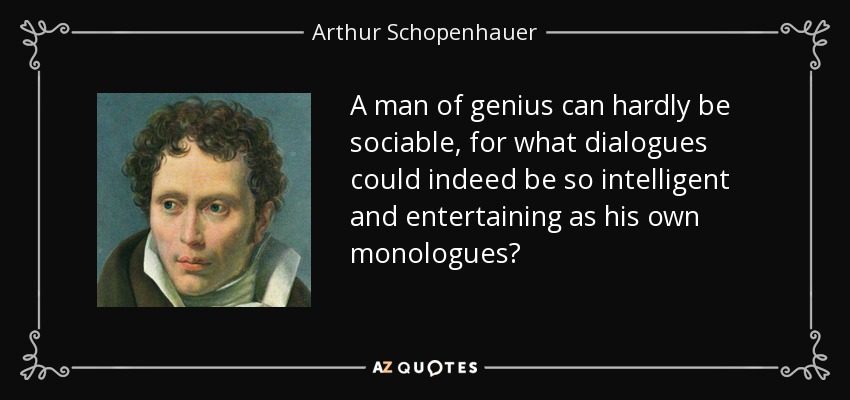
A man of genius can hardly be sociable, for what dialogues could indeed be so intelligent and entertaining as his own monologues?
Rather than make claims of final theories, perhaps we should focus on our ever-continuing dialogue with the universe. It is the dialogue that matters most, not its imagined end. It is the sacred act of inquiry wherein we gently trace the experienced outlines of an ever-greater whole. It is the dialogue that lets the brilliance of the diamond’s infinite facets shine clearly. It is the dialogue that instills within us a power and capacity that is, and always has been, saturated with meaning.
If we are to know ourselves, philosophy needs to maintain an ongoing dialogue with the sciences of mind.
It is my belief that whereas the twentieth century has been a century of war and untold suffering, the twenty-first century should be one of peace and dialogue. As the continued advances in information technology make our world a truly global village, I believe there will come a time when war and armed conflict will be considered an outdated and obsolete method of settling differences among nations and communities.
Television is a prisoner of dialogue and steady-cam. People walk down a hall, and the camera follows them around a corner.
Dialogue is not just quotation. It is grimaces, pauses, adjustments of blouse buttons, doodles on a napkin, and crossings of legs
In times of change and uncertainty, we need the spirit of jazz more than ever before, to bring people - especially young women and men - together, to nurture freedom and dialogue, to create new bridges of respect and understanding, for greater tolerance and cooperation.
Dialogue in fiction should be reserved for the culminating moments and regarded as the spray into which the great wave of narrative breaks in curving towards the watcher on the shore.
Never have I enjoyed youth so thoroughly as I have in my old age. In writing Dialogues in Limbo, The Last Puritan, and now all these descriptions of the friends of my youth and the young friends of my middle age, I have drunk the pleasure of life more pure, more joyful than it ever was when mingled with all the hidden anxieties and little annoyances of actual living. Nothing is inherently and invincibly young except spirit. And spirit can enter a human being perhaps better in the quiet of old age and dwell there more undisturbed than in the turmoil of adventure.
The process could be likened to relaxing on a riverbank and watching a fish leap out of the water, sparkle for a moment in the sunlight, then dive back in a graceful arc. There is no need to engage in a mental dialogue about the merits and demerits of the fish, emotionally react to the fish, or jump into the water to try to catch the fish. Once the fish is out of sight, it should also be out of mind.
The true use of Shakespeare or of Cervantes, of Homer or of Dante, of Chaucer or of Rabelais, is to augment one's own growing inner self. . . . The mind's dialogue with itself is not primarily a social reality. All that the Western Canon can bring one is the proper use of one's own solitude, that solitude whose final form is one's confrontation with one's own mortality.
One task of literature is to formulate questions and construct counterstatements to the reigning pieties. And even when art is not oppositional, the arts gravitate toward contrariness. Literature is dialogue: responsiveness. Literature might be described as the history of human responsiveness to what is alive and what is moribund as cultures evolve and interact with one another.
I believe in the power of journalism. To make informed decisions, you have to have an understanding of the dynamics of a situation. And journalism does bridge gaps and creates dialogue.
There's something great about terrible westerns. They look like gay dancers and bad, overwrought dialogue and overacting, black and white sped up horses.
Good dialogue is very important.
I treat any scene the same - dialogue, action - you're still creating something in character. It's all acting, fighting.
I'm totally an anxious mess all the time. There's a constant dialogue going on in my brain, and it's just reminding me of all the failures that I have had, and all of the things I need to do, and all of the things I'm not doing good enough.
In [Aristotle's] formal logic, thought is organized in a manner very different from that of the Platonic dialogue. In this formal logic, thought is indifferent toward its objects. Whether they are mental or physical, whether they pertain to society or to nature, they become subject to the same general laws of organization, calculation, and conclusion - but they do so as fungible signs or symbols, in abstraction from their particular "substance." This general quality (quantitative quality) is the precondition of law and order - in logic as well as in society - the price of universal control.
The constitution of madness as a mental illness, at the end of the eighteenth century, affords the evidence of a broken dialogue, posits the separation as already effected, and thrusts into oblivion all those stammered, imperfect words without fixed syntax in which the exchange between madness and reason was made. The language of psychiatry, which is a monologue of reason about madness, has been established only on the basis of such a silence.
When I first started, I didn't really know how to structure a play. I could write dialogue, but I just sort of failed beyond that, and kind of went wherever I wanted to go.
I believe that the biblical teaching is clear. It always contests political power. It incites to "counterpower," to "positive" criticism, to an irreducible dialogue (like that between king and prophet in Israel), to antistatism, to a decentralizing of the relation, to an extreme relativizing of everything political, to an anti-ideology, to a questioning of all that claims either power or dominion (in other words, of all things political), and finally, if we may use a modern term, to a kind of "anarchism" (so long as we do not relate the term to the anarchist teaching of the nineteenth century).
People in the eastern regions [of Ukaraine] are talking about federalisation, and Kiev has at long last started talking about de-centralisation. Order in the country can only be restored through dialogue and democratic procedures, rather than with the use of armed force, tanks and aircraft.
I am ready to have dialogue with the concerned parties once the nation is calm and the political temperatures are lowered enough for constructive and productive engagement.
America can restore its strengths as the world-respected land of opportunity by returning to open-society principles. An open society invests in people and new ideas, rewards talent and hard work, values dialogue and learns from dissent, operates to high standards with transparent information, looks for common ground, sees problems as opportunities for creative change, and encourages those who are fortunate to help others get the same chance, because service is the highest ideal. With such standards in mind, America the Beautiful can return to its admired role as America the Principled.
A piece of literature can be many things but first of all it must capture its audience. You need to seduce people, entice them into a world of beauty and horror, light and shadow, of passion, of romance, of mystery. That's the magic of it. Beyond that, of course, you can open a dialogue about the ideas which interest you, but first of all you absolutely must get inside people's minds.
Follow AzQuotes on Facebook, Twitter and Google+. Every day we present the best quotes! Improve yourself, find your inspiration, share with friends
or simply: