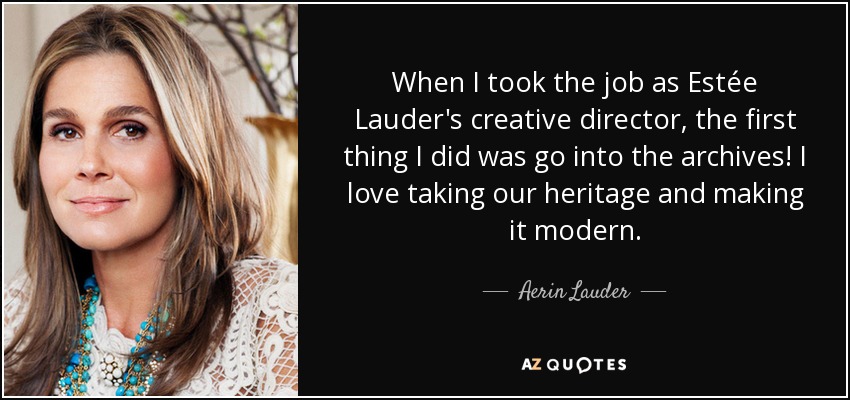
When I took the job as Estée Lauder's creative director, the first thing I did was go into the archives! I love taking our heritage and making it modern.
Everything is the director's fault - you can quote me on that. There are no excuses.
I look at the script first and who's directing it and then talk to the director to find out what his vision of the movie is and if it matches my vision and then we go after it.
It's rare that I'm working on a movie and that's the case. My goal is the same, ultimately at a certain point you give it to the director and their vision. You're there to support that vision.
I came from advertising. For me it's about protecting the director's vision. That's always the goal. There's keeping things on budget and on time and dealing with selling the movie so that to me is a focus. But also it's about serving the script. We are genre filmmakers, those are the films we love to make, so my perspective is a little different.
You'll still work with some directors where that doesn't happen, and sometimes it's out of necessity because you're in a really complicated, choreographed fight scene and the whole thing is being prevised in a computer, so it's been decided months before, but I think that's sneaking into the way action scenes are shot.
I was always waiting for the secret to be handed down to me. Ron Howard asked me what I was waiting for and I went, "Ron, I'm waiting to know the secret. I keep feeling there's some sort of secret that's going to passed on from a director." He went, "Oh no. There is none. You've just got to on and do it and make mistakes and figure it out."
As an actor and director, you have to take risks, even though I don't like saying that word. You can make a mistake.
I don't want to infantilize the actor; I want to empower the actor. Actors can be many things, but all of the really good ones are really great storytellers, and I'm interested in that. If you're not interested in that as a director then you better be Stanley Kurbrick.
To the documentary director the appearance of things and people is only superficial. It is the meaning behind the thing and the significance underlying the person that occupy his attention... Documentary approach to cinema differs from that of story-film not in its disregard for craftsman-ship, but in the purpose to which that craftsmanship is put. Documentary is a trade just as carpentry or pot-making. The pot-maker makes pots, and the documentarian documentaries.
I always wanted to direct. Directing is a lot more of a commitment though, a lot more time. I like directors who do very few takes, they know what they want.
It's always different, depending on the writer and the director. A collaborator like Graham Reznick delivers a fully finished piece, perfected in every way. Other writers direct the recording session and then leave quite a bit of the work to us.
A director once said, when I was complaining about something or other, "I agree, it is terrible. The worst thing you can do to an actor is give him a job." That shut me up and broke off a big hunk of my actor's cynical armor.
I've wanted to make movies for so long. I learned most of what I know from director commentaries and behind the scenes featurettes and criterions.
The relationship with actor and director is probably closer to theater, in that, when we record the dialogue, there is very little in the way of the creative collaboration - no cameras, lighting or even locations. Then, once we record, the post process is very similar to the post flow in filmmaking - editing, sound design, mixing, etc. At the end of the day, it's all about storytelling and honing in on a tone by developing a rhythm and structure that suits the storytelling.
It's depend of the communication, I think it's very important to let the director make his own vision of the character, not making a studio movie. Look the Dark Knight it's totally the vision of Nolan.
Playing Japanese characters and being in environments that are Japanese, like a character's apartment or whatever, if you have directors or art directors who just don't know what' s what with Japanese culture, then pretty soon something's just passed through. I've been through many times where I've pointed out the incorrectness of so much of what's been done to a set.
I've always had good relationships with directors. I'm one of those people where, if there's a good idea coming from the sound guy, I'll take it. Filmmaking is a collaborative effort, whether it's a first-time director or it's Mike Nichols. I think that's the standard that the great ones set.
I always go back to the original material. I want a good connection as the composer and writer of the score to the director and to the source material. It's really important.
Different directors have different techniques in the use of films. Cronenberg is very different in the way he works with film, and how he takes the audience into his films is different than how Peter Jackson would do that or Jon Stewart. So, if you go between those artists, you shift gears and you kind of fall into the working method of that film.
I know a lot of directors have a whole staff of people trying to find their next film for them. I always just end up writing mine.
I had a caricature view of the guy in the beret with the big megaphone, but a movie director and writer was beyond my role of understanding.
There are two kinds of filmmaking: Hitchcock's (the film is complete in the director's mind) and Coppola's (which thrives on process). For Hitchcock, any variation from the complete internal idea is seen as a defect. The perfection already exists. Coppola's approach is to harvest the random elements that the process throws up, things that were not in his mind when he began.
Eratosthenes was the director of the great library of Alexandria, the Centre of science and learning in the ancient world. Aristotle had argued that humanity was divided into Greeks and everybody else, whom he called barbarians and that the Greeks should keep themselves racially pure. He thought it was fitting for the Greeks to enslave other peoples. But Erathosthenes criticized Aristotle for his blind chauvinism, he believed there was good and bad in every nation.
Jimmy [Dean] was the most talented and original actor I ever saw work. He was also a guerrilla artist who attacked all restrictions on his sensibility. Once he pulled a switchblade and threatened to murder his director. I imitated his style in art and in life. It got me in a lot of trouble.
Follow AzQuotes on Facebook, Twitter and Google+. Every day we present the best quotes! Improve yourself, find your inspiration, share with friends
or simply: