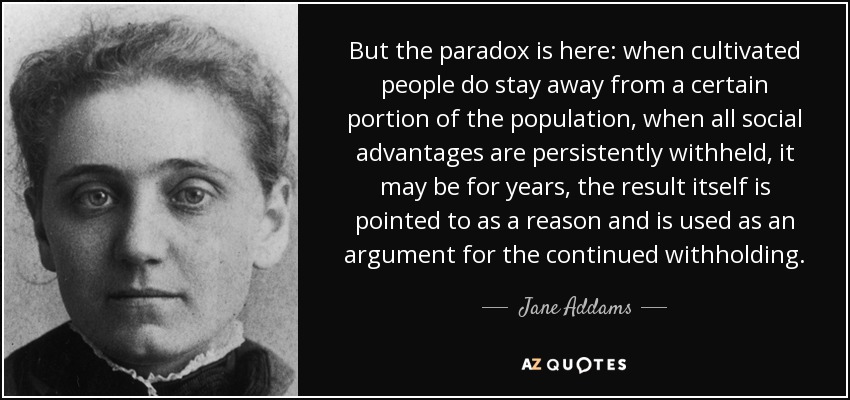
But the paradox is here: when cultivated people do stay away from a certain portion of the population, when all social advantages are persistently withheld, it may be for years, the result itself is pointed to as a reason and is used as an argument for the continued withholding.
There are levels of outrage, and there's a point at which you can't be trespassed upon anymore.
Work incessantly, cultivate discrimination, gather freedom from your own hard-earned results. Disregard successes but go back for help in an immediate problem. The possibility of discovery is everywhere. Freedom from your own work allows for intuition that draws from all your experience and perception but goes beyond it.
To get that word, male, out of the Constitution, cost the women of this country fifty-two years of pauseless campaign; 56 state referendum campaigns; 480 legislative campaigns to get state suffrage amendments submitted; 47 state constitutional convention campaigns; 277 state party convention campaigns; 30 national party convention campaigns to get suffrage planks in the party platforms; 19 campaigns with 19 successive Congresses to get the federal amendment submitted, and the final ratification campaign.
I saw no poor men, except a few intemperate ones. I saw some very poor women; but God and man know that the time has not come for women to make their injuries even heard of.
Had I been crested, not cloven, my Lords, you had not treated me thus.
Many women do not recognize themselves as discriminated against; no better proof could be found of the totality of their conditioning.
The Australian way of affirmative action is setting goals and recognising discrimination and lack of opportunity and deciding to take action and setting some goals and targets. I guess I prefer that language to talking about quotas.
Obama signed the Lilly Ledbetter Fair Pay Act to ensure fair pay for women in the workplace. In addition, he succeeded in getting a measure passed to end discrimination against gays in the military.
Everybody deserves fair treatment, equal treatment in the eyes of the law and the state. And that includes gays, lesbians, transgender persons. I am not a fan of discrimination and bullying of anybody on the basis of race, on the basis of religion, on the basis of sexual orientation or gender. This is actually part and parcel of the agenda that's also going to be front and centre, and that is how are we treating women and girls.
To avoid the consequences of posterity the mulattos give the blacks a first class letting alone. There is a frantic stampede white-ward to escape from Jamaica's black mass.
The suggestion of denying any measure of their full political rights to such a great group of our population as the colored people is one which, however it might be received in some other quarters, could not possibly be permitted by one who feels a responsibility for living up to the traditions and maintaining the principles of the Republican Party. Our Constitution guarantees equal rights to all our citizens, without discrimination on account of race or color. I have taken my oath to support that Constitution.
Religious expression must at least be afforded an equal playing field. Currently, the playing field is not level. Religious expression and practices are treated as second class forms of speech and singled out for discrimination.
According to UNESCO: there are over 154 million children in the world deprived of education due to poverty, slavery, racism, religious extremism, gender discrimination, and geographical isolation. The cost to educate a child in the third world is about $ 1 per month per child. To achieve global literacy, the investment would be $ 8 billion per year for 15 years.
We economists, in our classes, teach students that to some degree, price discrimination is actually a good thing; that it allows you to serve lower-income people. Take Africa, with AIDS. They could never finance what an AIDS cocktail costs here, over $10,000 a year. But if you sold it to them for $300 a year, which just barely covers cost, they could probably serve quite a few of their citizens, with World Bank help. We economists say that will be beneficial. But it's a two-tier system; yes, African people pay less than we would pay.
We need election systems that are free from fraud, discrimination, and partisan influence and that are more, not less, accessible to the citizens of this country.
I think what is being pointed out by African-Americans is that from slavery forward they have been living in a supposed democracy which treats them as less than other citizens, less than whites in the society. And I think that pointing out that there are structures of discrimination in the society, deeply rooted racist structures, that segregate housing, that send black children to ill-equipped schools, that discriminate in the workplace - these are truths about our society that must be faced.
These were always obsessions of mine, even as a very young child. These were things that interested me as the years went on. My friends were more preoccupied with social issues - issues such as abortion, racial discrimination, and Communism - and those issues just never caught my interest. Of course they mattered to me as a citizen to some degree...but they never really caught my attention artistically.
From what I understand from talking with older friends and feminists, I think that once I enter the workforce and start to think about marriage and having children, my gender will probably eclipse my feminist identity in terms of marginalization. Discrimination in terms of hiring and in the workplace are still real according to statistics. I also think, as a feminist, figuring out what a relationship based on true and complete equality is will be a challenge. But hopefully by the time I'm dealing with those issues feminists will have made great progress in all of those areas.
I think that in the diaspora, and among immigrants, religion becomes a vehicle for the transmission of cultural information, and cultural codes, and this does end up re-inscribing certain things about the religion - like caste. Caste discrimination and hierarchy are still a very fundamental and violent part of Hinduism. My family was upper caste, and that was very clear. I feel like caste and religious practice are inextricable, actually.
I remember being told by my parents when I was 4 that I couldn't go to an amusement park advertised on TV because colored kids weren't allowed there. That was a bit of a shock and really stayed with me over the years. That was how I first learned about racial segregation. Fortunately, I took it as a challenge, early on, and it motivated me. You never know how a child might respond to discrimination. It goes both ways. Some kids become embittered.
Perhaps the worst example of Smithsonian contempt for Jesus Christ is seen in its 1994 publication of a coffee-table book entitled Smithsonian Time Lines of the Ancient World ... This flagrant display of religious bigotry and discrimination in a book officially sponsored by the Smithsonian is intellectually and academically dishonest.
I have long felt that the trouble with discrimination is not discrimination per se, but rather that the people who are discriminated against think of themselves as second-class.
Follow AzQuotes on Facebook, Twitter and Google+. Every day we present the best quotes! Improve yourself, find your inspiration, share with friends
or simply: