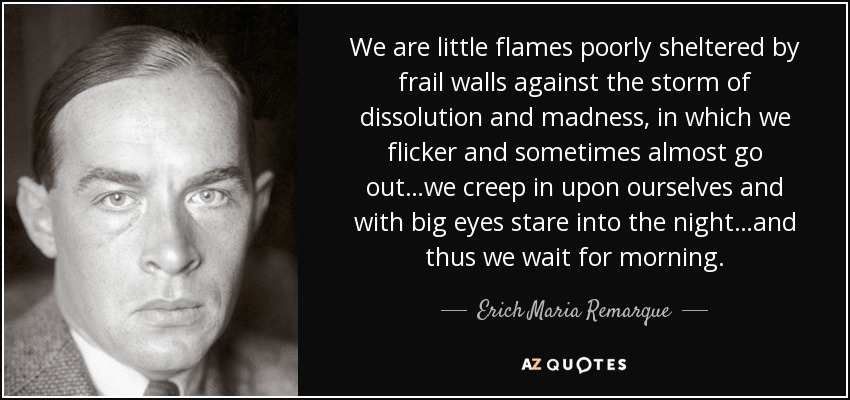
We are little flames poorly sheltered by frail walls against the storm of dissolution and madness, in which we flicker and sometimes almost go out…we creep in upon ourselves and with big eyes stare into the night…and thus we wait for morning.
A general dissolution of principles and manners will more surely overthrow the liberties of America than the whole force of the common enemy. While the people are virtuous they cannot be subdued; but when once they lose their virtue then will be ready to surrender their liberties to the first external or internal invader.
...despite all this, it is still hard to admit that there is no one more English than the Indian, no one more Indian than the English. There are still young white men who are angry about that; who will roll out at closing time into the poorly lit streets with a kitchen knife wrapped in a tight fist. But it makes an immigrant laugh to hear the fears of the nationalist, scared of infection, penetration, miscegenation, when this is small fry, peanuts, compared to what the immigrant fears - dissolution, disappearance.
It is a mistake to regard age as a downhill grade toward dissolution. The reverse is true. As one grows older, one climbs with surprising strides.
In the sunset of dissolution, everything is illuminated by the aura of nostalgia, even the guillotine.
When you have reached the point where you no longer expect a response, you will at last be able to give in such a way that the other is able to receive, and be grateful. When Love has matured and, through a dissolution of the self into light, become a radiance, then shall the Lover be liberated from dependence upon the Beloved, and the Beloved also be made perfect by being liberated from the Lover.
The solution of the problem lies in seeing it—in the seeing, without wanting a solution, or dissolution—just seeing what’s there. . . .
Against love's fire fear`s frost hath dissolution
The sum of the whole is this: walk and be happy, walk and be healthy. "The best of all ways to lengthen our days" is not, as Mr. Thomas Moore has it, "to steal a few hours from night, my love;" but, with leave be it spoken, to walk steadily and with a purpose. The wandering man knows of certain ancients, far gone in years, who have staved off infirmities and dissolution by earnest walking,-hale fellows close upon eighty and ninety, but brisk as boys.
It is difficult to conceive any situation more painful than to watch the lingering agony of an exhausted country, to tend it during the alternate fits of stupefaction and raving which precede its dissolution, and to see the symptoms of vitality disappear one by one, till nothing is left but coldness, darkness, and corruption.
Here and gone. That’s what it is to be human, I think—to be both someone and no one at once, to hold a particular identity in the world (our names, our place of origins, our family and affectional ties) and to feel that solid set of ties also capable of dissolution, slipping away, as we become moments of attention.
For in disease the most voluntary or most special movements, faculties, etc., suffer first and most, that is in an order the exact opposite of evolution. Therefore I call this the principle of Dissolution.
... I feel tired to death, paralyzed by this mysteriously wasted life's stubborn concentration on hopelessness and dissolution. It occurs to me that if I lie still like this for long enough, then I'll be dead when I finally wake again, and nothing can ever again torment me, beset me, or present me with evidence of my baseness and decay. That thought is the only one that can comfort me.
The force that unites the elements to become all things is Love, also called Aphrodite; Love brings together dissimilar elements into a unity, to become a composite thing. Love is the same force that human beings find at work in themselves whenever they feel joy, love and peace. Strife, on the other hand, is the force responsible for the dissolution of the one back into its many, the four elements of which it was composed.
The task of the modern era was the realization and humanization of God – the transformation and dissolution of theology into anthropology.
The dissolution of the pictorial into sheer texture, into apparently sheer sensation, into an accumulation of repetitions, seems to speak for and answer something profound in contemporary sensibility.
The smell of the sea, of kelp and fish and bitter moving water, rose stronger in my nostrils. It flooded my consciousness like an ancestral memory. The swells rose sluggishly and fell away, casting up dismal gleams between the boards of the pier. And the whole pier rose and fell in stiff and creaking mimicry, dancing its long slow dance of dissolution. I reached the end and saw no one, heard nothing but my footsteps and the creak of the beams, the slap of waves on the pilings. It was a fifteen-foot drop to the dim water. The nearest land ahead of me was Hawaii.
There are now no more horizons. And with the dissolution of horizons we have experienced and are experiencing collisions, terrific collisions, not only of peoples but also of their mythologies. It is as when dividing panels are withdrawn from between chambers of very hot and very cold airs: there is a rush of these forces together.
The full-grown modern human being who seeks but refuge finds instead boredom and mental dissolution, unless he can be, even in his withdrawal, creative. He can find the quality of happiness in the strain and travail only of achievement and growth. And he is conscious of touching the highest pinnacle of fulfillment which his life-urges demand when his is consumed in the service of an idea, in the conquest of the goal pursued.
It is only in times of social dissolution, as in the last age of the small Semitic states, when men and their gods were alike powerless before the advance of the Assyrians, that magical superstitions based on mere terror, or rites designed to conciliate alien gods, invade the sphere of tribal or national religion. In better times the religion of the tribe or state has nothing in common with the private and foreign superstitions or magical rites that savage terror may dictate to the individual.
Look at Christ, my dear friend: His life was divine through and through, full of self-denial, and He did everything for mankind, finding His satisfaction and His delight in the dissolution of His material being.
Laughter, while it lasts, slackens and unbraces the mind, weakens the faculties and causes a kind of remissness and dissolution in all the powers of the soul; and thus it may be looked on as weakness in the composition of human nature. But if we consider the frequent relieves we receive from it and how often it breaks the gloom which is apt to depress the mind and damp our spirits, with transient, unexpected gleams of joy, one would take care not to grow too wise for so great a pleasure of life.
The Greeks are wrong to recognize coming into being and perishing; for nothing comes into being nor perishes, but is rather compounded or dissolved from things that are. So they would be right to call coming into being composition and perishing dissolution.
Do not, I beseech you be troubled by the increase of forces already in dissolution. You have mistake the hour of the night: it is already morning.
That community is already in the process of dissolution where each man begins to eye his neighbor as a possible enemy, where non-conformity with the accepted creed, political as well as religious, is a mark of disaffection; where denunciation, without specification or backing, takes the place of evidence; where orthodoxy chokes freedom of dissent; where faith in the eventual supremacy of reason has become so timid that we dare not enter our convictions in the open lists, to win or lose.
Follow AzQuotes on Facebook, Twitter and Google+. Every day we present the best quotes! Improve yourself, find your inspiration, share with friends
or simply: