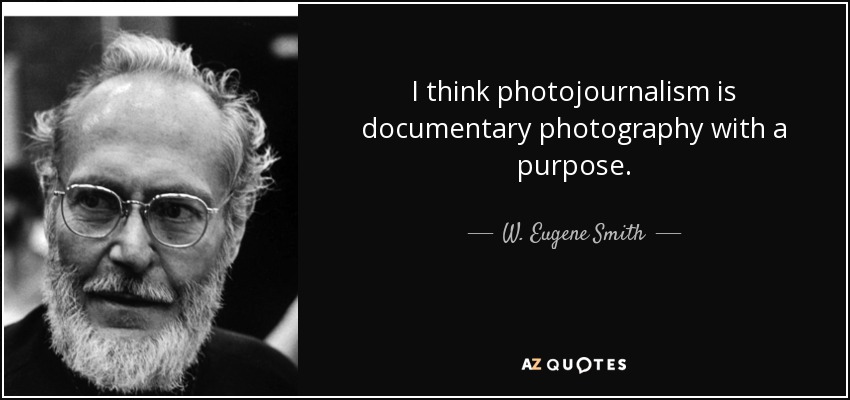
I think photojournalism is documentary photography with a purpose.
Reportage is interesting only when placed in a fictional context, but fiction is interesting only if it is validated by a documentary context.
When you say documentary, you have to have a sophisticated ear to receive that word. It should be documentary style, because documentary is police photography of a scene and a murder ... that's a real document. You see, art is really useless, and a document has use. And therefore, art is never a document, but it can adopt that style. I do it. I'm called a documentary photographer. But that presupposes a quite subtle knowledge of this distinction.
[Documentary photography] is unwittingly literary, because it is nothing other than an observation of contemporary life apprehended at the right moment by an artist capable of seizing it. (1928)
I need there to be documentary photographers, because my work is meta-documentary; it is a commentary about the documentary use of photography.
Photography is the typical means of expression of a society founded on a civilization of technicians, conscious of the aims it has set for itself... Its power of exactly reproducing external reality, a power inherent in its technique, lends it a documentary character and makes it appear as the most faithful and impartial process for the reproduction of social life.
The documentary style is an incredibly flexible and useful one. It's a wonderful tool for establishing the credibility of the version of things that's in the photograph - a kind of rhetorical device or rhetorical strategy. It's always felt very natural to me, because I want a person to end up thinking about the world, and to think about it in a way that is transformed by the experience of art.
For years my only purpose was to do documentary photos for magazines, without any idea that they were part of a larger project. It was as if I were carried along by a stream - even though I believed that the current was taking me in the right direction.
In a way my work is documentary. But I am also a photographer who has a distinct style. My photographs are a companion to the reality of the situation.
A picture that is ghostly and silent can be more eloquent and less clichéd than a noisier photo-journalistic approach and I have attempted to make pictures that whilst they are not documentary in the traditional sense, they are still documents, like forensic traces.
I'm kind of a twisted social documentary photographer.
The exposé, the compassion and outrage, of documentary fueled by the dedication to reform has shaded over into combinations of exoticism, tourism, voyeurism, psychologism and metaphysics, trophy hunting - and careerism.
Documentary is a little like horror movies, putting a face on fear and transforming threat into fantasy, into imagery. One can handle imagery by leaving it behind. (It is them, not us.)
Documentary photography has amassed mountains of evidence. And yet... the genre has simultaneously contributed much to spectacle, to retinal excitation, to voyeurism, to terror, envy and nostalgia, and only a little to the critical understanding of the social world.
...I don't see myself as a documentary photographer. I am more drawn to the image itself, rather than to the description of a scene. And, anyway, every image only halfway represents reality, whereas the other half is rather, more or less, fulfilling our imagination.
My staged work looks so real that people actually take it for documentary. But, in fact, that is my intention, to disguise the manufacturedness of it. Half of my work, or probably more than that, is staged.
The photographic frame is no longer used as a documentary window into undisturbed private lives, but as a stage on which the subjects consciously direct themselves to bring forward hidden information that is not normally displayed on the surface.
Making the documentary was an extraordinary experience and it really hit home to me the quasi-religious nature of this anthropogenic global warming cause. These people really have found religion.
I think being really open to this new world of online and what it means to be online. Also, understanding that maybe it's time to let go of the 90-minute experience and realize that all of the content that comes on top of the 90-minute film experience, [that] there's a lot of that, especially with documentaries.
I've always been interested in how to present something that relates to our reality - which is not really... I don't even know if documentary itself does as good a job. It has its own problems in trying to get at the reality of the situation.
No one likes documentaries.
I personally chose to go vegan because I educated myself on factory farming and cruelty to animals, and I suddenly realized that what was on my plate were living things, with feelings. And I just couldn't disconnect myself from it any longer. I read books like 'Diet for a New America' and saw documentaries like 'Earthlings' and 'Meet your Meat,' and it became an easy choice for me.
I think everything can be painted because painting can change reality; but everything cannot be photographed and the photographer often comes home empty-handed, with images which (often) have a documentary interest, but which rarely go further than that. One has to be completely available, very tenacious and admit that many subjects won't give any results... and a miracle sometimes happens, without warning.
Most people see a documentary about the meat industry and then they become a vegetarian for a week.
I saw a documentary on how ships are kept together. Riveting!
Follow AzQuotes on Facebook, Twitter and Google+. Every day we present the best quotes! Improve yourself, find your inspiration, share with friends
or simply: