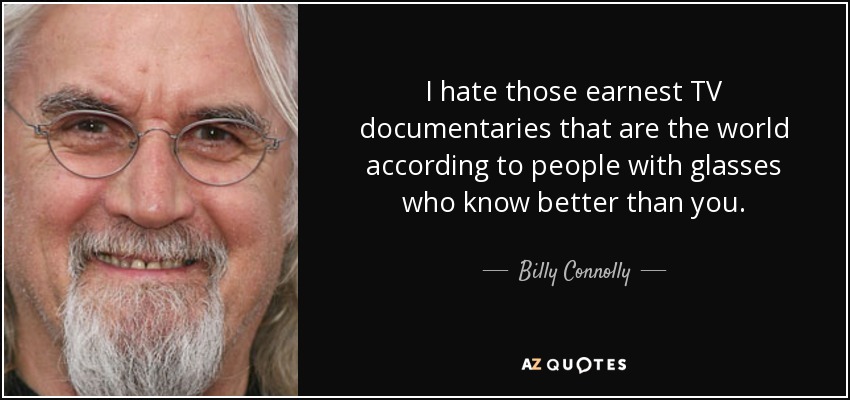
I hate those earnest TV documentaries that are the world according to people with glasses who know better than you.
The dismal half-baked images of the average "reportage" and "documentary" photography are self dammning... the slick manner, the slightly obscure significance, the esoteric fear of simple beauty for its own sake - I am deeply concerned with these manifestations of decay. Gene Smith's work validates my most vigorous convictions that if the documentary photographs is to be truly effective it must contain elements of art, intensity, fine craft and spirituality. All these his work contains and we may turn to his work with gratitude, appreciation and great respect.
I feel like the blues is actually some kind of documentary of the past and the present - and something to give people inspiration for the future.
I never really had any intention of getting involved in documentaries until the opportunity came around. I always thought much more in classic fiction cinema terms and I think I tried to apply those ideas to documentaries and not vice versa.
When you see the documentary, you'll see that there were parallels. Michael and I both wanted Daniel Craig, and it was the same as it was for Cubby and Harry when they wanted Sean [Connery]. The studio wanted a star and wanted an American, and wanted this and that, but they determined, "No, it's Sean Connery."
Most of my life, I thought that I would end up a novelist. But then, in New York City, after college, I started a company with a college friend where we made documentary video for museums. In that capacity, I shot, directed, edited and began to learn the vocabulary of film.
I'm not a fan of the Eagles, but I've watched their documentary numerous times and everyone who's watched it with me has sung along to the songs, much to my dismay.
Everybody should have a documentary made about themselves. It's amazing what you see and what you learn.
There's a documentary film-maker called Werner Herzog, who's a German film-maker. I really dig his stuff, I'd love to chat with him.
Alejandro Amenabar is a different kind of director than I lot of the directors I've asked for. He really asks you to enter his dream as opposed to, you know, a guy like Sidney Lumet or something is going to ask you to create a character almost like a documentary. He wants you to make the people really real and he's going to capture it like a documentarian.
You try to do as much as you can on set because practical looks cool and practical looks great. Until you get to a point where the reality is you look at it - and I went through this in my last movie which was a war film, which my brother fought in Iraq and I did a ton of research and as much as I could made it documentary-like - and then at some point on set, the reality is somebody says to you, "You know, you can use a real squib and you can have three hours of clean up and you can lose five shots or we can do that blood explosion in post and you can get those five extra shots."
You know, a documentary is only interesting once in a while. If you look at a whole book of Dorothea [Lange]'s where she has row after row of people bending over and digging out carrots - that can be very tedious. And so it's only once in a while that something happens that is worth doing.
I've always intended to eventually make films. I've always been very aware of tone and shots. But documentaries are a great proving ground for me.
I started by studying Kiswahili to learn the dialect. Then, I studied tapes, documentaries, footage, and audio cassettes of Idi Amin's speeches. And I met with his brothers, his sisters, his ministers, his generals' all kinds of people, in order to try to understand him.
We've never had a situation where mass media has been so censored, at least in my lifetime. When I was younger, networks like NBC, CBS, were independently owned, and took their jobs as journalists seriously. There used to be documentaries like "The Selling of the Pentagon."
At home, I watch fights and documentaries - that's it. If it's not about the birth and death of stars, 'Frozen Planet,' or someone getting punched in the face, I'm probably not watching it.
For some reason or other there was in me the desire to see the world clean and fresh and alive, as primitive things are clean and fresh and alive. The so-called documentary picture left me wanting something.
I heard a quote once in a documentary about a band that said you're better off owning everything 100 percent and selling 20,000 copies of an album than signing with a record company and selling a million copies. There has never been a truer statement about show business than that.
An eyewitness account is evidence that an artist has proposed a work of art. But documentary evidence (i.e. a photograph) is more conclusive.
Documentary is, therefore, an approach, which makes use of the artistic faculties to give vivification to fact - to use Walt Whitman's definition of the place of poetry in the modern world.
Both those taking snaps and documentary photographers... have not understood information. What they produce are camera memories, not information, and the better they do it, the more they prove the victory of the camera over the human being.
When the American documentary filmmaker Donn Alan Pennebaker wanted to do a film on Dylan, Dylan asked him what he'd already done, and Pennebaker answered, Nothing except shots in the street. Dylan asked to see them, and he agreed to let him do the film.
By calling it a memoir, I meant is as a collection of memories. I thought it was (a more) artful (title) than documentary.
I think that the whole voyeuristic attitude of filmmakers or of me personally - of shooting documentaries and so forth - is an important issue. And it was an important issue to me, personally. And the whole question of when - when do you put the camera down or when do you keep shooting to get the shot. And a number of times in my life I've had that question hit me very hard.
He was, as Billy Name said in the acclaimed Ric Burns documentary about Andy Warhol, uninterested in being a second-tier artist. He was uninterested in being a first-tier artist! He wanted to be, you know, a god. Someone who completely changed the...he wanted to be Zeus with the lightning bolt and nothing less would have satisfied him.
Follow AzQuotes on Facebook, Twitter and Google+. Every day we present the best quotes! Improve yourself, find your inspiration, share with friends
or simply: