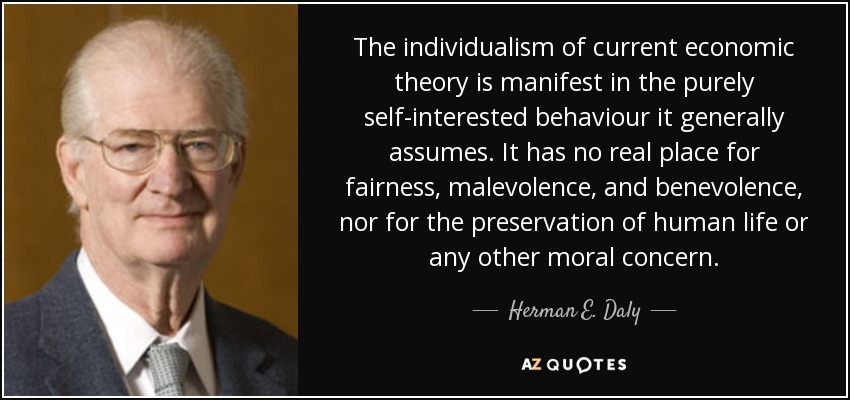
The individualism of current economic theory is manifest in the purely self-interested behaviour it generally assumes. It has no real place for fairness, malevolence, and benevolence, nor for the preservation of human life or any other moral concern.
The first issue to be settled is whether socialism has a right to exist. Are its allegations concerning the present system true? Is industry proceeding on a principle of fraud? I wish to test the power of recent economic theory to give an exact answer to this question.
Library of the Works of Ludwig von Mises”. Here is an article he wrote in 1951, some two years after his magnum opus Human Action appeared, where is lays out his case in a more popular form. The money sentences are “Economic theory has demonstrated in an irrefutable way that a prosperity created by an expansionist monetary and credit policy is illusory and must end in a slump, an economic crisis. It has happened again and again in the past, and it will happen in the future, too.
Economic theory has nothing to say as to what commodity will acquire the status of money. Historically, it happened to be gold. But if the physical makeup of our world would have been different or is to become different from what it is now, some other commodity would have become or might become money. The market will decide.
In short, both experience and economic theory imply that the US could now t to a more competitive dollar without experiencing either increased inflation or decreased economic growth.
I believe myself to be writing a book on economic theory which will largely revolutionize - not, I suppose, at once but in the course of the next ten years - the way the world thinks about economic problems.
Washington's insatiable desire to spend our children's inheritance on failed stimulus plans and other misguided economic theories have given record debt and left us with far too many unemployed.
We are all far less rational in our decision-making than standard economic theory assumes. Our irrational behaviors are neither random nor senseless: they are systematic and predictable. We all make the same types of mistakes over and over, because of the basic wiring of our brains.
I imagine you already know that I am much more socialistic in my economic theory than capitalistic. And yet I am not so opposed to capitalism that I have failed to see its relative merits. It started out with a noble and high motive, to block the trade monopolies of nobles, but like most human systems it falls victim to the very thing it was revolting against. So today capitalism has outlived its usefulness. It has brought about a system that takes necessities from the masses to give luxuries to the classes.
People tend to be clueless about prices. Contrary to economic theory, we don't really decide between A and B by consulting our invisible price tags and purchasing the one that yields the higher utility, he says. We make do with guesstimates and a vague recollection of what things are “supposed to cost.”
In view of the importance of philanthropy in our society, it is surprising that so little attention has been given to it by economic or social theorists. In economic theory, especially, the subject is almost completely ignored. This is not, I think, because economists regard mankind as basically selfish or even because economic man is supposed to act only in his self-interest; it is rather because economics has essentially grown up around the phenomenon of exchange and its theoretical structure rests heavily on this process.
Even philosophies who have denounced pseudosciences like psychoanalysis, have condoned pseudoscientific economic theories like neoclassical microeconomics. It is far safer and easier to criticize Freud and Jung than to criticize Milton Friedman and Friedrich Hayek, because the latter are backed by political movements whereas the former are not.
For the individual, as I can testify, a brief grounding in semantics, besides making philosophy unreadable, makes unreadable most political speeches, classical economic theory, after-dinner oratory, diplomatic notes, newspaper editorials, treatises on pedagogics and education, expert financial comment, dissertations on money and credit, accounts of debates, and Great Thoughts from Great Thinkers in general. You would be surprised at the amount of time this saves.
Everybody thinks of economics whether he is aware of it or not. In joining a political party or in casting his ballot, the citizen implicitly takes a stand upon essential economic theories.
The metal of economic theory is in Marx's pages immersed in such a wealth of steaming phrases as to acquire a temperature not naturally its own.
For Marx, 'pure' economic theory, that is economic theory which abstracts from a specific social structure, is impossible.
One of the big take-aways from a lot of economic theory is that people should engage in consumption smoothing.
Positivism eliminates any kind of natural law principle - for example, that there are economic laws which can be transgressed only at your peril. With positivism, there is a tendency to leap into ad hoc economic theory.
If, of course, one builds into the concept of an 'individual' all that Professor Hayek does in his Road To Serfdom, Individualism and Economic Order and many other works, which is, to put it briefly, the whole of laisser-faire economic theory, then plainly man as such a programmed predator has very little interest in being fraternal, or very little chance.
The notion that a society could be regulated entirely by market forces is a utopian fantasy: an impossible dream generated by imagining what the world would be like if everyone's behavior was utterly consistent with some abstract moral ideal-in this case, economic theories that assume all human action is based on calculating, systematic, (but scrupulously law-abiding), greed.
My interest in economics has always been in the whole corpus of economic theory, the interrelationships between the various fields of theory and their relevance for the formulation of economic policy.
My job was to teach the whole corpus of economic theory, but there were two subjects in which I was especially interested, namely, the economics of mass unemployment and international economics.
There is much of economic theory which is pursued for no better reason than its intellectual attraction; it is a good game. We have no reason to be ashamed of that, since the same would hold for many branches of mathematics.
Free market capitalism is far more than economic theory. It is the engine of social mobility-the highway to the American Dream.
If I really believed in Friedman's economic theory, then I'd be quite satisfied to spend the rest of my life with a garden hose shoved down my throat, being filled with custard by representatives of the people of China.
Follow AzQuotes on Facebook, Twitter and Google+. Every day we present the best quotes! Improve yourself, find your inspiration, share with friends
or simply: