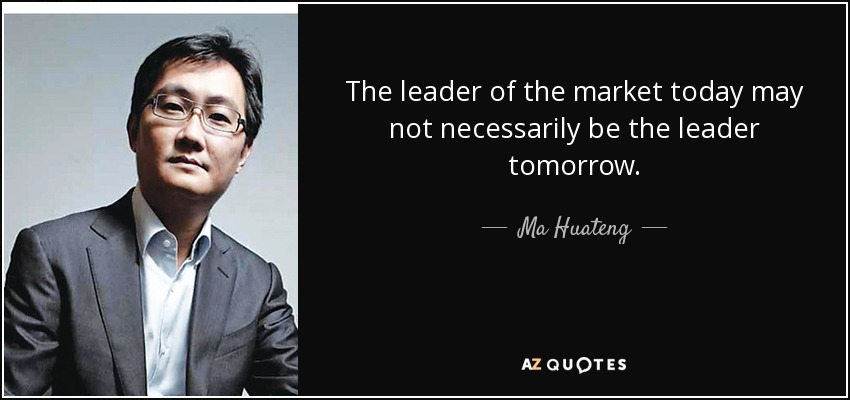
The leader of the market today may not necessarily be the leader tomorrow.
People can get information - on entertainment, politics, finance - much easier than before. That will change the way people do business, the way people live.
Where most entrepreneurs fail is on the things they don't know they don't know.
An entrepreneur is someone who dares to dream the dreams and is foolish enough to try to make those dreams come true.
It is important in any population to have an ecosystem around start-up ideas to leverage the most out of them such an ecosystem needs developing and most of this is about giving entrepreneurs confidence.
In business, there are times when you disagree, and sometimes it turns out that you're just plain wrong. Humor takes away tension and helps you realize you're wrong.
Entrepreneurs are never satisfied. They want to do things better. They strive for perfection and use all the ingenuity to their command to achieve it.
Some 80% of your life is spent working. You want to have fun at home; why shouldn't you have fun at work?
I think a lot of becoming an entrepreneur is something which people have to learn just from getting out there and giving it a go, and having to learn the art of survival.
I've always learned on-the-job, in real time. A problem comes up; I research it, and try to solve it. You can't study to be an entrepreneur; you have to develop those skills day in day out. All entrepreneurial experiences are related, whether you're selling worm poop to Wal-Mart or a grade tracking application to the public elementary school system. In the end, it's all very similar.
My half-baked reading of history is that we continue to go through these waves of entrepreneurial explosion followed by merger mania and consolidation. Out of that come big sluggish companies that eventually collapse under the weight of what they've created, and are killed off by the next wave of entrepreneurs.
Business skills, when well applied, can do more than just make money. They can potentially make money and do some real good, which is immensely satisfying. To do that, it's important to think outside the box, take risks, and be an entrepreneur.
Once you know what you want and what is important for you to achieve, also define the values associated with it. What is important? That is something a lot of entrepreneurs pass by too quickly. For us, the things that were important were, No. 1, customer success. Nothing is more important to us than making sure every customer is successful in our service.
"(Big name research firm) says our market will be $50 billion in 2010." Every entrepreneur has a few slides about how the market potential for his segment is tens of billions. It doesn't matter if the product is bar mitzah planning software or 802.11 chip sets. Venture capitalists don't believe this type of forecast because it's the fifth one of this magnitude that they've heard that day. Entrepreneurs would do themselves a favor by simply removing any reference to market size estimates from consulting firms.
It's the combination: big idea with a good entrepreneur: there's nothing more powerful. That's just as true [for] education and human rights as it is for hotel or steels.
The most important job of the entrepreneur begins before there is a business or employees. The job of an entrepreneur is to design a business that can grow, employ many people, add value to its customers, be a responsible corporate citizen, bring prosperity to all those that work on the business, be charitable, and eventually no longer need the entrepreneur. Before there is a business, a successful entrepreneur is designing this type of business in his or her mind's eye. According my rich dad, this is the job of a true entrepreneur.
Rich dad went on to explain that the world was filled with different types of entrepreneurs. There are entrepreneurs who are big and small, rich and poor, honest and crooked, for-profit and not-for-profit, saint and sinner, small town and international, and successes and failures. He said, "The word entrepreneur is a big word and it means different things to different people."
Any outcome, any deal that doesn't preserve the freedom and openness of the Internet for consumers and entrepreneurs will be unacceptable.
"No one is doing what we're doing." This is a bummer of a lie because there are only two logical conclusions. First, no one else is doing this because there is no market for it. Second, the entrepreneur is so clueless that he can't even use Google to figure out he has competition. Suffice it to say that the lack of a market and cluelessness is not conducive to securing an investment. As a rule of thumb, if you have a good idea, five companies are going the same thing. If you have a great idea, fifteen companies are doing the same thing.
Most of the time, creative entrepreneurs lose interest long before their marketing message loses its power.
When things are at their worst, I find something always happens.
Consider what it takes for successful businessmen and businesswomen, effective entrepreneurs and hardworking associates, shrewd retirees and idealistic students to combine forces with a creative pastor to grow a "successful church" today. Clearly, it doesn't require the power of God to draw a crowd in our culture. A few key elements that we can manufacture will suffice.
Entrepreneurs must love what they do to such a degree that doing it is worth sacrifice and, at times, pain. But doing anything else, we think, would be unimaginable.
There are very few self-made millionaires, if any, who have not taken risks which would make the rest of us unable to sleep at night, or keep our food down.
Entrepreneurs constantly confuse what they do with who they are. We're all certainly responsible for what we do, but failing doesn't make us bad people and succeeding doesn't make us omniscient.
Follow AzQuotes on Facebook, Twitter and Google+. Every day we present the best quotes! Improve yourself, find your inspiration, share with friends
or simply: