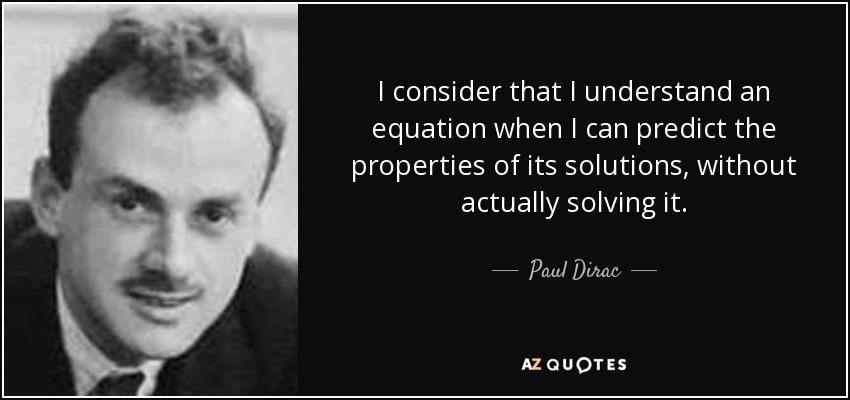
I consider that I understand an equation when I can predict the properties of its solutions, without actually solving it.
It is more important to have beauty in one's equations than to have them fit experiment.
Playing a three-hour Rush show is like running a marathon while solving equations.
Well, in the first place, it leads to great anxiety as to whether it's going to be correct or not ... I expect that's the dominating feeling. It gets to be rather a fever... At age 60, when asked about his feelings on discovering the Dirac equation.
What can a pencil do for all of us? Amazing things. It can write transcendent poetry, uplifting music, or life-changing equations; it can sketch the future, give life to untold beauty, and communicate the full-force of our love and aspirations.
Think of your existing power as the exponent in an equation that determines the value of information. The more power you have, the more additional power you derive from the new data.
Darwin's theory of evolution is a framework by which we understand the diversity of life on Earth. But there is no equation sitting there in Darwin's 'Origin of Species' that you apply and say, 'What is this species going to look like in 100 years or 1,000 years?' Biology isn't there yet with that kind of predictive precision.
All the standard equations of mathematical physics can be separated and solved in Kerr geometry.
You know the best thing about competition? There's this whole strategy game, and when it all works out its like solving that hard math equation. You finally get the answer and you're so happy.
Science is beautiful when it makes simple explanations of phenomena or connections between different observations.
Concern for man and his fate must always form the chief interest of all technical endeavors. Never forget this in the midst of your diagrams and equations.
When the Constitution gave us the right to bear arms, it also made us responsible for using them properly. It's not fair of us as citizens to lean more heavily on one side of that equation than on the other.
When I get bored, or get stuck on an equation, I like to go ice skating, but it makes you forget your problem. Then you can tackle the problem with a fresh new insight. Einstein liked to play the violin to relax. Every physicist likes to have a past time. Mine is ice skating.
It is more important to have beauty in one's equations than to have them fit experiment... It seems that if one is working from the point of view of getting beauty in one's equations, and if one has really a sound insight, one is on a sure line of progress. If there is not complete agreement between the results of one's work and experiment, one should not allow oneself to be too discouraged, because the discrepancy may well be due to minor features that are not properly taken into account and that will get cleared up with further developments of the theory.
But think of Adam and Eve like an imaginary number, like the square root of minus one: you can never see any concrete proof that it exists, but if you include it in your equations, you can calculate all manner of things that couldn't be imagined without it.
Accordingly, we find Euler and D'Alembert devoting their talent and their patience to the establishment of the laws of rotation of the solid bodies. Lagrange has incorporated his own analysis of the problem with his general treatment of mechanics, and since his time M. Poinsôt has brought the subject under the power of a more searching analysis than that of the calculus, in which ideas take the place of symbols, and intelligent propositions supersede equations.
The equation of animal and vegetable life is too complicated a problem for human intelligence to solve, and we can never know how wide a circle of disturbance we produce in the harmonies of nature when we throw the smallest pebble into the ocean of organic life.
String theory has the potential to show that all of the wondrous happenings in the universe - from the frantic dance of subatomic quarks to the stately waltz of orbiting binary stars; from the primordial fireball of the big bang to the majestic swirl of heavenly galaxies - are reflections of one, grand physical principle, one master equation.
In my own research when I'm working with equations, I never feel like I really understand what I'm doing if I'm solely relying on the mathematics for my understanding. I need to have a visual picture in my mind. I'm constantly translating from the math to some intuitive mind's-eye picture.
No matter how much you rehearse on that stage, once you add 30,000 screaming people with flashing cameras into the equation, it's pretty intense.
My favourite fellow of the Royal Society is the Reverend Thomas Bayes, an obscure 18th-century Kent clergyman and a brilliant mathematician who devised a complex equation known as the Bayes theorem, which can be used to work out probability distributions. It had no practical application in his lifetime, but today, thanks to computers, is routinely used in the modelling of climate change, astrophysics and stock-market analysis.
The underlying physical laws necessary for the mathematical theory of a large part of physics and the whole of chemistry are thus completely known, and the difficulty is only that the exact application of these laws leads to equations much too complicated to be soluble. It therefore becomes desirable that approximate practical methods of applying quantum mechanics should be developed, which can lead to an explanation of the main features of complex atomic systems without too much computation.
It was basic research in the photoelectric field-in the photoelectric effect that would one day lead to solar panels. It was basic research in physics that would eventually produce the CAT scan. The calculations of today's GPS satellites are based on the equations that Einstein put to paper more than a century ago.
I’m a student of patterns. At heart, I’m a physicist. I look at everything in my life as trying to find the single equation, the theory of everything.
A good deal of my research in physics has consisted in not setting out to solve some particular problem, but simply examining mathematical equations of a kind that physicists use and trying to fit them together in an interesting way, regardless of any application that the work may have. It is simply a search for pretty mathematics. It may turn out later to have an application. Then one has good luck. At age 78.
Follow AzQuotes on Facebook, Twitter and Google+. Every day we present the best quotes! Improve yourself, find your inspiration, share with friends
or simply: