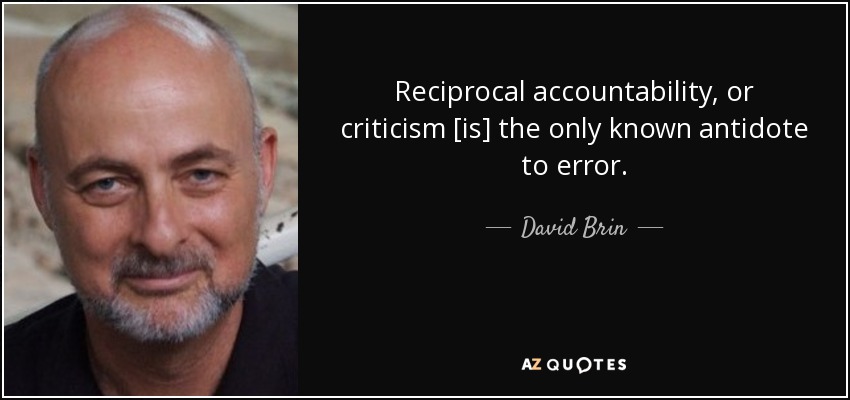
Reciprocal accountability, or criticism [is] the only known antidote to error.
In all of history, we have found just one cure for error—a partial antidote against making and repeating grand, foolish mistakes, a remedy against self-deception. That antidote is criticism.
When you are sixteen you do not know what your parents know, or much of what they understand, and less of what's in their hearts. This can save you from becoming an adult too early, save your life from becoming only theirs lived over again--which is a loss. But to shield yourself--as I didn't do--seems to be an even greater error, since what's lost is the truth of your parents' life and what you should think about it, and beyond that, how you should estimate the world you are about to live in.
At the last dim horizon, we search among ghostly errors of observations for landmarks that are scarcely more substantial. The search will continue. The urge is older than history. It is not satisfied and it will not be oppressed.
There we measure shadows, and we search among ghostly errors of measurement for landmarks that are scarcely more substantial.
Calvinism emphasizes divine sovereignty and free grace; Arminianism emphasizes human responsibility. The one restricts the saving grace to the elect; the other extends it to all men on the condition of faith. Both are right in what they assert; both are wrong in what they deny. If one important truth is pressed to the exclusion of another truth of equal importance, it becomes an error, and loses its hold upon the conscience. The Bible gives us a theology which is more human than Calvinism and more divine than Arminianism, and more Christian than either of them.
Life has puffed and blown itself into a summer day, and clouds and spring billow over the heavens as if calendars were a listing of mathematical errors.
There are two equal and opposite errors into which our race can fall about the devils. One is to disbelieve in their existence. The other is to believe, and to feel an excessive and unhealthy interest in them. They themselves are equally pleased by both errors and hail a materialist or a magician with the same delight.
The monkish vows keep us far from that sink of vice that is the female body, but often they bring us close to other errors. Can I finally hide from myself the fact that even today my old age is still stirred by the noonday demon when my eyes, in choir, happen to linger on the beardless face of a novice, pure and fresh as a maidens?
Besides it is an error to believe that rigour is the enemy of simplicity. On the contrary we find it confirmed by numerous examples that the rigorous method is at the same time the simpler and the more easily comprehended. The very effort for rigor forces us to find out simpler methods of proof.
Prejudice for regularity and simplicity is a source of error that has only too often infected philosophy.
Developing fewer features allows you to conserve development resources and spend more time refining those features that users really need. Fewer features mean fewer things to confuse users, less risk of user errors, less description and documentation, and therefore simpler Help content. Removing any one feature automatically increases the usability of the remaining ones.
Fascism was an emergency makeshift. To view it as something more would be a fatal error.
The ideas which now pass for brilliant innovations and advances are in fact mere revivals of ancient errors, and a further proof of the dictum that those who are ignorant of the past are condemned to repeat it.
In vain do we seek tranquility in the desert; temptations are always with us; our passions, represented by the demons, never let us alone: those monsters created by the heart, those illusions produced by the mind, those vain specters that are our errors and our lies always appear before us to seduce us; they attack us even in our fasting or our mortifications, in other words, in our very strength.
If for every error and every act of incompetence one can substitute an act of treason, many points of fascinating interpretation are open to the paranoid imagination.
My mind is incapable of conceiving such a thing as a soul. I may be in error, and man may have a soul; but I simply do not believe it.
The empire of Christ the King includes not only Catholic nations, not only baptized persons who, though of right belonging to the Church, have been led astray by error, or have been cut off from her by schism, but also all those who are outside the Christian faith: so that truly the whole of mankind is subject to the power of Jesus Christ.
Most people define learning too narrowly as mere 'problem-solving', so they focus on identifying and correcting errors in the external environment. Solving problems is important. But if learning is to persist, managers and employees must also look inward. The need to reflect critically on their own behaviour, identify the ways they often inadvertently contribute to the organisation’s problems, and then change how they act.
He [Thelonious Monk] played each note as though astonished by the previous one, as though every touch of his fingers on the keyboard was correcting an error and this touch in turn became an error to be corrected and so the tune never quite ended up the way it was meant to.
There must be no barriers to freedom of inquiry... There is no place for dogma in science. The scientist is free, and must be free to ask any question, to doubt any assertion, to seek for any evidence, to correct any errors. Our political life is also predicated on openness. We know that the only way to avoid error is to detect it and that the only way to detect it is to be free to inquire. And we know that as long as men are free to ask what they must, free to say what they think, free to think what they will, freedom can never be lost, and science can never regress.
Power must be used, but it must be tempered by soul-searching and the recognition of our human capacity for error. That is the maxim that should inform our approach to every challenge, from reforming state government to engaging in foreign affairs.
My loyalty to my people, to our people, and to Israel comes first and prevents me from saying anything critical of Israel outside Israel… As a Jew I see my role as a melitz yosher, a defender of Israel: I defend even her mistakes… I must identify with whatever Israel does – even with her errors.
The low view of God entertained almost universally among Christians is the cause of a hundred lesser evils everywhere among us.
The unattended garden will soon be overrun with weeds; the heart that fails to cultivate truth and root out error will shortly be a theological wilderness.
Follow AzQuotes on Facebook, Twitter and Google+. Every day we present the best quotes! Improve yourself, find your inspiration, share with friends
or simply: