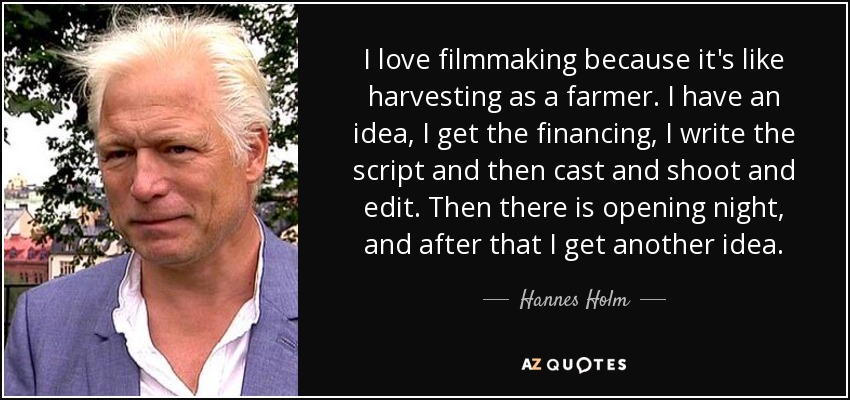
I love filmmaking because it's like harvesting as a farmer. I have an idea, I get the financing, I write the script and then cast and shoot and edit. Then there is opening night, and after that I get another idea.
Equally important is the lack of cultivable land for farmers, a profound problem when you take into account that Afghanistan has always largely been an agricultural country, and that even before the wars destroyed lands and irrigation canals, only 5 per cent of the land was cultivable.
We were into the Speedway. We'd take a train out to the Speedway where farmers had flatbed trucks with bleachers on them. They'd park in the infield and we'd sit on those. Our heroes weren't the drivers, they were the pit crews. That's because we were local, and we knew what was going on.
A big producer can survive price fluctuations on the world market. A small farmer can't.
Federal overreach from agencies like the EPA is hurting family farms. I will fight against these crippling regulations, and always side with the hard working farmers and ranchers of Missouri.
I've got to find local farmers and get natural foods.
Even in the early days of America when it was largely an agrarian or agricultural, farmer-type of economy. There were still cities; there were still elites.
My father was a cotton farmer first and - but he didn't have any land or what land he had, he lost it in the Depression. So he worked as a woodman and cut pulpwood for the paper mills, rode the rails in boxcars going from one harvest to another to try to make a little money picking fruit or vegetables.
We want to create a society in which our workers and farmers can afford to appear in handsome attire and enjoy a good life and health; we want this kind of society.
As to the latter point - that by having a child in America you are somehow starving a child in Bangladesh - remember that agricultural economics is not a zero-sum game. Farmers want to make a living, so as demand increases, so does production. Not only that, but agricultural productivity has increased so rapidly that in some countries the government pays farmers not to plant crops in an effort to keep food prices from dropping.
The food system is a very complex beast. There are people who are going to get their food at Wal-Mart or at Safeway; they're not going to the farmers' market. Those people need choices too.
I really do think that cooking is very important. It's really important for the farmers because it means you're going to be buying real food and not processed food, so that means the farmers will capture more of your food dollar.
When I got out of school, I spent two years just hitchhiking around. Every time I met some old farmer who could play banjo, I got him to teach me a lick or two. Little by little, I put it together.
I chase a little white ball around and work on my farmer tan, that's about it. I think that I've been lucky enough to represent some great companies, and I think maybe that's what it is.
The remaining revenue on the consumption of foreign luxuries to domestic comforts, being collected on our seaboard and frontiers only, and incorporated with the transactions of our mercantile citizens, it may be the pleasure and the pride of an American to ask, What farmer, what merchant, what laborer ever sees a tax gatherer of the United States?
More generally, independent farmers had to be trained to become docile workers in the expanding industrial system. It was necessary to drive from their heads evil ideas, such as the belief that wage labor was not much different from chattel slavery. That continues to the present, now sometimes taking the form of an attack on public education.
There are a lot of regulations that are really just crushing jobs. Look at the coal miners in the Rust Belt that are getting out of work. Look at the - look at the loggers and the timber workers and the paper mills in the West Coast. Look at the ranchers or farmers in the Midwest with regulations.
I saw all that [white trash] growing up in Alabama and Georgia. I had a group of country cousins and we'd go visit them when I was a kid. They lived on a red dirt Georgia back road, in a shack, with twelve kids. Farmers. No electricity, they had a well on their back porch, but they had nothing, yet they were the happiest, freest people I'd ever met. I loved to visit them. Great sense of humor, and they kept up with all the latest music, country, rockabilly, that stuff. Great food they grew in the fields and canned. Happy people.
Leona Helmsley's dog made $12 million last year... and Dean McLaine, a farmer in Ohio, made $30,000. It's just a gigantic version of the madness that grows in every one of our brains.
First of all, farmers should work with universities and research institutions in the country, and hopefully with the government.
There is no reason why a company like Monsanto, for example, that is pushing GMOs, cannot go to Kenya, partner with the university, partner with the research institutions, and try to promote - in a responsible way - advanced techniques to help farmers. But this should be done in such a way that the farmers' livelihoods are not undermined because the government is irresponsible or careless, or because it is compromised.
One of the reasons why we started the Green Belt Movement is to work with these ordinary peasant farmers so as to educate them that, despite the fact that they are poor, it is in their interest to protect the soil that they have, to protect the forest they have, to protect the land that they have, because if they don't do it, things can be only worse tomorrow for them for them and for their children.
I'm not into branding - I'm trying to be organic to who I am on every level. I do really connect to being a part of the working class. Those are my roots. My family [consists of] farmers from Portugal, builders, housekeepers and stonemasons.
Even in our own agriculture strategy, if we got a great new drought-resistant seed and we managed to get it distributed in the system, we just assumed that it would reach female farmers. That's a false assumption, because women don't interact with agro-dealers. So if you don't develop specific programming to ensure that seed gets in a woman's hands, then the extra income [generated by higher-yielding crops] goes into her husband's hands.
It does not matter whether you paint, sculpt, or make shoes, whether you are a gardener, a farmer, a fisherman, a carpenter-it does not matter. What matters is, are you putting your very soul into what you are creating? Then your creative products have something of the quality of divine.
Follow AzQuotes on Facebook, Twitter and Google+. Every day we present the best quotes! Improve yourself, find your inspiration, share with friends
or simply: