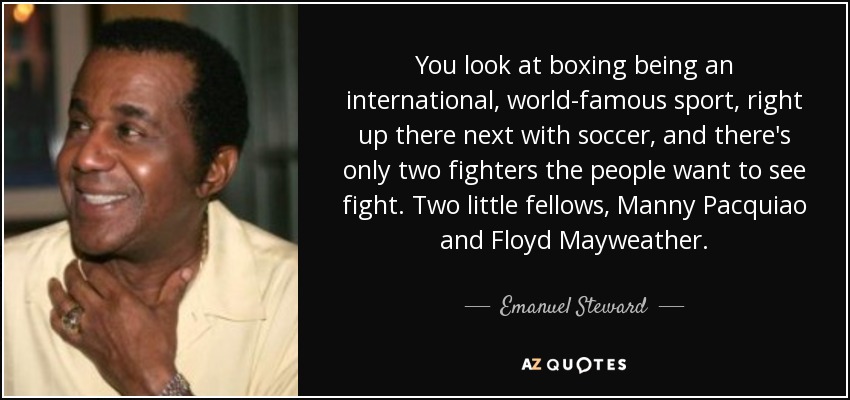
You look at boxing being an international, world-famous sport, right up there next with soccer, and there's only two fighters the people want to see fight. Two little fellows, Manny Pacquiao and Floyd Mayweather.
All education should be directed toward the refinement of the individual's sensibilities in relation not only to one's fellow humans everywhere, but to all living things whatsoever.
Society is a republic. When an individual endeavors to lift himself above his fellows, he is dragged down by the mass, either by means of ridicule or of calumny. No one shall be more virtuous or more intellectually gifted than others. Whoever, by the irresistable force of genius, rises above the common herd is certain to be ostracized by society, which will pursue him with such merciless derision and detraction that at last he will be compelled to retreat into the solitude of his thoughts.
The concept of individual with a conscience is one whose highest allegiance is to his fellow man.
In the book, America had already been weakened by bio terror plagues before waves of selfish violence took down the rest. But the real enemy was the kind of male human being who nurses fantasies of violent glory at the expense of his fellow citizens.
There were so many fellows ranked over me I couldn't just whoop them all. I had to out-shadow them by talking.
Since we are not yet fully comfortable with the idea that people from the next village are as human as ourselves, it is presumptuous in the extreme to suppose we could ever look at sociable, tool-making creatures who are from other evolutionary paths and see not beasts, but brothers, not rivals, but fellow pilgrims journeying to the shrine of intelligence...The difference... is not in the creature judged, but in the creature judging.
The following proposition seems to me in a high degree probable—namely, that any animal whatever, endowed with well-marked social instincts, the parental and filial affections being here included, would inevitably acquire a moral sense or conscience, as soon as its intellectual powers had become as well, or nearly as well developed, as in man. For, firstly, the social instincts lead an animal to take pleasure in the society of its fellows, to feel a certain amount of sympathy with them, and to perform various services for them.
I am fully persuaded that thousands of our fellow-men might profit equally by a similar course to mine; but, constitutions not being all alike, a different course of treatment may be advisable for the removal of so tormenting an affliction.
In coming to the Congress as a new Member and becoming a fellow Blue Dog, we have had an opportunity to share and really spend a great deal of time in examining the challenges that our Nation finds itself in in getting its fiscal house in order.
The average man is hooked to his fellow men, while the warrior is hooked only to himself. Perhaps you are chasing rainbows. You're after the self-confidence of the average man, when you should be after the humbleness of a warrior. The difference between the two is remarkable. Self Confidence entails knowing something for sure; humbleness entails being impeccable in one's actions and feelings.
Every intellectual has a very special responsibility. He has the privilege and the opportunity of studying. In return, he owes it to his fellow men (or 'to society') to represent the results of his study as simply, clearly and modestly as he can. The worst thing that intellectuals can do - the cardinal sin - is to try to set themselves up as great prophets vis-à-vis their fellow men and to impress them with puzzling philosophies. Anyone who cannot speak simply and clearly should say nothing and continue to work until he can do so.
Man has an incurable habit of not fulfilling the prophecies of his fellow men.
We cannot truly love God if we do not love our fellow travelers on this mortal journey.
My favorite quote: The land ethic simply enlarges the boundaries of the community to include soils, waters, plants, and animals, or collectively: the land. In short, a land ethic changes the role of Homo sapiens from conqueror of the land-community to plain member and citizen of it. It implies respect for his fellow-members, and also respect for the community as such.
Apollo without Dionysus may indeed be a well-informed, good citizen but he's a dull fellow. He may even be 'cultured,' in the sense one often gets from traditionalist writings in education. . . . But without Dionysus he will never make and remake a culture.
You are a vain fellow. You want to be a hero. That is why you do such silly things. A hero!... I don't quite know what that is: but, you see, I imagine that a hero is a man who does what he can. The others do not do it.
Harden our hearts. To the innocents in the womb and we have hardened our hearts. To the need for compassion and mercy and. Fellow feeling. And charity. And decency in this world.
One Blue Dog Democratic House Member reminded me earlier this month of the saying that 'insanity is doing the same thing over and over again and expecting different results.' He wondered if his fellow Members weren't more in need of advice from psychiatrists than from economists at this point.
I told you once that I was searching for the nature of evil. I think I've come close to defining it: a lack of empathy. It's the one characteristic that connects all the defendants. A genuine incapacity to feel with their fellow man. Evil, I think, is the absence of empathy.
Today, I am wondering what would have happened to me by now, if, fifty years ago, some fluent talker had converted me to the theory of the eight-hour day and convinced me that it was not fair to my fellow-workers to put forth my best efforts in my work? I am glad that the eight-hour day had not been invented when I was a young man. If my life had been made up of eight-hour days, I don't believe I could have accomplished a great deal.
Yet again, unscientific claims were being circulated broadly, but the scientists' refutation of them was published where only fellow scientists would see it.
My favourite fellow of the Royal Society is the Reverend Thomas Bayes, an obscure 18th-century Kent clergyman and a brilliant mathematician who devised a complex equation known as the Bayes theorem, which can be used to work out probability distributions. It had no practical application in his lifetime, but today, thanks to computers, is routinely used in the modelling of climate change, astrophysics and stock-market analysis.
The paradox of American democracy has been that its slogan of equal opportunity has meant, often, equal opportunity to get power over your fellows.
Try to remember the kind of September When life was slow and oh so mellow. Try to remember the kind of September When grass was green and grain was yellow. Try to remember the kind of September When you were a tender and callow fellow. Try to remember and if you remember then follow follow.
Follow AzQuotes on Facebook, Twitter and Google+. Every day we present the best quotes! Improve yourself, find your inspiration, share with friends
or simply: