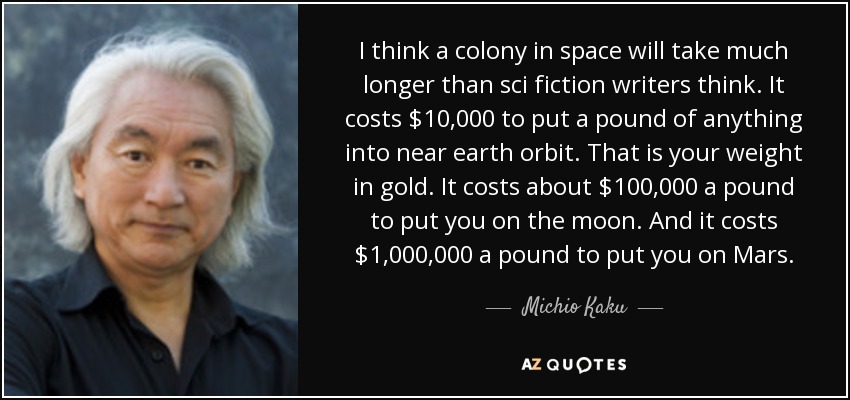
I think a colony in space will take much longer than sci fiction writers think. It costs $10,000 to put a pound of anything into near earth orbit. That is your weight in gold. It costs about $100,000 a pound to put you on the moon. And it costs $1,000,000 a pound to put you on Mars.
When fiction writers like my poems I feel like I've hit the jackpot.
The fiction writer has a lot of balls to juggle. Setting, pacing, dialogue, and so on. And let's not forget: plot. That was always a hard one for me. And I always had this spastic tendency to wrap up a story before I'd seen it the whole way through, a sort of writer's pre-ejaculatory tendency: "The End!"
The goal, I suppose, any fiction writer has, no matter what your subject, is to hit the human heart and the tear ducts and the nape of the neck and to make a person feel something about the characters are going through and to experience the moral paradoxes and struggles of being human.
If you want to be a fiction writer, you need to start reading like a fiction writer. To do so, you need to learn about craft so that the next time you pick up a contemporary short story, you're reading it not as an abstraction floating in formaldehyde, existing simply for the theorist's dull scalpel to saw on, but as a concrete thing constructed out of words and shaped by syntax, brought to life by a writer who made several thousand choices, some large, some small, before letting that imperfect beauty, the story, walk on its own two feet.
I don't think the function of writing, at least for me as a fiction writer, is to say to people, "Here's the answer." It's not an op-ed.
I'm the only member of SFWA in Nebraska, but I don't pine away for the companionship of other science fiction writers. I [go] to very few conventions. I'm quite willing to be that eccentric who has a very odd job, quite happy to be the only science fiction writer in town.
My writing process is ritualized and monotonous, but there's no other way to get the job done. All other fiction writers I've met say the same thing.
I consider myself an essayist and a fiction writer. In the essays, I certainly have been influenced by some of the leading science essayists. Like Loren Eiseley, Stephen Jay Gould, Lewis Thomas.
That's the fine balance of a fiction writer...to be able to give your characters enough freedom to surprise you and yet still maintain some kind of artistic control.
I was clasified as a 'Science Fiction' writer simply because I wrote about Schenectady.
A lot of the despair we feel watching the news every day flows from our sense of helplessness, and as a fiction writer you get to control things, if only on the page. You get to run the show. You can right wrongs, bring departed loved ones back to life, even take vengeance on God, if that's your thing.
I am an old-fashioned storyteller. I try to make people laugh and cry. A fiction writer's duty is to entertain. If you can sneak in something profound or symbolic, so much the better.
What I'm doing is exploring things. This is why I'm a fiction writer rather than an essayist or a politician or whatever. I just gather material and find a scenario, and see where it takes me. I don't have a plan.
I believe that I am some sort of fiction writer and I'm using myself in my work because I'm the person I'm most convenient to use!
And while dollars have little to do with it, the fiction writer should be asking the same question any capable film producer would ask: Is this scene truly necessary? It is the kind of thinking that, put into practice, results in a story with a sense of energy and direction.
A couple of hundred years from now, maybe [science fiction writers] Isaac Asimov and Fred Pohl will be considered the important philosophers of the twentieth century, and the professional philosophers will almost all be forgotten, because they're just shallow and wrong, and their ideas aren't very powerful.
People like Jefferson, Lincoln, Susan B. Anthony and M. L. K. are larger than life to me. I find myself staring at photographs of Lincoln almost in disbelief that he was a man who walked the earth and not merely some fiction writer's creation.
I was on a panel with light skinned Blacks and a famous gay science fiction writer, who were complaining about how Blacks are against gays and light skinned Blacks and how intolerant Blacks are of different groups. My position was that Blacks were among the most humanistic, tolerant groups in the country and that across the street from my house in Oakland was one inhabited by White gays.
When you're not doing fiction, there's a limit to how much illustrating you can do with your work. I mean, you can do fine. There are great non-fiction writers, but people aren't necessarily going to say anything that reveals them as much as a picture might. Even their surroundings, in lot of cases, the things that meant the most to me were the things I noticed in their houses. I was always looking, as much as I was listening to them. I was looking around for clues as to why I was there.
As a fiction writer, of course, you need to take some leeway with certain aspects of history to make the story work.
In terms of writing, I think what most fiction writers treasure more than anything is the feeling that they're living for the length of a book inside another person.
I was joking earlier when I said that all writers are manic depressives, but it's a joke with a lot of truth behind it. For fiction writers and poets, too, there's something wrong with you and you do this art as a way of correcting it or addressing it in some way.
The challenge for any fiction writer is that your job involves simply sitting at a desk for a very, very long time.
Much to my surprise, there's a sense for people in the cable industry that fiction writers might actually be good at script writing. You can write dialogue!
Follow AzQuotes on Facebook, Twitter and Google+. Every day we present the best quotes! Improve yourself, find your inspiration, share with friends
or simply: