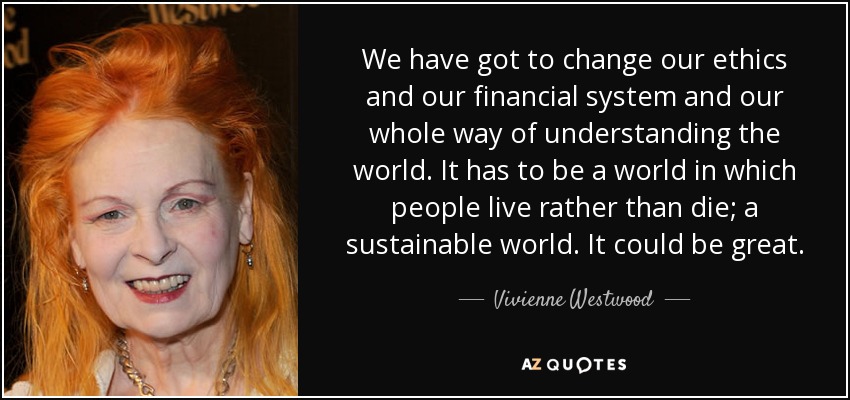
We have got to change our ethics and our financial system and our whole way of understanding the world. It has to be a world in which people live rather than die; a sustainable world. It could be great.
She [Carolyn Maloney] understands the whole picture. She is comfortable with these issues 'cause she is chair of the committee, and she's dogged and will make sure the average woman and man is represented as well as making sure that our financial system stays afloat. In other words, she gets it and she has represented the financial district, but she also represents the average person and definitely the average woman.
When I was a Senator from New York, I represented and worked with so many talented principled people who made their living in finance. But even thought I represented them and did all I could to make sure they continued to prosper, I called for closing the carried interest loophole and addressing skyrocketing CEO pay. I also was calling in '06, '07 for doing something about the mortgage crisis, because I saw every day from Wall Street literally to main streets across New York how a well-functioning financial system is essential.
It took us years to get into the mess that we got ourselves in at the end of 2008, and it's going to take a while to get us out. We lost eight million jobs, we saw a financial system near collapse, we have a continuing housing crisis that we're making progress on dealing with.
The financial system has been turned over to the Federal Reserve Board. That Board administers the finance system by authority of a purely profiteering group. The system is Private, conducted for the sole purpose of obtaining the greatest possible profits from the use of other people's money.
I don't feel so strongly against remakes, but if I don't like it, I guess I just don't do it. It is what it is. Hollywood is driven by the financial system, so if they think that it has a brand and people are going to go see it because it's a recognizable property, they're going to remake it.
Britain wants the single currency to be a success. It is massively in our interests that we have a stable financial system on our doorstep.
The rest of the world needs the U.S. economy and financial system to recover in order for it to revive. We remain at the center of global economic activity with financial and trade ties to every region of the globe.
The Death of Money is an engrossing account of the massive stresses accumulating in the global financial system, especially since the 2008 financial crisis. Jim Rickards is a natural teacher. Any serious student of financial crises and their root causes needs to read this book.
I do sense that the financial system is under the gun. In order to keep our system and economies moving globally, there's the need to extend new money.
I would very honestly just tell you that what I tried to do was simply respond to inquiries from people as they came in. Where I've thought I could say something useful, I've tried to add a voice that was, frankly, a dissident voice earlier on, but one that I think has become a more mainstream voice-and not because I've shifted. I think that the critique I had of what was going on in our financial system from six, eight years ago-after seeing some of what we've suffered through and even since the cataclysm itself-in terms of the structural changes.
Defaulting on the nation's debt would be cataclysmic. The U.S. Treasury's Aaa rating is the one constant in the world's financial system. When times are bad anywhere on the planet, global investors flock to Treasury bonds because they know they will get their money back.
We are inheriting the worst financial system since the Depression. We're inheriting a situation - when people go back and study major banking crises a quarter century from now, the one that America developed in 2007 and 2008 is going to be one of those crises.
The global financial crisis is a great opportunity to showcase and propagate both causal and moral institutional analysis. The crisis shows major flaws in the way the US financial system is regulated and, more importantly, in our political system, which is essentially a bazaar of legalized bribery where financial institutions can buy themselves the governmental regulations they want, along with the regulators who routinely receive lucrative jobs in the industry whose oversight had formerly been their responsibility, the so-called revolving-door practice.
A possibility is that we see more and more leverage, and credit-to-GDP ratios rise once more to even higher levels; eventually the banking systems of all advanced economies reach magnitudes of 500 percent, 1000 percent or more of GDP, so that every economy starts to have financial systems that resemble recent cases like Switzerland, Ireland, Iceland, or Cyprus. That might be a very fragile world to live in.
A default of the US government would not only be very harmful here, it would probably send the country back into deep recession, but it just might crash the international financial system.
At the center of every recession is a serious imbalance in the economy and mirrored in the financial system. Think subprime mortgage and the Great Recession, or the technology bubble and the early 2000s recession. There are no such imbalances today.
Following World War II, the U.S. was the architect of the UN system, and the world financial system, and the Human Rights Declaration, and of course the United Nations is based here in New York City. But, unfortunately, especially in the last decade, the U.S. really has been turning its back on international agreements and the set of agencies and procedures that they create as a means for governing the world.
Keep in mind that, when I came in, we had had a crisis that was the worst we've seen since the 1930s, and working with people like Chancellor Merkel, working with the G-20 and other institutions internationally, we were able to stabilize the financial system, stabilize the US economy and return to growth.
The welfare state is collapsing all around us. There are people that realize that we can't go on this way, but I'm not sure how many people realize how close we are to the collapse of the U.S. financial system.
The President [Barack Obama], I think if you look at it from his shoes, you know, was facing a very difficult situation where he had to own Washington, tame New York, save a collapsing economy, with a collapsed financial system. He moved, I think, to a team that he felt was tried and true, in terms of dealing with financial crisis. That was his decision.
The recent trading environment has felt something like walking into a place and having a sense that something is wrong and dangerous but not knowing exactly what will happen or when. “QE Infinity” has so distorted the prices of stocks and bonds that nobody can possibly determine what the investing landscape would look like, or what the condition of the economy and financial system would be, in the absence of Fed bond-buying.
The banks, because of mismanagement, because of huge risk taking, are now in very vulnerable positions. We can expect that we're gonna have to do more to shore up the financial system. We also are gonna have to make sure that we set up financial regulations so that not only does this never happen again, but you start having some sort of - trust in how the credit markets work again.
I and others were mistaken early on in saying that the subprime crisis would be contained. The causal relationship between the housing problem and the broad financial system was very complex and difficult to predict.
President Obama has a good sense not just of the economic requisites for financial crisis firefighting but also how you build political support for moving forward on reforming the financial system, making sure that the banks are carrying enough capital.
Follow AzQuotes on Facebook, Twitter and Google+. Every day we present the best quotes! Improve yourself, find your inspiration, share with friends
or simply: