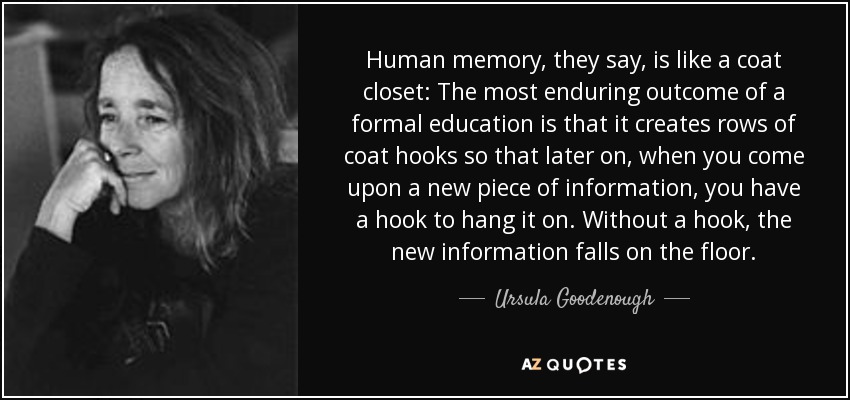
Human memory, they say, is like a coat closet: The most enduring outcome of a formal education is that it creates rows of coat hooks so that later on, when you come upon a new piece of information, you have a hook to hang it on. Without a hook, the new information falls on the floor.
It has been a long road from Plato's Meno to the present, but it is perhaps encouraging that most of the progress along that road has been made since the turn of the twentieth century, and a large fraction of it since the midpoint of the century. Thought was still wholly intangible and ineffable until modern formal logic interpreted it as the manipulation of formal tokens. And it seemed still to inhabit mainly the heaven of Platonic ideals, or the equally obscure spaces of the human mind, until computers taught us how symbols could be processed by machines.
There must be a profound recognition that parents are the first teachers and that education begins before formal schooling and is deeply rooted in the values, traditions, and norms of family and culture.
The formal granting of independence created a more Manichean system of dependency and exploitation, since for those who practice it, it means power without responsibility and for those who suffer from it, it means exploitation without redress. In the days of old-fashioned colonialism, the imperial power had at least to explain and justify at home the actions it was taking abroad. In the colony those who served the ruling imperial power could at least look to its protection against any violent move by their opponents. With neocolonialism neither is the case.
One can't proceed from the informal to the formal by formal means.
As long as each individual is facing the television tube alone, formal freedom poses no threat to privilege
Ideology on which the Kyoto Protocol is based, is a new form of totalitarian ideology, along with Marxism, Communism and socialism. We had doubts about the Kyoto Protocol, we wanted reasoning from our partners in the European Union, in the IPCC. Formal requests had been sent to these organizations. But we have not received responses yet, which suggests that no coherent answers can be offered. What we hear is 'it is not comprehensive responses that matter, we will not give them anyway; what is important is whether you believe us or not'.
The emphasis is on meditation in Tantric Zen. The experience of meditation in formal practice, zazen, where you're sitting down and meditating and concentrating.
Way down deep the American people are afraid of an entangling relationship between formal religions - or whole bodies of religious belief - and government. Apart from constitutional law and religious doctrine, there is a sense that tells us it's wrong to presume to speak for God or to claim God's sanction of our particular legislation and his rejection of all other positions. Most of us are offended when we see religion being trivialized by its appearance in political throw-away pamphlets.
I wanted to make photographs that were immediate and revealing - different from traditional portraiture that called for formal distance between artist and subject.
True leadership is moral authority, not formal authority. Leadership is a choice, not a position. The choice is to follow universal timeless principles, which will build trust and respect from the entire organization. Those with formal authority alone will lose this trust and respect.
Management is formal authority given from above. Leadership is moral authority given from below and all around.
The question is not whether a picture is good, in some formal, technical sense, but, does it mean what I need it to mean? Writers can edit sentences that may be well-crafted but that don't express an intended thought. But in photography, there are no revisions: A photograph is in or it's out, and the photographer must live with the consequences of his or her choices.
The immersive stories of This Is Paradise are a lithe blend of formal invention and traditional narrative pleasures. As such they reflect Kristiana Kahakauwila's intimate but expansive vision of a Hawai'i forged from the collisions of past and present, here and there. Her protagonists are as richly distinctive as the pidgin they speak, and yet each struggles profoundly with identity-that negotiation between ourselves and the world, which is at once Hawaiian, American, universally and compellingly human.
It should stimulate the mind as well as the appetite. The well made cocktail is one of the most gracious of drinks. It pleases the senses. The shared delight of those who partake in common of this refreshing nectar breaks the ice of formal reserve. Taut nerves relax, taut muscles relax, tired eyes brighten, tongues loosen, friendships deepen, the whole world becomes a better place in which to live.
The saddest symptom about many so-called Christians is the utter absence of anything like conflict and fight against spiritual apathy in their Christianity. They eat, they drink, they dress, they work, they amuse themselves, they get money, they spend money, they go through a brief round of formal religious services once or twice every week. But of the great spiritual warfare - its watchings and strugglings, its agonies and anxieties, its battles and contests - of all things they appear to know nothing at all. Let us take care that this case is not our own.
I was hoping to do an impressionist painting, but I wanted a good likeness and I wanted to create a feeling of the lady as a person, as a human being rather than as a figurehead for the monarchy and a pomp-and-circumstance sort of formal portrait. I wanted more of a relaxed portrait.
Other people do better going on to grad school and others yet are naturally inclined and do just fine without any formal training at all. Everyone is different. The only things I think are imperative are focus, determination and hard work.
My models were oral, were storytellers. Like my grandmothers and my aunts. It's true, a lot of people in my life were not literate in a formal sense, but they were storytellers. So I had this experience of just watching somebody spin a tale off the top of her head. I loved that.
I prefer formal techniques, and use sonnets and rhyme, any manner of scheme to give a shape and order-of feeling as well as argument-to a poem. But all my life, I've also been a person who's made his bed in the morning and picks up the bath mat. That's what I mean by temperament. Whether genetic or acquired, I have a disposition to arrangements. One is born with this, as if with blue eyes or a weak heart. Do you think Allen Ginsberg ever put the cap back on his toothpaste?
I like poetry because poetry - even in free verse - is formal, and it has to be very concise and packed and rich, and I like the feeling of having to do that, having to make the language tight and still free, as if the deepest freedom is created by the restrictions.
Though I consider The Chronology of Water to be an anti-memoir for very precise reasons, it is an art form, and thus as open to "critique" as any other art form. Memoir has a form, formal strategies, issues of composition and craft, style, structure, all the elements of fiction or nonfiction or painting or music or what have you.
Most of my formal choices are a combination of everything I learned about form - semiotics, linguistics, and the history of style experimentations tethered to literary movements (formalism, deconstruction, modernism, and postmodernism), and the basic principal of breaking every rule I ever learned from a patriarchal writing tradition that never included my body or experience, and thus has nothing to offer me in terms of representation.
I believe I'm very conscious of exactly what I'm doing. I'm auditioning lines of dialogue, and I'm interrogating whether the lines would translate from Russian into English the right way. The English that results can perhaps seem somewhat more formal than colloquial, but not so formal as to feel academic.
After love a formal feeling comes.
Follow AzQuotes on Facebook, Twitter and Google+. Every day we present the best quotes! Improve yourself, find your inspiration, share with friends
or simply: