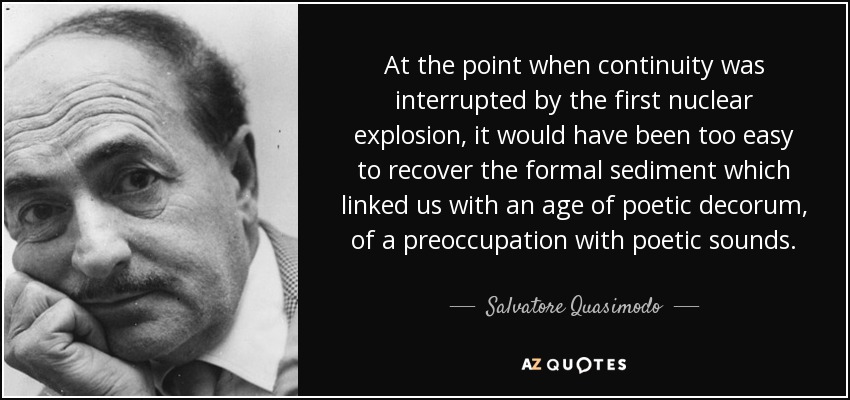
At the point when continuity was interrupted by the first nuclear explosion, it would have been too easy to recover the formal sediment which linked us with an age of poetic decorum, of a preoccupation with poetic sounds.
Born Berlin 1931, Germany, father a British diplomat, mother an American artist. Educated at various schools all over the world. 1958 Settled down to live in London. 1966 Became interested in photography through photographing my young children. No formal training.
Primo Levi's - I mean, he's a very different kind of writer. He's a much more formal writer. He's a much more -almost detached. I mean, I wouldn't really say that he's detached ultimately. But he does write as a scientist, and so he describes things very - in great detail, very carefully.
A group of four cardinals wrote to [Pope] Francis accusing him of sowing confusion on important moral issues, and they asked for clarifications. He did not reply. And one of the signatories, the American Cardinal Raymond Burke, said if the pope does not clarify, he will proceed with what he called a formal correction of the pope after Christmas.
... in general, the Anglo-Irish do not make good dancers; they are too spritely and conscious; they are incapable of one kind of trance or of being seemingly impersonal. And, for the formal, pure dance they lack the formality: about their stylishness (for they have stylishness) there is something impromptu, slightly disorderly.
Normal adults can doodle, amble, and drift with no need to assess risk, since there is normally no risk at all. Jazz improvisation seems less subject to standards of risk than surgery, and less than much formal athletic performance, as in a tennis match.
Sebald, Naipaul, and Joyce are three of my biggest influences, all of them for their formal freedom and their ability to create mood. So those comparisons are immensely flattering and, of course, unearned.
There isn't a formal definition of success.
Democracy is itself, a religious faith. For some it comes close to being the only formal religion they have.
When I would present my work as a student, often I would hear, "Your project is too formal" - it's too form-based; it's too form-driven. Which is kind of shocking for a visual practice, for someone to say something discouraging about a focus on an exploration of aesthetics.
To be an ally is a formal military alliance. And we have a formal military alliance in NATO. But we are partners with other countries all across the world. And they're - they will be a partner.
The formal artistic gesture is already expressed in the act of taking the photograph.
When I took my first poetry class, I felt that I could understand the relationships between words and the formal qualities of language in a way I would never understand music.
I take it that computational processes are both symbolic and formal. They are symbolic because they are defined over representations, and they are formal because they apply to representations, in virtue of (roughly) the syntax of the representations.
What exactly is mathematics? Many have tried but nobody has really succeeded in defining mathematics; it is always something else. Roughly speaking, people know that it deals with numbers, figures, with relations, operations, and that its formal procedures involving axioms, proofs, lemmas, theorems have not changed since the time of Archimedes.
I try to photograph things that are near to me because I work best among things I know. I'm not concerned with startling anyone or discovering new forms; formal qualities are only tools to help state my message.
The question is, how do you stop the power elite from doing as much damage to you as possible? That comes through movements. It's not our job to take power. You could argue that the most powerful political figure in April of 1968 was Martin Luther King. And we know Johnson was terrified of him. We have to accept that all of the true correctives to American democracy came through these movements that never achieved formal political power and yet frightened the political establishment enough to respond.
I love the dynamic contrast between the spontaneous shots and the more formal, pro-rock-star photos.
In 1985, a group of mujahedeen came to Washington and was greeted by President Reagan, who called them "freedom fighters." These people, by the way, don't represent Islam in any formal sense. They're not imams or sheiks. They are self-appointed warriors for Islam.
Every book I've written has been different from the others, and each one seems to have its own timeline, requirements, and formal challenges.
So, some of the most difficult formal poems that I've written, say one sentence sonnets, I've been able to do those fairly quickly whereas some of the clearest, simplest lyrics that I've written have taken me the longest to get to the clarity of feeling that you're looking for.
Prison is quite literally a ghetto in the most classic sense of the word, a place where the U.S. government now puts not only the dangerous but also the inconvenient—people who are mentally ill, people who are addicts, people who are poor and uneducated and unskilled. Meanwhile the ghetto in the outside world is a prison as well, and a much more difficult one to escape from than this correctional compound. In fact, there is basically a revolving door between our urban and rural ghettos and the formal ghetto of our prison system.
Failure, then, failure! so the world stamps us at every turn. We strew it with our blunders, our misdeeds, our lost opportunities, with all the memorials of our inadequacy to our vocation. And with what a damning emphasis does it then blot us out! No easy fine, no mere apology or formal expiation, will satisfy the world's demands, but every pound of flesh exacted is soaked with all its blood. The subtlest forms of suffering known to man are connected with the poisonous humiliations incidental to these results.
Moving parts in rubbing contact require lubrication to avoid excessive wear. Honorifics and formal politeness provide lubrication where people rub together. Often the very young, the untravelled, the naive, the sophisticated deplore these formalities as 'empty,' 'meaningless,' or 'dishonest,' and scorn to use them. No matter how 'pure' their motives, they thereby throw sand into machinery that does not work too well at best.
My chief job is to constantly stir or rekindle the curiosity of people that gets driven out by bureaucracy and formal schooling systems.
Follow AzQuotes on Facebook, Twitter and Google+. Every day we present the best quotes! Improve yourself, find your inspiration, share with friends
or simply: