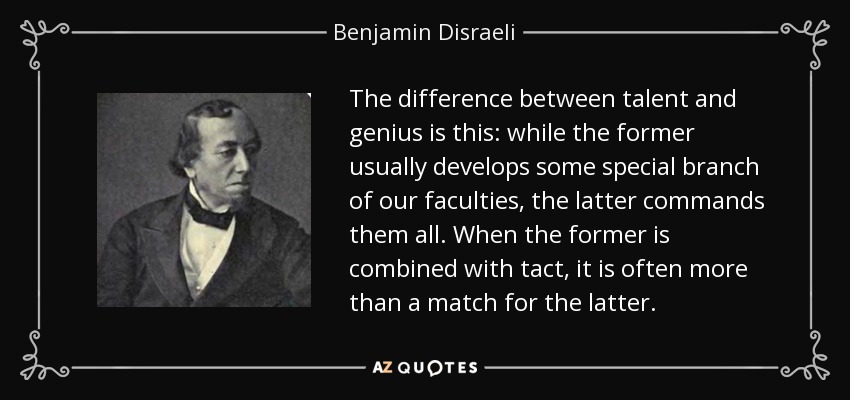
The difference between talent and genius is this: while the former usually develops some special branch of our faculties, the latter commands them all. When the former is combined with tact, it is often more than a match for the latter.
Isn't it curious how one has only to open a book of verse to realise immediately that it was written by a very fine poet, or else that it was written by someone who is not a poet at all. In the case of the former, the lines, the images, though they are inherent in each other, leap up and give one this shock of delight. In the case of the latter, they lie flat on the page, never having lived.
The mother of useful arts is necessity; that of the fine arts is luxury. For father the former has intellect; the latter genius, which itself is a kind of luxury.
I am convinced that those societies (such as the Native American peoples) which live without government enjoy in their general mass an infinitely greater degree of happiness than those who live under the European governments. Among the former, public opinion is in the place of law, & restrains morals as powerfully as laws ever did anywhere. Among the latter, under pretence of governing they have divided their nations into two classes, wolves & sheep. I do not exaggerate.
When winter stern, his gloomy front uprears, A sable void the barren earth appears; The meads no more their former verdure boast, Fast-bound their streams, and all their beauty lost; The herds, the flocks, in icy garments mourn, and wildly murmur for the Spring's return; From snow-topp'd hills the whirlwinds keenly blow, Howl through the woods, and pierce the vales below, Through the sharp air a flaky torrent flies, Mocks the slow sight, and hides the gloomy skies.
Whatever people may say, the fastidious formal manner of the upper classes is preferable to the slovenly easygoing behaviour of the common middle class. In moments of crisis, the former know how to act, the latter become uncouth brutes.
As in our lives so also in our studies, it is most becoming and most wise, so to temper gravity with cheerfulness, that the former may not imbue our minds with melancholy, nor the latter degenerate into licentiousness.
Both love of mankind, and respect for their rights are duties; the former however is only a conditional, the latter an unconditional, purely imperative duty, which he must be perfectly certain not to have transgressed who would give himself up to the secret emotions arising from benevolence.
Poets and men of action differ: the former yield to their feelings in order to reproduce them in lively colors, and therefore judge only ex post facto; the latter feel and judge at one and the same time.
He that will often put eternity and the world before him, and who will dare to look steadfastly at both of them, will find that the more often he contemplates them, the former will grow greater, and the latter less.
it may be said that children are but newly-issued editions of old compositions, re-bound and corrected, with fresh introductions, modern print and headpieces, but the text is that of former editions handed down from generation to generation.
Mothers who force their daughters into interested marriage, are worse than the Ammonites who sacrificed their children to Moloch--the latter undergoing a speedy death, the former suffering years of torture, but too frequently leading to the same result.
I have known persons without a friend--never any one without some virtue. The virtues of the former conspired with their vices to make the whole world their enemies.
Good-nature is that benevolent and amiable temper of mind which disposes us to feel the misfortunes and enjoy the happiness of others, and, consequently, pushes us on to promote the latter and prevent the former; and that without any abstract contemplation on the beauty of virtue, and without the allurements or terrors of religion.
We can speculate on what's likely, but what's needed is an investigation. And speculation is no substitute for facts. As a former prosecutor, I prosecuted antitrust cases civilly. And I can say that antitrust investigations merit searching, penetrating scrutiny and investigation. That's what we need here.
Let me take up your metaphor. Friendship is a vase, which, when it is flawed by heat or violence or accident, may as well be broken at once; it can never be trusted after. The more graceful and ornamental it was, the more clearly do we discern the hopelessness of restoring it to its former state. Coarse stones, if they are fractured, may be cemented again; precious stones, never.
Phychical pain is more easily borne than physical; and if I had my choice between a bad conscience and a bad tooth, I should choose the former.
There is a wide difference between admiration and love. The sublime, which is the cause of the former, always dwells on great objects and terrible; the latter on small ones and pleasing; we submit to what we admire, but we love what submits to us: in one case we are forced, in the other, we are flattered, into compliance.
The notion of obligations comes before that of rights, which is subordinate and relative to the former. A right is not effectual by itself, but only in relation to the obligation to which it corresponds.
I believe that in a contest between the living and the almost living, the latter must, if necessary, give way to the will of the former.
A poet is a combination of an instrument and a human being in one person, with the former gradually taking over the latter. The sensation of this takeover is responsible for timbre; the realization of it, for destiny.
From good to bad, and from bad to worse, From worse unto that is worst of all, And then return to his former fall.
Childhood is less clear to me than to many people: when it ended I turned my face away from it for no reason that I know about, certainly without the usual reason of unhappy memories. For many years that worried me, but then I discovered that the tales of former children are seldom to be trusted. Some people supply too many past victories or pleasures with which to comfort themselves, and other people cling to pains, real and imagined, to excuse what they have become.
Fancy, an animal faculty, is very different from imagination, which is intellectual. The former is passive; but the latter is active and creative. Children, the weak minded, and the timid are full of fancy. Men and women of intellect, of great intellect, are alone possessed of great imagination.
My retirement was now become solitude; the former is, I believe, the best state for the mind of man, the latter almost the worst. In complete solitude, the eye wants objects, the heart wants attachments, the understanding wants reciprocation. The character loses its tenderness when it has nothing to strengthen it, its sweetness when it has nothing to soothe it.
Follow AzQuotes on Facebook, Twitter and Google+. Every day we present the best quotes! Improve yourself, find your inspiration, share with friends
or simply: