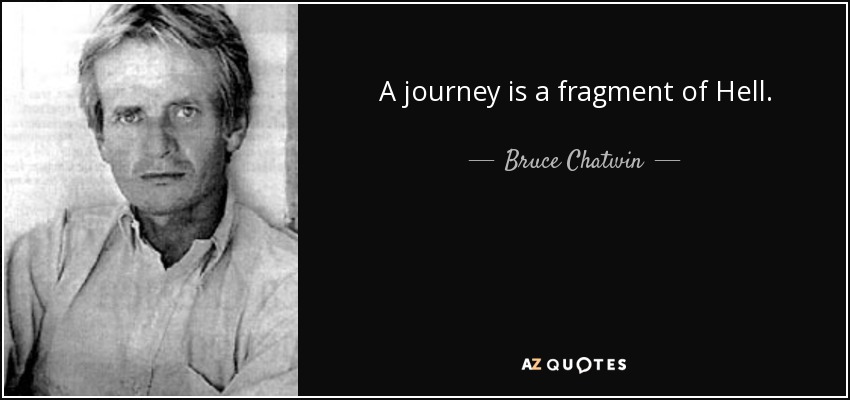
A journey is a fragment of Hell.
I slept in black tents, blue tents, skin tents, yurts of felt and windbreaks of thorns. One night, caught in a sandstorm in the Western Sahara, I understood Muhammed's dictum, 'A journey is a fragment of Hell.'
No thought can encapsulate the vastness of the totality. Reality is a unified whole, but thought cuts it up into fragments. Every thought implies a perspective, and every perspective, by its very nature, implies limitation, which ultimately means that it is not true, at least not absolutely. Only the whole is true, but the whole cannot be spoken or thought.
Tedious as it may appear to some to dwell on the discovery of odds and ends that have, no doubt, been thrown away by the owner as rubbish ... yet it is by the study of such trivial details that Archaeology is mainly dependent for determining the date of earthworks. ... Next to coins fragments of pottery afford the most reliable of all evidence.
Because each photograph is only a fragment, its moral and emotional weight depends on where it is inserted. A photograph changes according to the context in which it is seen: thus Smith's Minamata photographs will seem different on a contact sheet, in a gallery, in a political demonstration, in a police file, in a photographic magazine, in a book, on a living-room wall. Each o these situations suggest a different use for the photographs but none can secure their meaning.
True conformity to the dictates of nature requires reverence for the past and solicitude for the future. 'Nature' is not simply the sensation of the passing moment; it is eternal, though we evanescent men experience only a fragment of it. We have no right to imperil the happiness of posterity by impudently tinkering with the heritage of humanity.
A fashionable idea in technical circles is that quantity not only turns into quality at some extreme of scale, but also does so according to principles we already understand. Some of my colleagues think a million, or perhaps a billion, fragmentary insults will eventually yield wisdom that surpasses that of any well-thought-out essay, so long as sophisticated secret statistical algorithms recombine the fragments. I disagree. A trope from the early days of computer science comes to mind: garbage in, garbage out.
Everything seemed to change on that one day, but really, I think, things had been changing and changing over the course of many previous days, and perhaps what eventually appears to be information always appears at first to be just flotsam, meaningless fragments, until enough flotsam accretes to manifest, when one notices it, a construction.
If that condition of mind and soul, which we call inspiration, lasted long without intermission, no artist could survive it. The strings would break and the instrument be shattered into fragments.
If only simplicity were not the most difficult of all things. It consists of watching objectively the development of any fragment of fantasy.
No great, inspiring culture of the future can be built upon the moral principle of relativism. For at its bottom such a culture holds that nothing is better than anything else, and that all things are in themselves equally meaningless. Except for the fragments of faith (in progress, in compassion, in conscience, in hope) to which it still clings, illegitimately, such a culture teaches every one of its children that life is a tale told by an idiot, signifying nothing.
To love another person you have to undertake some fragment of their destiny.
Knowledge can be enormously costly, and is often scattered in widely uneven fragments, too small to be individually usable in decision making. The communication and coordination of these scattered fragments of knowledge is one of the basic problems- perhaps the basic problem- of any society.
Poverty is less a matter of income than of prospects. While the incomes of the poor have steadily risen through Great Society largesse, their prospects have plummeted as families have broken into dependent fragments.
The entire world we apprehend through our senses is no more than a tiny fragment in the vastness of Nature.
All the nations and peoples are too closely knit together today for any one of them to imagine that it can live apart. Peace has been said to be indivisible, so is freedom, so is prosperity now, and so also is disaster in this one world that can no longer be split into isolated fragments.
Memories seem to surface in no particular order, with no time attached. Yesterday can seem as distant as last year. My life now consists of fragments where some are so blinding in their intensity that they make everything else indistinguishable. It feels as if my existence was extinguished in a flash, and afterwards my universe became incomprehensible. I want to remember everything. But perhaps I need to give it more time. Allow myself some rest. Distance myself a little, to see if I can make out a pattern. And face the truth about what is really there.
Literature is the noblest of all the arts. Music dies on the air, or at best exists only as a memory; oratory ceases with the effort; the painter's colors fade and the canvas rots; the marble is dragged from its pedestal and is broken into fragments.
Each person is entitled to some version of God that seems real, yet many versions contradict one another. The God of any religion is only a fragment of God. This has to be true, because a being who is unbounded has no image, no role to play, no location either inside or outside the cosmos, whereas religions offer many images--father, mother, lawgiver, judge, ruler of the universe.
I like to think - knowing that it's an enabling fiction - of those moments as fragments from a world to come, a world where price isn't the only measure of value.
The U theory suggests that the central integrating thought ... will emerge from building three integrated capacities: a new capacity for observing that no longer fragments the observer from what's observed; a new capacity for stillness that no longer fragments who we really are from what's emerging; and a new capacity for creating alternative realities that no longer fragments the wisdom of the head, heart and hand.
The hypothesis I wish to advance is thatthe language of morality is ingrave disorder.... What we possess, if this is true, are the fragments of a conceptual scheme, parts of which now lack those contexts from which their significance derived. We possess indeed simulacra of morality, we continue to use many of the key expressions. But we have--very largely if not entirely--lost our comprehension, both theoretical and practical, of morality.
The superstition that the hounds of truth will rout the vermin of error seems, like a fragment of Victorian lace, quaint, but too brittle to be lifted out of the showcase.
A life of mere pleasure! A little while, in the spring-time of the senses, in the sunshine of prosperity, in the jubilee of health, it may seem well enough. But how insufficient, how mean, how terrible when age comes, and sorrow, and death! A life of pleasure! What does it look like when these great changes beat against it--when the realities of eternity stream in? It looks like the fragments of a feast, when the sun shines upon the withered garlands, and the tinsel, and the overturned tables, and the dead lees of wine.
I have to say in premise 'Winter Journal' is really not a memoir. And I don't even think of it as an autobiography. I think of it as a literary composition - similar to music - composed of autobiographical fragments. I'm really not telling the story of my life in a coherent narrative form.
Follow AzQuotes on Facebook, Twitter and Google+. Every day we present the best quotes! Improve yourself, find your inspiration, share with friends
or simply: